

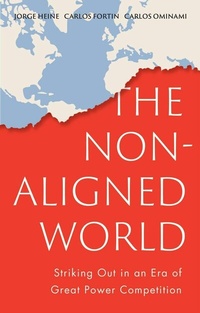
The Non-Aligned World
Description

In recent years, the number of countries embracing this venerable approach to foreign policy has increased exponentially, making it a force to be reckoned with in world affairs. The war in Ukraine, the expansion of the BRICS group, and the conflict in Gaza have given a special impetus to its rise in a new form: Active Non-Alignment (ANA). This has gone hand-in-hand with the growing power and influence of the Global South in world politics.
In this agenda-setting book, Jorge Heine, Carlos Fortin and Carlos Ominami, explain the origins, dynamics and significance of ANA, for the future of world order. Far from a transitory expression of the current state of affairs, they argue that ANA is here to stay. It provides a powerful guide to action and a fine-tuned compass for the Global Majority, that is, the countries in Africa, Asia and Latin America, to strike out and prioritize their national interests, whilst navigating the perilous waters of a troubled world in the throes of change.
More details
Other editions
Additional editions
Persons
Carlos Fortin is an Emeritus Fellow and Research Associate at the Institute of Development Studies at the University of Sussex, UK and Professor at the Institute of International Studies at the University of Chile. Between 1990 and 2005 he was Deputy Secretary-General of the United Nations Conference on Trade and Development (UNCTAD), Geneva. Previously he was Director of Programmes of the South Commission and one of the lead authors of the Commission's Final Report, The Challenge to the South (1990). He is the author of nine books and more than seventy articles in academic journals and collective volumes on globalization and development, the multilateral trade regime, and the role of the State in development.
Carlos Ominami is president of the Foro Permanente de Política Exterior, a Chilean think tank, a director of the Chile 21 Foundation, and an associate fellow at the Institute of International Relations and Strategic Studies (IRIS) in Paris. An economist with a doctorate from the University of Paris Nanterre, he served as Chile's Minister of Economic Affairs from 1990-1992 and as a Senator from 1994-2010. He has worked as a researcher at the Centre Nationale de la Recherche Scientifique (CNRS) in France, and as an advisor to the French Ministry of Industry and to the French Ministry of Cooperation. A columnist for La Tercera, one of Chile's leading dailies, and a member of the Grupo de Puebla, a group of progressive Latin American leaders, he has published a dozen books both in Chile and in France.
Content
Figures and Tables
Acknowledgments
Abbreviations
Preface
1. The War in Ukraine: Reactions from the Global South
2. What is Active Non-Alignment and What Fuels It?
3. The Cold War, Decolonization and the Non-Aligned Movement
4. The Political Economy of Active Non-Alignment
5. Active Non-Alignment and the ASEAN Way
6. From the Extreme West to Active Non-Alignment
7. The Global South and Active Non-Alignment
Conclusion
Notes
Preface
In May 2024, at a White House press conference held during a state visit to the United States, Kenyan president William Ruto was asked whether Kenya preferred Chinese or US investment. His response was: "We are facing neither East nor West. We are facing forward." In doing so, he was citing Kwame Nkrumah - Ghana's first Prime Minister and one of the founding fathers of the Non-Aligned Movement (NAM).1
Five years ago, we put forward the concept of Active Non-Alignment (ANA) as the best way for Latin America to deal with the crisis it faced at the time, one aggravated by the pressures it was being subjected to both by Washington and Beijing to follow their dictates.2 The concept resonated and triggered considerable interest across the region. It was also criticized by some as anachronistic, as nothing more than an exercise in nostalgia that bore no relevance to the realities of the new century. Yet, today, non-alignment is back with a vengeance, and not just in Latin America, but also in Africa and Asia, albeit in a new incarnation, as ANA.
What is Active Non-Alignment? ANA is a foreign policy doctrine based on refusing to take sides in the Great Power competition that is a signature feature of the international system of the third decade of the new century. Deployed by developing nations that find themselves pressured by the United States, on the one hand, and by China, on the other, it puts the national interest of the country front and center - as opposed to doing so with the geopolitical concerns of others. It examines each foreign policy issue on its merits, rejecting what it considers an artificial binary choice between Washington and Beijing. The grand strategy of ANA is what has been called "playing the field," that is, taking advantage of this competition among the Great Powers to maximize the development opportunities for Global South nations, in a way that was not possible during the "unipolar moment" of unbridled US primacy, or even during the Cold War.
In turn, the tactic of ANA is that of hedging, that is, taking on a middle position between balancing and bandwagoning, while keeping options open. ANA aims to keep good relations with both (or more) Great Powers in conflict, while diversifying links as much as possible. Hedging is the best approach to deal with situations of uncertainty, in which outcomes are not assured and the downside to making the wrong choice can be devastating. A key feature of it is its proactive nature, always in search of new opportunities to enhance the economic growth and development of nations whose populations are badly in need of both. Ultimately, ANA aims at enhancing and strengthening national autonomy.
How does ANA differ from traditional non-alignment, i.e., the notions espoused by the NAM in its heyday?
In terms of the international setting developing nations find themselves in, there are obvious parallels between the Cold War and the current Great Power competition. In both cases, the US is pitted against a power that defines itself as Communist, and, in both cases, these parties reach out to the hearts and minds of the peoples of what used to be called the Third World and is now known as the Global South. In this context, the key principles espoused by the NAM, like those of non-intervention, peaceful coexistence, multilateralism and the respect of international law, retain their currency. The fact that we still live in the nuclear age, and the specter of nuclear annihilation has by no means disappeared, makes championing the cause of peace as dear to the ANA as it was to the NAM. That said, there are obvious differences between the two situations.
In the third decade of the new century, the geo-economic axis has shifted from the North Atlantic to the Asia Pacific.3 Of the top ten cities with the largest number of billionaires in 2024, six are in Asia.4 New international financial institutions (IFIs), like the Asian Investment and Infrastructure Bank (AIIB) and the New Development Bank (NDB), dot the multilateral development banking landscape. This allows for the "collective financial statecraft" of today's Global South, and the possibility of it tapping into the vast resources of projects like China's Belt and Road Initiative (BRI), amounting to a cool one trillion dollars in its first decade. This is very different from the diplomatie des cahiers des doleances (victimhood diplomacy) of yesterday's Third World, whose demands for vast transfers of wealth from North to South fell on deaf ears. Today's Global South thus speaks from a position of relative strength, as opposed to the considerable weakness of the Third World of the 1950s and 1960s, giving ANA much more leverage to pursue its objectives. Whereas the key platforms of non-alignment were the NAM itself and the G77 - huge, unwieldy bodies that had the power of numbers, but little else - today's ANA relies on smaller but more effective bodies, like the BRICS, that command not just ideational but also considerable material resources to attain their objectives. This signals a decisive shift in the traditionally fraught relationship between the Global North and the Global South.
Over the past five years we have continued to develop and refine the concept of ANA, which has come to the fore at a time of momentous change in world politics. A veritable cascade of earth-shattering developments - the COVID-19 pandemic; the Russian invasion of Ukraine; the dramatic expansion of the BRICS group (now known as BRICS+), representing a considerable challenge to the West; and Israel's war in Gaza in the wake of Hamas's attack on Israel - have impelled this seismic moment.
This overlapping succession of events has led some to speak of a "polycrisis,"5 leading us to Italian philosopher Antonio Gramsci's dictum in his Prison Notebooks that "the crisis consists precisely in the fact that the old is dying and the new cannot be born: in this interregnum a great variety of morbid symptoms appear."6
What is dying is the old world order that followed the end of the Cold War in 1989-91, with the fall of the Berlin Wall and the collapse of the Soviet Union. This was a world order that, for want of a better term, came to be known as "the unipolar moment," to signify the undisputed hegemony of the US. What is not yet born is the new order that will replace it. While some refer to it as a multipolar order, others, like Amitav Acharya, speak of a multiplex order.7 And in this transition, with the old rules falling by the wayside and the new ones not yet in place, a bit of a "free for all" persists. Thus, the seemingly chaotic state of the world today.
Yet, two phenomena stand out at this significant turning point in world affairs. One is the rise of the Global South as a force to be reckoned with in international politics. The other is the re-emergence of non-alignment as an approach to foreign policy in the post-colonial world. The two are closely associated. As key countries from the Global South contend with the many challenges of this troubled world, the conduct of their foreign policy is increasingly driven by ANA.
ANA as the way forward
So, what is ANA all about and why has it spread like wildfire?
Building on our work on the subject over the past five years, our argument in this book is the following:
- The world order is undergoing a major moment of transition, in many ways as significant as the one that took place at the end of the Cold War.
- This transition is driven by the relative decline of the hitherto-hegemonic power, the United States, and by the rapid rise of China - though also by the emergence of other rising powers, what Fareed Zakaria has referred to as "The Rise of the Rest."8
- As tends to happen in history, this dynamic has triggered a fierce Great Power competition - between Washington and Beijing. This has escalated from a trade war to a tech war to a conflict with increasingly ideological and military overtones.
- In this competition, weaker states, especially those in the developing world, find themselves between a rock and a hard place. In such circumstances, ANA represents the best alternative to deal with this predicament.
- ANA means that countries put their own national interest front and center, refusing to budge to pressure from the Great Powers. For the ANA doctrine, the grand strategy is what Kassab has called "playing the field," that is, picking and choosing among the various issues, as opposed to siding automatically with one or another of the Great Powers.9
- In turn, in terms of foreign policy tactics, ANA relies on hedging, that is, a middle position between balancing and bandwagoning, which allows states to keep their options open. This is the safest way to deal with situations of high uncertainty, such as the one the world finds itself in today, in which (once again) the specter of nuclear war has raised its ugly head.
- The major wars that arose in 2022-4 - mainly the war in Ukraine resulting from Russia's invasion, and Israel's war on Gaza after being attacked by Hamas - have brought to the fore the growing rift between North and South.
- Yet, far from being fundamental causes of this rift, these wars and the reactions to them in the South are expressions of a much deeper malaise of the post-colonial world with current international...
