

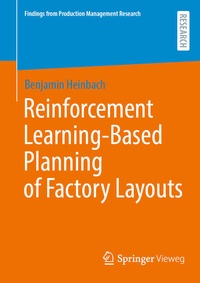
Reinforcement Learning-Based Planning of Factory Layouts
Description

Facility layout planning is a core discipline in production management, directly shaping operational efficiency, material flow, and cost structures. Despite its criticality, facility layout planning presents a complex combinatorial problem, often approached through heuristics or metaheuristics that lack scalability and adaptability. This book investigates the use of (Deep) Reinforcement Learning (DRL) to automate and enhance layout planning by conceptualising facility layout planning as a Markov Decision Process (MDP). The author found that DRL agents - trained solely through interaction feedback without domain-specific input - can autonomously generate layout configurations that significantly reduce material handling costs and generalise across varying problem instances, thus demonstrating DRL's viability as a scalable and adaptive resolution technique for facility layout planning. Building on the conceptual parallel between human iterative layout adjustment and Reinforcement Learning processes, this research follows a Design Science Research paradigm of experimental artefact design. It unfolds over four peer-reviewed publications. Beyond the experimental contributions, this work opens a path toward AI-driven factory planning tools that can potentially reduce planning effort, improve layout quality, and ultimately enable more responsive and data-driven production system design in dynamic industrial environments.
More details
Other editions
Additional editions
Person
Benjamin Heinbach studied International Project Management at the Chalmers University of Technology in Gothenburg, Sweden. During his doctoral research at the Chair of International Production Engineering and Management at the University of Siegen, he focused on the application of reinforcement learning techniques in production management.
Content
Introduction.- Theoretical Background for Automated Layout Planning Using Reinforcement Learning.- Publication I: Bibliometric Study on the Use of Machine Learning as Resolution Technique for Facility Layout Problems.- Publication II: gym-flp: A Python Package for Training Reinforcement Learning Algorithms on Facility Layout Problems.- Publication III: Deep reinforcement learning for layout planning - An MDP-based approach for the facility layout problem.- Publication IV: From Theory to Application: Investigating the Generalizability of Facility Layout Problems Using a Deep Reinforcement Learning Approach.- Spotlight: A brief discussion on Generative AI vs. Reinforcement Learning for Facility Layout Planning.- Critical Reflection on Results and Future Perspective.- Summary.- References.
