

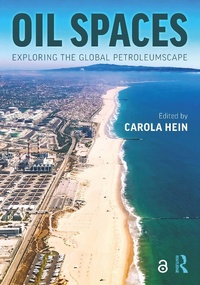
Oil Spaces
Exploring the Global Petroleumscape
1st Edition
Published on 23. August 2021
300 pages
978-1-000-44948-8 (ISBN)
Description

Oil Spaces traces petroleum's impact through a range of territories from across the world, showing how industrially drilled petroleum and its refined products have played a major role in transforming the built environment in ways that are often not visible or recognized. Over the past century and a half, industrially drilled petroleum has powered factories, built cities, and sustained nation-states. It has fueled ways of life and visions of progress, modernity, and disaster.
In detailed international case studies, the contributors consider petroleum's role in the built environment and the imagination. They study how petroleum and its infrastructure have served as a source of military conflict and political and economic power, inspiring efforts to create territories and reshape geographies and national boundaries. The authors trace ruptures and continuities between colonial and postcolonial frameworks, in locations as diverse as Sumatra, northeast China, Brazil, Nigeria, Tanzania, and Kuwait as well as heritage sites including former power stations in Italy and the port of Dunkirk, once a prime gateway through which petroleum entered Europe.
By revealing petroleum's role in organizing and imagining space globally, this book takes up a key task in imagining the possibilities of a post-oil future. It will be invaluable reading to scholars and students of architectural and urban history, planning, and geography of sustainable urban environments.
In detailed international case studies, the contributors consider petroleum's role in the built environment and the imagination. They study how petroleum and its infrastructure have served as a source of military conflict and political and economic power, inspiring efforts to create territories and reshape geographies and national boundaries. The authors trace ruptures and continuities between colonial and postcolonial frameworks, in locations as diverse as Sumatra, northeast China, Brazil, Nigeria, Tanzania, and Kuwait as well as heritage sites including former power stations in Italy and the port of Dunkirk, once a prime gateway through which petroleum entered Europe.
By revealing petroleum's role in organizing and imagining space globally, this book takes up a key task in imagining the possibilities of a post-oil future. It will be invaluable reading to scholars and students of architectural and urban history, planning, and geography of sustainable urban environments.
More details
Edition
1. Auflage
Language
English
Place of publication
London
United Kingdom
Publishing group
Taylor & Francis Ltd
Target group
College/higher education
Illustrations
4 Tables, black and white; 129 Halftones, black and white; 129 Illustrations, black and white
File size
97,27 MB
ISBN-13
978-1-000-44948-8 (9781000449488)
Copyright in bibliographic data and cover images is held by Nielsen Book Services Limited or by the publishers or by their respective licensors: all rights reserved.
Schweitzer Classification
Other editions
Additional editions
Book
08/2021
1st Edition
Routledge
€49.59
Shipment within 15-20 days
Book
08/2021
1st Edition
Routledge
€192.21
Shipment within 15-20 days
Person
Carola Hein is professor of history of architecture and urban planning at Delft University of Technology. Her authored and (co-) edited books include Adaptive Strategies for Water Heritage (2019), The Routledge Handbook of Planning History (2018), Port Cities (2011), Cities, Autonomy and Decentralisation in Japan (2006), The Capital of Europe (2004), and Rebuilding Urban Japan after 1945 (2003).
Content
1. Space, Time, and Oil: The Global Petroleumscape PART I: Oil, Agency, and Territoriality 2. The Original North American Petroleumscape: Oil-and-Gas Empire, Petrochemical Nation 3. Petroleumscape as Battleground: Pladjoe, Pearl in the Crown of the Bataafsche Petroleum Maatschappij (BPM/Shell) in the Dutch East Indies 4. Mapping the Persian Gulf Petroleumscape: The Production of Territory, Territoriality, and Sovereignty 5. Between Visible and Invisible: Eni and the Building of the African Petroleumscape 6. The Offshore Petroleumscape: Grids, Gods, and Giants of the North Sea PART II: Oil, Materiality, and Cultural Practices 7. Arab Oil Towns as Petro-Histories 8. Building Brazil's Petroleumscape on Land and Sea: Infrastructure, Expertise, and Technology 9. Precious Property: Water and Oil in Twentieth-Century Kuwait 10. Dimensions of the Petroleumscape in the Port and the City of Hamburg 11. "Production First, Livelihood Second": The Life and Death of Worker-Peasant Model Villages in a Chinese Oil Field PART III: Oil Ecologies and Imaginaries 12. Energy Humanities and the Petroleumscape 13. Antwerp's Petroleumscape: Imagining the Carbon Age 14. Power Stations and Petroleum Heritage in Italy: The Case of Porto Tolle 15. Petroleumscape as Heritage Landscape: The Case of the Dunkirk Port City Region
