

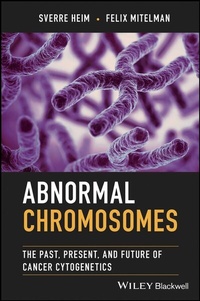
Abnormal Chromosomes
Description

In Abnormal Chromosomes: The Past, Present, and Future of Cancer Cytogenetics, globally renowned researchers Drs. Sverre Heim and Felix Mitelman deliver a state-of-the-art review of how cancer cytogenetic analyses have contributed to an improved understanding of tumorigenesis as well as to the diagnosis and treatment of cancer patients. The book also discusses how cytogenetics - the study of chromosomes - meets, interacts with, and cross-fertilizes other investigative technologies, including molecular somatic cell genetics.
The book provides an impetus to think more deeply about the role chromosomes, and their abnormalities, play in health and disease, especially in neoplastic disorders. From which origins did cytogenetics develop? How did the finding of acquired chromosomal abnormalities in cells of leukemias and solid tumors influence our understanding of cancer as a biological process? How was information of this nature put to good use in the clinical management of cancer patients?
Abnormal Chromosomes: The Past, Present, and Future of Cancer Cytogenetics offers readers:
* A thorough introduction to ancient theories of disease, the advent of cellular pathology, and how a scientific interest in chromosomes developed
* Comprehensive exploration of the conceptual importance of Theodor Boveri and his somatic mutation theory of cancer
* A detailed chronological resume of cancer cytogenetic discoveries during the 20th century
* In-depth discussions of the role of chromosome abnormalities, oncogenes, and tumor suppressor genes in leukemias, lymphomas, and solid tumors, together with a survey of what chromosome analyses have revealed about the clonal evolution of neoplastic cell populations
* A discussion of the importance of pathogenetic classifications of neoplastic diseases, the role chromosome abnormalities play in this context, and which technological breakthroughs can be expected in chromosome-oriented cancer research
Abnormal Chromosomes: The Past, Present, and Future of Cancer Cytogenetics was written for everyone with a scientific or clinical interest in cancer, especially how acquired chromosome abnormalities lead to neoplastic transformation. The book teaches how cytogenetic analyses contribute to a better understanding of tumorigenesis, but also how the finding of specific chromosome aberrations can be crucial for the diagnosis, prognosis, and management of cancer patients.
More details
Other editions
Additional editions
Persons
Sverre Heim has over thirty years' experience in the field of cancer cytogenetics. He has used chromosomal markers to trace the clonal relationships among neoplastic cell populations and determined their patterns of evolution. He has served on editorial boards and scientific advisory committees and authored nearly 500 scientific publications.
Felix Mitelman is an elected member of the Royal Swedish Academy of Sciences and the American Academy of Arts and Sciences, as well as the Editor-in-Chief and Founder of Genes, Chromosomes & Cancer.
Content
Preface vii
Part I Past 1
Chapter 1 Understanding Disease: Ancient Theories 3
Chapter 2 The Advent of Cellular Pathology 7
Chapter 3 The Colored Bodies of Cell Nuclei: Chromosomes and Heredity 15
Chapter 4 Boveri and the Somatic Mutation Theory of Cancer 23
Chapter 5 Cytogenetics from 1914 to 1960: Slow Progress Followed by Serendipitous Methodological Breakthroughs Leading to Important Discoveries 29
Chapter 6 The First Cancer-Specific Chromosome Aberrations: Ph1 and Others 41
Part II Present 57
Chapter 7 The Banding Revolution: Cancer Cytogenetics in the 1970s 59
Chapter 8 Chasing Correlations: Chromosomes and Oncogenes in Leukemias and Lymphomas 75
Chapter 9 Solid Tumor Cytogenetics 87
Chapter 10 Gains, Losses, and Rearrangements of Genomic Material: Pathogenetic Considerations 105
Chapter 11 Morphology Meets Chemistry: Integration of Molecular Genetics into the Cytogenetic Search for Cancer-Specific Chromosome Aberrations 117
Chapter 12 Unraveling the Clonal Evolution of Neoplastic Cell Populations 125
Chapter 13 Clinical Usefulness 137
Part III Future 149
Chapter 14 Toward a Pathogenetic Classification of Cancer 151
Chapter 15 Where There is Structure, There is Function 161
Chapter 16 Which Resolution Level is Optimally Suited to
Answer Which Questions? Seeing Never Goes Out of Fashion . . . 169
Chapter 17 Are New Technical Breakthroughs on the Horizon? 179
Afterthoughts 189
Index 195
CHAPTER 2
The Advent of Cellular Pathology
Good thinking alone is rarely enough to gain reliable insights into the workings of nature, neither in general nor when it comes to what causes illness and death; also relevant experimental data are needed. Brave and curious men for centuries cut up and examined corpses of the recently deceased to see with their own eyes (which is the exact meaning of the word "autopsy") what characterizes victims of various diseases.
This activity was looked down upon, even viewed as a crime in many societies and over long periods of time, and yet our present knowledge of both normal and pathological anatomy owes a large debt of gratitude to these courageous pioneers. Perhaps most prominent among them was Andreas Vesalius (1514-1564) who is sometimes referred to as the founder of human anatomy. His De humani corporis fabrica ("On the structure of the human body") represented a major step in the establishment of scientific medicine and long remained one of the most influential books on human anatomy (Figure 2.1). It was exceptional in building exclusively on information gained from examination of human corpses, not dissection of monkeys or other animals as had previously often been the case. It is a bemusing coincidence that Vesalius' revolutionary treatise was published in 1543, the same year that Copernicus' De revolutionibus coelestium orbitum ("On the revolutions of the celestial spheres") came out, practically on the author's death bed. The mathematician and astronomer - who was also a good Catholic canon - thus saw to it that no one would be able to prosecute him for the blasphemy of ascribing to the sun, not the earth, prime position within the universe. Indeed, those were heady times, with Renaissance man taking long strides in several directions toward a deeper understanding of reality. Some of the directions were wholly novel while others represented rediscoveries - or rebirths - of thoughts first voiced by the ancients.
FIGURE 2.1 Woodcut anatomical illustration of the muscular system from Vesalius' 1543 masterpiece De humani corporis fabrica.
Source: Wikipedia/Public Domain.
Vesalius and others described - meticulously, honestly, and in considerable detail - what we today call macroscopic human anatomy. Scientific knowledge about pathogenetic (pathogenesis means how a disease develops whereas etiology deals with why it occurs) changes taking place beyond the resolution level of human eyesight had to await the introduction of technological novelties that augment our innate senses, above all the art of how to grind lenses and arrange them to see what had hitherto been invisible.
Whereas simple magnifying glasses, for example water-filled spheres, had been used occasionally since antiquity and eyeglasses with primitive lenses since the thirteenth century, the first certain examples of the use of compound microscopes, combining an objective lens near the specimen with an eyepiece to view a real image, date from the first decades of the seventeenth century. Some of the names associated with these initial telescopic and microscopic studies are among the absolute giants of modern science - Galileo Galilei's discovery of Jupiter's moons (amongst other things) and subsequent controversy with the church over the validity of Copernicus' heliocentric system come first to mind - whereas others are less well known today. Among the latter are particularly many Dutchmen, for Amsterdam was the center of lens-grinding technologies as well as the assembly of instruments made from them. The industry was not without its dangers, and not only because of whatever misgivings the powers that be might have about the discoveries scientists made using state-of-the-art equipment put together in Amsterdam's workshops, but also for the manual workers. The famous philosopher Baruch de Spinoza seems to have been one such victim. In order to pursue his intellectual interests without being dependent on the rich and opinionated, he had taken up the craft of lens grinding. In 1677, at the young age of 44, he died from a lung disease that may have been caused by inhalation of glass dust, though tuberculosis remains another possibility.
Examination of biological specimens by many investigators in the mid-seventeenth century (Anton van Leeuwenhoek's contributions seem to have been particularly valuable) using increasingly refined microscopes - first with single lenses, later in combinations - eventually led to the identification of cells, a discovery usually credited to Robert Hooke in 1665. The name derives from Latin cella meaning "a small room," something akin to the ones monks lived in. However, due to the still insufficient magnification obtained, microscopists could not yet see any internal components of the cells they studied. Thus, nobody at the time had any clear conception of the cells' structure or function, let alone one backed up by what we today would call solid scientific evidence.
This did not prevent some researchers from holding strong views based on what they claimed to see. The story about the homunculus (Figure 2.2) - and animalcules in other species - is a case in point. Nicolas Hartsoeker was a lens grinder who had studied optics under van Leeuwenhoek and become an expert microscope builder. Toward the end of the seventeenth century, he conducted the first known microscopic studies of human semen. Hartsoeker "saw" within the sperm cells' head a tiny person, one homunculus per head, who he assumed was destined to grow into a full human being after reception and subsequent nurturing by the fertile female soil. This erroneous observation or interpretation seemingly confirmed the spermist theory of conception which held sway for centuries (Paracelsus appears to have been the first medical authority to have stipulated the existence of homunculi, in De rerum natura from 1537). The above rendering of the story may not be entirely precise, however, as pointed out in the caption to Figure 2.2, so perhaps Hartsoeker deserves to be at least partly exonerated. At any rate, the long-lasting homunculus intermezzo illustrates that strange ideas about (im)balances between the two sexes clearly are not peculiar to modern times.
FIGURE 2.2 A tiny, preformed human inside a sperm - a homunculus - drawn in 1694 by the Dutch microscopist Nicolas Hartsoeker. This figure has been reproduced countless times, usually with the caption stating that it represents the homunculus Hartsoeker saw, or thought he saw, under the microscope. Yet it seems that Hartsoeker only said that "perhaps" we would see this if it had been possible to see through the "skin" that surrounds the sperm head, and "if we had the tools." The exact story behind the drawing will probably never be known.
Source: Wikimedia Commons/Public Domain.
The quality of microscopes did not change significantly from the period of Hooke and Leeuwenhoek until the 1800s, although incremental improvements in the microscopists' picture of what cells and tissues look like - the two fields became known as cytology and histology, respectively - of course occurred. Worthy of mention in this context was the discovery by Karl Rudolphi and J.H.F. Link that cells have independent, not shared, walls as had hitherto been assumed. For this, in 1804 awards were bestowed upon them by the Royal Society of Science, Göttingen, Germany, for having "solved the problem of the nature of cells," no less. The same year, Franz Bauer provided compelling evidence for the existence of a cell nucleus.
Out of all these studies grew the understanding that cells are the fundamental elements of life itself. This so-called cell theory was eventually formulated in 1839 by Matthias Schleiden (a botanist) and Theodor Schwann (a physiologist): All living organisms, be they plants or animals, are composed of one or more cells which thus constitute the basic units of vital structures. Today we sometimes recognize also noncellular entities such as viruses as forms of life, but otherwise the cell theory holds true.
Schleiden, like many others before him, originally thought that free cell formation occurred through crystallization, but that hypothesis was refuted in the 1850s by several investigators who instead found that cells themselves give rise to new cells, by division or binary fission. Shortly afterwards, the German pathologist Rudolf Virchow (1821-1902) formulated this new insight into one of cell theory's most central tenets: Omnis cellula e cellula (everything cellular stems from cells).
It is worthy of note that the use of microscopes was not universally embraced by biologists, just as in Galilei's time there were some astronomers who did not consider telescopes reliable. The cell theory came into being at a time when histology was still dominated by the teachings of the French anatomist Bichat who thoroughly distrusted the use of microscopes and, consequently, whatever they helped examiners to see. Based on gross investigations alone, Bichat described no fewer than 21 different types of animal tissues. Of necessity, that purely macroscopy-based classification was not reconcilable with the wave of new data...
