

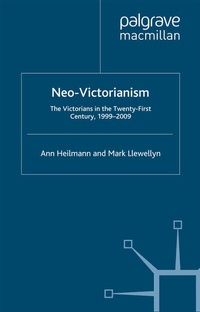
Neo-Victorianism
Description

Reviews / Votes
'What is it that our current obsession with the Victorians in fiction, film, TV, and even theme parks, reveals about our anxieties and desires in the twenty-first century? This coherent, detailed and timely study addresses this fascinating question in a lively and engaging way. Heilmann and Llewellyn provide a valuable account of what is currently one of the most interesting areas of literary studies, as well as introducing us to a host of twenty-first century texts which have not as yet been widely discussed. '
- Diana Wallace, Reader in English, University of Glamorgan, UK
'Ann Heilmann and Mark Llewellyn's joint study of the neo-Victorian phenomenon in novel, film, and televisual adaptations, and (more briefly) in commodity culture and heritage parks, affords a veritable smorgasbord of Victoriana for fellow critics and readers of the genre to dip into selectively or consume in its entirety... Neo-Victorianism looks set to become essential reading for fellow researchers as well as any serious student of neo-Victorian studies and will prove an invaluable guide for further critical enquiry into reader response theorisations of this genre.' - Marie-Luise Kohlke, Neo-Victorian Studies
'Heilmann and Llewellyn's Neo-Victorianism is a timely and topical book, presenting a much-needed overview of an emerging field...While other critics have tackled the neo-Victorian over the last decade, this study's merit is twofold. First, the comprehensiveness of its almost encyclopedic approach provides an invaluable map to students, teachers, and other interested readers who may be new to this thriving area of research. Second, Heilmann and Llewellyn's conceptual work in their substantial introduction, which addresses the ''ethics and aesthetics of appropriation,'' helps both define the parameters of neo-Victorian writing and lay out models for analyzing this growing body of work.' - Anne Schwan, Edinburgh Napier University, UK, Contemporary Women's Writing
More details
Other editions
Additional editions
Persons
MARK LLEWELLYN is Senior Lecturer in English at the University of Liverpool, UK, Secretary to the British Association for Victorian Studies (BAVS), Editor of the Journal of Gender Studies (Routledge/Taylor and Francis), and Consultant Editor to Neo-Victorian Studies He has published widely on late-Victorian literature, particularly the work of George Moore; contemporary women's writing; and theorizations of the neo-Victorian: his most recent publications include the edited collections Metafiction and Metahistory in Contemporary Women's Writing (with Ann Heilmann, 2007) and Conflict and Difference in Nineteenth-Century Literature (with Dinah Birch, 2010). Mark is currently working on a book entitled Incest in English Culture, 1835-1908.
