

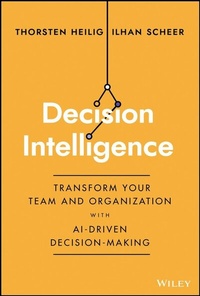
Decision Intelligence
Description

Dramatically improve your decisions with data and AI
In Decision Intelligence: Transform Your Team and Organization with AI-Driven Decision-Making, a team of pioneering decision and AI strategists delivers a digestible and hands-on resource for professionals at every part of the decision-making journey. The book discusses the latest technology and approaches that bridge the gap between behavioral science, data science, and technological innovation.
Discover how leaders from various industries and environments are using data and AI to make better future decisions, taking both human as well as business factors into account. This book covers:
- A demystifying behind-the-scenes peek inside how AI models, forecasts, and optimization for business challenges really work, and why they open up entirely new possibilities.
- A business-ready introduction to decision intelligence, exploring why traditional decision-making strategies are outdated and how to transition to decision-intelligence.
- The evolution of Decision Intelligence, coming from analytics and modern techniques like process mining and robotic process automation
- An examination of decision intelligence at the organizational level, including discussions of agile transformation, transparent organizational culture, and why psychological safety is a crucial enabler for new ways of decision-making in modern companies
- An overview of why (and where exactly) AI still needs human expertise and how to incorporate this topic in daily planning and decision making
"In Decision Intelligence, Thorsten Heilig and Ilhan Scheer build a compelling case for the world of tomorrow's version of decision-making." ¿Martin Lindstrom, New York Times best-selling author "Decision Intelligence will be one of the big topics for this decade and completely change the way organizations manage, plan, and operate. This book provides a comprehensive guide from the basics to the applications." ¿Niklas Jansen, Entrepreneur and Tech Investor, Founding Partner Interface Capital and Co-Founder Blinkist
"The book impressively demonstrates the potential and entry points into the world of AI-powered decision making. A very valuable reading for managers and their organizations". ¿Michael Kleinemeier, Member of the Merck KG Board of Partners, former Member of the SAP SE Executive Board "The AI hype perfectly captured, easy to understand, de-mystified and mapped to clear use cases - a must-read for today's managers." ¿Dr. Daniela Gerd tom Markotten, Member of the Management Board for Digitalization and Technology, Deutsche Bahn AG
More details
Other editions
Additional editions
Persons
ILHAN SCHEER is the Asset Engineering Europe Lead at Accenture. He's an international leader on digital transformation and psychological safety in organizations. He was the Founder of fable+, a data-driven consulting boutique acquired by Accenture.
Content
Figures List xi
Foreword xiii
Acknowledgments xvii
Introduction xxi
Chapter 1 Decoding Decision-Making: Good and Bad Decisions 1
How to Measure the Quality of a Decision 6
The History of Decision-Making 10
The Impact of Technology on Business Decision-Making in the 21st Century 14
Regaining the Human Aspects 17
Chapter 2 Why Traditional Decision-Making Is Broken 21
The New (Corporate) Normal: An Increasingly Dynamic and Complex Reality with Uncertainties 23
Why Data Analytics and Business Intelligence Can't Keep up with the New Reality 31
The Illusion of Human Control: Will We Ever Be Able to Make the Best Possible Choice? 35
Chapter 3 Decision Intelligence: Making Relevant Information Visible and Actionable 39
How to Shift Your Decision-Making Perspective 43
The Ultimate Partnership Between Humans and Machines 47
Chapter 4 The Business Value of Decision Intelligence 55
From Using DI as a Strategy to DecisionOS 57
Step up the Operational Game: Recurring Use-Cases for Companies 61
Chapter 5 Decision Intelligence in Practice: Industry Examples of Applied DI 67
DI in Logistics 69
DI in Retail 78
DI in Pricing and Marketing 83
Chapter 6 The Technology Stack: Applying AI Systems for Decision-Making 91
Data, the Backbone to Leverage Business Value 95
Artificial Intelligence: Understanding the Patterns Behind 102
Optimization Is Key for Better Business Outcomes 116
Chapter 7 Decision Intelligence Organization: The Key to Unlocking the True Potential of Data-Driven Decision-Making 125
Culture Eats Intelligent Decision-Making for Breakfast 129
Ways of Working in DI Organizations 132
The Four Rs of the DI Organization 137
Cultivating a DI Organization: A Symphony of Skills 142
Recognizing Biases in Your Decision-Making Process 147
Chapter 8 Leading a Decision Intelligence Organization 155
Trust and Courage 158
Transparency and Experimentation 162
Psychological Safety: The Secret Ingredient for a Decision Intelligence Organization 167
Embracing Failure and Forging Forward 175
Epilogue 179
References 183
Index 195
CHAPTER 1
Decoding Decision-Making: Good and Bad Decisions
"Every decision you make affects every facet of your life."
- Michael Jordan
Imagine sitting in a bustling café1 in Heidelberg with us, sipping a cup of coffee, watching people come and go. Your gaze lands on someone by the window, deep in thought, brow furrowed as they ponder a decision. We have all been in these moments - the complexity and difficulty of a decision weighing heavy on us, feeling like we have to navigate a maze of choices, trying to find the right directions.
In this chapter, we'll embark on an intellectual journey exploring the nuances of good and bad decisions and why the dichotomy of right and wrong is oversimplified. We will explore the intricacies of human decision-making, learning from history's greatest thinkers and discovering how the past can inform our present choices.
Let's begin with a simple yet powerful question: What makes a decision good or bad? As it turns out, the answer is as complex as the decisions themselves. A decision's quality is not determined by a simple binary choice of right or wrong, but rather by the fine balance between the values at stake, the context, and the potential consequences. Recognizing this complexity frees us from the shackles of absolutes and empowers us to navigate the ever-shifting decision-making landscape.
To illustrate this point, consider two leaders tasked with addressing a looming crisis. One leader, focused on immediate relief, allocates resources to mitigate the short-term consequences. Meanwhile, the other leader adopts a long-term approach, investing in preventive measures to avoid a similar crisis in the future. Which decision is "right"? Well, the answer to that question depends on the values and priorities at play and the unique circumstances of each scenario. Besides, one is always wiser afterward - thus decisions must always be evaluated in the light of the situation and the level of information available at the time they were made (see also Kahneman & Tversky, 1979). The thing about decision-making is that it often takes work to determine whether a decision is good or bad. Sometimes we only realize the consequences of our choices after some time. As the saying goes, "Hindsight is 20/20." In other words, we have a clearer understanding of the best course of action only after the dust has settled.
To quote American author and humorist Mark Twain, "Good decisions come from experience, and experience comes from bad decisions." This wisdom highlights that we often become more intelligent and better decision-makers by learning from the consequences of our previous choices. When reflecting on past decisions, it's essential to remember that what might seem like a wrong decision at the time could be a valuable learning experience that shapes our future choices.
Another question for the modern decision-maker is this: For whom is this decision good? And who stands to lose from this decision? Not only do decisions have to be taken in the context of the best strategy to reach a desired outcome, but they also might need to negotiate multiple contexts of the stakeholders - who may often be seeking competing outcomes. Moreover, this process is not simply about effective communication and compromise. Those involved in and affected by the decision will have unequal negotiating power, and it is the skill of the leader to recognize that and create a psychologically safe environment that surfaces all voices. (See, for example, Edmondson, 1999; because we consider psychological safety to be a crucial topic here, we have devoted Chapter 8 to it.) By embracing this mindset, we can better navigate the complexities of our world and make more informed choices that ultimately lead to better outcomes for all.
Decision-making is a fundamental aspect of management and involves choosing between different options based on available information and analysis. It is a process that requires the identification of a problem or opportunity, followed by the generation and evaluation of possible solutions. Ultimately, a decision is made based on the best available option, taking into account various factors such as risk, opportunity cost, and potential outcomes. In the context of business, a good decision is one that aligns with the organization's goals and values and has a positive impact on the company's financial and operational performance, as well as further key aspects and targets set by the organization, such as sustainability, social responsibility, and environmental aspects. A good business decision is also one that considers the interests of all stakeholders, including customers, employees, shareholders, and the community at large.
In addition, decision-making can be particularly challenging in today's fast-paced and hypercompetitive business world. While it is essential to acknowledge that mistakes are an inherent part of human behavior, they can also lead to bigger risks, sanctions, and failures. That being said, it is essential for organizations, individuals in leadership positions, and every employee to cultivate their decision-making skills to effectively navigate the constantly changing business landscape. As you explore this book further, you'll discover how Decision Intelligence can help you make better decisions by optimizing the use of information and cutting-edge predictive analytics (Chapter 6). Plus, you'll learn about the importance of fostering a mature data and decision culture (Chapter 7).
The transformation to a Decision Intelligence organization cultivates a culture of learning and improvement within organizations, encouraging individuals and groups to collaborate, experiment, and provide feedback (see also Chapter 8). This culture enables organizations to transform mistakes and failures into opportunities for growth and development. To effectively implement Decision Intelligence within an organization, certain prerequisites must be in place, including the necessary tools, processes, and culture. Organizations must create a culture that motivates individuals to invest their efforts and take interpersonal risks. This culture should foster experimentation, collaboration, and speaking up with ideas and concerns (Edmondson & Lei, 2014).
How to Measure the Quality of a Decision
Making a decision, especially one that influences the outcomes for numerous people, requires careful consideration and attentiveness to optimize decision quality (Gigerenzer & Selten, 2002). For example, imagine being in a position where your choices could shape the future of a large organization. In such situations, examining at least six major inputs contributing to a well-informed decision is crucial. Furthermore, since these inputs form the foundation of a complex decision, executing each as effectively as possible is essential to ensure a set of high-quality inputs, ultimately leading to a good decision. The six input parameters are as follows:
- Leadership commitment to decision quality and pace
In order to make decisions of the highest quality and most efficient pace, leaders must prioritize both decision quality and decision speed. To this end, effective instruments should be implemented, as shown by Kathleen M. Eisenhardt's study in the high-velocity microcomputer industry. Organizations must establish clear targets for quality and pace using a decision-making protocol (Eisenhardt, 1989). For example, the leadership team should adopt a process that combines human insight, data, analytics, machine learning, and AI to establish logical parameters (Davenport & Harris, 2007). This approach necessitates a democratized decision-making process that departs from historical precedent. In making decisions, leaders should rely on input from key advisors and their professional instincts honed from years of experience (Prahalad & Hamel, 1994).
- Processes and tools
Next, leaders should focus on decision processes and tools. They need to make sure their decision processes are a good fit for the decisions they often make. In simple terms, leaders should create and use key decision documents and keep them up to date (Nutt, 2008).
For instance, a company specializing in manufacturing might face frequent decisions related to supply chain management, production scheduling, and quality control. By developing decision-making processes and tools tailored to these specific types of decisions, the company can improve both the speed and quality of its decision-making. This might involve creating a centralized database for suppliers, designing a real-time production monitoring system, or implementing a robust quality control process. By refining and adapting these processes over time, the company can respond more effectively to changes in its operating environment and maintain a competitive edge.
- Roles, responsibility, and accountability
Give people the power to make decisions based on their knowledge, skills, and experience, not just their job titles (Raelin & Cataldo, 2011). This means letting experts lead the way in their areas of expertise. For example, think about a company that needs to make a big decision about a technical problem. In this situation, a senior engineer might know more about the issue than the vice president. Even though the vice president is in charge, the engineer's...
