

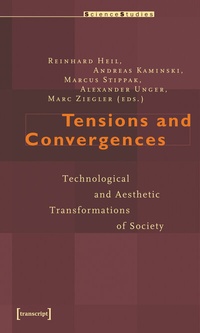
Tensions and Convergences
Technological and Aesthetic Transformations of Society
1st Edition
Published on 15. July 2015
366 pages
978-3-8394-0518-5 (ISBN)
Description

This book presents results of an international conference which addressed the interaction of aesthetical and technological dimensions within the formation of contemporary society. The contributions discuss the production of time and space, self and nature, individual and society in the image of technology. They focus on the productive tensions and convergences between aesthetic and technological concepts when implemented in everyday life. The volume contains - among others - texts about technologies of visualisation, the aesthetics of warfare and the design of technological lifeworlds.
More details
Other editions
Additional editions
Reinhard Heil | Andreas Kaminski | Marcus Stippak
Tensions and Convergences
Technological and Aesthetic Transformations of Society
Book
03/2007
1st Edition
transcript
€33.80
Article exhausted; check different version
Persons
Editor
Reinhard Heil, Karlsruher Institut für Technologie, Deutschland
Reinhard Heil, Philosoph, ist wissenschaftlicher Mitarbeiter am Institut für Technikfolgenabschätzung und Systemanalyse (ITAS) des Karlsruher Instituts für Technologie (KIT).
ISNI:
Andreas Kaminski, Technische Universität Darmstadt, Deutschland
Andreas Kaminski (Dr. phil.) ist wissenschaftlicher Mitarbeiter am Institut für Philosophie der TU Darmstadt. Seine Forschungsschwerpunkte sind Technikphilosophie, Medien der Wissensvermittlung, Phänomenologie und »Prüfung« um 1900/2000.
ISNI:
Marc Ziegler, Postgraduiertenkolleg »Technisierung und Gesellschaft«, Deutschland
Content
- Cover Tensions and Convergences
- TABLE OF CONTENTS
- Preface
- Modern Alliances Between Aesthetics and Technology
- Technical Gadgetry. Technological Development in the Aesthetic Economy
- Aesthetic Precision
- Architecture in the Mirror of Technology. The Rhetoric of Le Corbusier and the Futurist Movement
- Readerless Media: Modernism, Information Theory, and the Commodity
- Mass Aesthetics, Technicist Expansionism and the Ambivalence of Posthumanist Cultural Thought
- Aesthetics of Technoscience
- Transhumanist Arts. Aesthetics of the Future? Parallels to 19th Century Dandyism
- Art in the Age of Biotechnology
- Cultural Aspects of Interface Design
- Imaging Reality. On the Performativity of Imagination
- Working on Visibility
- Causality, Custom and the Marvellous. On Natural Science at the Beginning of Modern Times
- Growth of Biofacts: The Real Thing or Metaphor?
- The Brain as Icon - Reflections on the Representation of Brain Imaging on American Television, 1984-2002
- "If There is a Risk Inside of Me, I am the First Person who Should Know About it." - Images of 'Genetic Risks' as Anticipation of the Future
- From the Historical Continuity of the Engineering Imaginary to an Anti-Essentialist Conception of the Mechanical-Electrical Relationship
- Technological Transformation of Space and Social Life
- Architectural Structuralism and a New Mode of Knowledge Production
- Some Notes on Aesthetics in a 'Städtebau' on a Regional Scale
- Between Determination and Freedom: The Technological Transformation of Education and Learning
- (Self)Normalisation of Private Spaces - Biography, Space and Photographic Representation
- Cultural Assessment and Appropriation of Technology
- The Aestheticisation of Futurity. From Facts to Values - Authority to Authenticity
- Technological Transformation of Society in Children's Books
- Aesthetics of Technology as Forms of Life
- On the Symbolic Dimension of Infographics and its Impact on Normalization (With Examples Drawn from Demography)
- The Mental and Practical Impact of Pre-Bacteriological Quality Criteria for Water in the 1870s
- The Aesthetic Dimension of Warfare
- War and the Beautiful: On the Aestheticising of the First World War in Film - Yesterday and Today
- Soldiers on the Screen. Visual Orders and Modern Battlefields
- Military Bodies, Weapon Use and Gender in the German Armed Forces
- "A Horribly Beautiful Picture". Aesthetic Dimensions of Aerial Warfare
- Postmodern Aesthetics: Manipulating War Images
- Authors
