

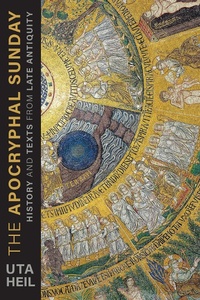
Apocryphal Sunday
Description

A range of apocryphal and pseudepigraphic texts from Late Antiquity points to the importance of Sunday as a holiday for baptized Christians. First and foremost is the so-called Letter from Heaven, which has experienced a broad and long-lasting reception up to modern times, although it was also criticized as a forgery from its beginning. Unfortunately, these texts have not received sufficient attention so far.
This volume presents various versions of the Letter from Heaven, as well as other texts (the pseudepigraphic Acts of the Synod of Caesarea; pseudepigraphic sermons of Eusebius of Alexandria, John Chrysostom, and Basil of Caesarea; passages from the Didascalia or Diataxis of Jesus Christ; the Second Apocryphal Apocalypse of John; the Visio Pauli; a sermon of Sophronius of Jerusalem; and the Apocalypse of Anastasia), together with a translation and commentary. An introduction tells the story of this letter and integrates it and the other texts into the cultural history of Sunday. It becomes clear that Sunday as a day of rest and a feast day was not in the foreground of the development of an ecclesiastical festival calendar for a long time, although Emperor Constantine enacted a law on holiday rest on Sunday in 321 CE. Sunday, rather, marks the end of the Christianization of time and the calendar, when Easter, Pentecost, Christmas, and martyrs' feasts were already taken for granted. The authors of these texts obviously wanted to accelerate , which is why an anonymous person even resorted to presenting Christ himself as the author of this letter. Here, severe punishments are threatened to all who do not observe Sunday, who work as if it were a weekday, and who skip worship. The broad tradition shows that the letter was read and distributed despite all the criticism, and was even turned into an early form of a chain letter.
More details
Other editions
Additional editions
Person
Content
- Cover
- Title Page
- Copyright
- Contents
- Preface (Uta Heil, with Canan Arıkan-Caba, Philip Polcar, Christoph Scheerer, and Angela Zielinski Kinney)
- A. Introduction
- 1. Contexts (Uta Heil)
- 2. Texts in Addition to the Letter from Heaven (Uta Heil)
- 2.1. The Pseudepigraphal Acts of the Council of Caesarea
- 2.2. A New Fragment of the Dialogue between Jason and Papiscus (CPG 1101) from Sophronius of Jerusalem, Oratio de circumcisione Christi
- 2.3. Visio Pauli 34 or Apocalypse of Paul 44 (BHG 1460
- BHL 6580-82)
- 2.4. A Homily: "Today, My Beloved, I'd Like to Praise the Day of the Lord" (CPG 2955 and CPG 4869)
- 2.5. A "Question and Answer about Sunday" (CPG 5525)
- 2.6. A Homily: "Hear, All Brothers Christians, What the Prophets Say" (CPG 4848)
- 2.7. An Anonymous Fragment on Four Sunday Names (Codex Vaticanus graecus 2392)
- 2.8. The Diataxis of the Holy Apostles (BHG 812a-e)
- 2.9. A Passage from the Apocalypsis Iohannis Apocrypha Altera (BHG 922i
- CANT 332)
- 2.10. A Passage from the Apocalypse of Anastasia or Visio Anastasiae Monialis (BHG 1868.1870)
- 3. Letter from Heaven
- 3.1 Introduction and Research History (Uta Heil)
- 3.2 Latin Manuscripts (Angela Zielinski Kinney)
- 3.3 Manuscript Studies (Latin) (Angela Zielinski Kinney)
- 3.3.1 Methodology
- 3.3.2 Additional Manuscripts of the Latin Letter from Heaven (Up to 1500 CE)
- 3.3.3 Results: Latin Recension I
- 3.3.4 Results: Latin Recension II
- 3.3.5 Preliminary Conclusions
- 3.4 Greek Manuscripts (Canan Arikan-Caba)
- 3.5 History (Uta Heil)
- 4. Considerations (Uta Heil)
- 4.1 Framing, Structure, and Discovery Legends (Uta Heil)
- 4.2 Rest or Work (Uta Heil)
- 4.2.1 The Sabbath Commandment in the Greek Sunday Apocrypha
- 4.2.2 Legacy of Eusebius of Caesarea
- 4.2.3 Sunday Rest in the Latin Letter from Heaven
- 4.2.4 A Day of Reconciliation
- 4.2.5 Ecclesiastical Canons and Punitive Miracles
- 4.2.6 Duration of Sunday until Monday Morning
- 4.3 Threats and Punishments (Uta Heil)
- 4.4 Punishment of Women (Uta Heil)
- 5. Evaluation (Uta Heil)
- B. Texts and Translations
- 1. The Letter of Licinianus of Cartagena (Philip Polcar)
- 2. Letter from Heaven-Latin Recension II (Philip Polcar and Christoph Scheerer)
- 3. Letter from Heaven-Stone Inscription (Michel-Yves Perrin)
- 4. Letter from Heaven-Latin Recension I (Philip Polcar)
- 5. Letter from Heaven-Greek Recension Alpha (Canan Arikan-Caba)
- 6. Letter from Heaven-Greek Recension Beta (Angela Zielinski Kinney)
- 7. Letter from Heaven-Greek Recension Beta (London) (Canan Arikan-Caba)
- 8. The So-Called Acts of the Council of Caesarea (Uta Heil and Christoph Scheerer)
- 9. Sophronius of Jerusalem and Dialogue of Jason and Papiscus (Uta Heil)
- 10. Visio Pauli 34 or Apocalypse of Paul 44 (Uta Heil)
- 11. Three Pseudepigraphal Sunday Homilies (Annette von Stockhausen)
- A Homily "Today, My Beloved, I'd Like to Praise the Day of the Lord
- A "Question and Answer about Sunday
- A Homily "Hear, All Brothers Christians, What the Prophets Say
- 12. Four Names for Sunday (from Codex Vaticanus Graecus 2392) (Renate Burri)
- 13. Diataxis-Instructions of the Twelve Apostles (Uta Heil and Ioannis Grossmann)
- 14. The Second Apocryphal Apocalypse of John (Uta Heil)
- 15. The Apocalypse of Anastasia (Uta Heil)
- C. Literature
- Selected Bibliography
- Indexes
