

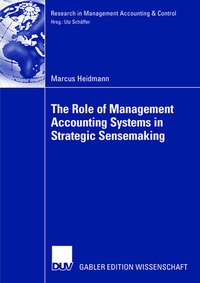
The Role of Management Accounting Systems in Strategic Sensemaking
1st Edition
Published on 13. March 2008
XV, 229 pages
978-3-8349-9633-6 (ISBN)
Description

Foreword rtation thesis is the insight that man- ers need to identify and understand strategic issues in order for their companies to s- cessfully cope with strategic change. Information from management accounting s- tems (MAS) can be helpful in this process fined as formal s- tems that provide information from the internal as well as the external environment. Consequently, the desire to better understand the role of these systems in the process of strategic sensemaking comes to mind. It is even intensified when considering the impression from management accounting practice that the tool box pecially the traditional one, us sensemaking. Due to the explorative nature of the research questions, and the objective of studying strategic sensemaking in its natural setting, the empirical approach of this dissertation is based on a multiple-case study design und generates an array of interesting findings. Heidmann shows, for example, that managers do not primarily use MAS to identify or implicitly assumed in most studies on st- tegic sensemaking: instead, they use management accounting systems to search for - ditional information that help them to make sense of these issues. In addition, the study at hand underlines the relevance of communication several times. This is true for the communication processes in the context of adaptation and preparation of management accounting systems as well as for their actual use.
More details
Other editions
Additional editions
Book
01/2008
1st Edition
Springer Gabler
€53.49
Shipment within 10-15 days
Persons
Dr. Marcus Heidmann promovierte bei Prof. Dr. Utz Schäffer am Lehrstuhl für Controlling der European Business School, Oestrich-Winkel. Er ist als Unternehmensberater bei McKinsey & Company tätig.
Content
Theoretical Foundation.- Management Accounting Systems and Strategic Sensemaking.- Research Design.- Results of Case Study Research.- Implications and Outlook.
A Introduction (p. 1)
"They [the companies] did not listen. They did not see. They did not react. These organizations failed to acquire accurate information about environmental events, or they did not interpret it correctly. They did not learn."
Richard L. Daft and George P. Huber
1. Research Topic and Objectives
Constant shifts in consumer demand, severe dislocations in factors of production, sudden changes of the social face an uncertain, changing world. In a recent survey of 16,476 business executives from 148 countries, 84% of the respondents claim that competition in their industry has increased over the past 5 years and 80% of the executives expect that it will continue to intensify. Price erosion, the entry of new competitors and faster development of new products are examples for current competitive pressures.
Survival in a competitive environment requires managers to identify and make sense of strategic issues as a prerequisite for st environmental trends and possible events impact on the firm". They are usually poorly structured, poorly documented, and open to multiple interpretations. acquire, interpret, and control flows of environmental information in order not to be blindsided by threats, or even unprepared for opportunities.
In order to make sense of strategic issues, managers must relate the firms strengths and weaknesses to specific opportunities and threats embedded in these issues. This requires information from the internal as well as the external environment. Management accounting systems (MAS) are formal systems that provide such information to managers. They include reports, performance measurement systems, computerized information systems, such as executive information systems or management information systems, and also planning, budgeting and forecasting processes required to prepare and review management accounting information.
Management accounting systems provide information that is required for strategic sensemaking and therefore it is important to understand their contribution. The objective of this research is to explore the role of management accounting systems in strategic sensemaking. In order to achieve this research objective it is helpful to draw on the interpretive and the systemsstructural or logistical perspective of organizational information processing. Researchers following the interpretive perspective of information processing define strategic sensemaking as a learning process where individuals learn about the relationships between the organization and its environment.
More generally, management accounting researchers like BURCHELL ET AL. claim that management accounting systems can serve as "learning machines", which raises the question how management accounting systems contribute to learning through strategic sensemaking. Several typologies of management accounting information use have been developed, but most do not provide references between information use and learning.
A notable exception is SIMONSs differentiation between interactive and diagnostic use: He suggests that the interactive use of management accounting systems can guide organizational learning and influence the process of strategic sensemaking, while the diagnostic use of management accounting systems helps to implement past and present strategies. A line of management accounting research has focused on the interactive use of management accounting systems and suggests some ways for how this type of use can contribute to strategic sensemaking.
ABERNETHY AND BROWNELL show that the interactive use of management accounting systems contributes positively to performance during strategic change. They speculate that management accounting systems used interactively can serve as integrative liaison devices. This would enable the interchange of information concerning strategic issues, by breaking down functional and hierarchical barriers in- hibiting information flows.
"They [the companies] did not listen. They did not see. They did not react. These organizations failed to acquire accurate information about environmental events, or they did not interpret it correctly. They did not learn."
Richard L. Daft and George P. Huber
1. Research Topic and Objectives
Constant shifts in consumer demand, severe dislocations in factors of production, sudden changes of the social face an uncertain, changing world. In a recent survey of 16,476 business executives from 148 countries, 84% of the respondents claim that competition in their industry has increased over the past 5 years and 80% of the executives expect that it will continue to intensify. Price erosion, the entry of new competitors and faster development of new products are examples for current competitive pressures.
Survival in a competitive environment requires managers to identify and make sense of strategic issues as a prerequisite for st environmental trends and possible events impact on the firm". They are usually poorly structured, poorly documented, and open to multiple interpretations. acquire, interpret, and control flows of environmental information in order not to be blindsided by threats, or even unprepared for opportunities.
In order to make sense of strategic issues, managers must relate the firms strengths and weaknesses to specific opportunities and threats embedded in these issues. This requires information from the internal as well as the external environment. Management accounting systems (MAS) are formal systems that provide such information to managers. They include reports, performance measurement systems, computerized information systems, such as executive information systems or management information systems, and also planning, budgeting and forecasting processes required to prepare and review management accounting information.
Management accounting systems provide information that is required for strategic sensemaking and therefore it is important to understand their contribution. The objective of this research is to explore the role of management accounting systems in strategic sensemaking. In order to achieve this research objective it is helpful to draw on the interpretive and the systemsstructural or logistical perspective of organizational information processing. Researchers following the interpretive perspective of information processing define strategic sensemaking as a learning process where individuals learn about the relationships between the organization and its environment.
More generally, management accounting researchers like BURCHELL ET AL. claim that management accounting systems can serve as "learning machines", which raises the question how management accounting systems contribute to learning through strategic sensemaking. Several typologies of management accounting information use have been developed, but most do not provide references between information use and learning.
A notable exception is SIMONSs differentiation between interactive and diagnostic use: He suggests that the interactive use of management accounting systems can guide organizational learning and influence the process of strategic sensemaking, while the diagnostic use of management accounting systems helps to implement past and present strategies. A line of management accounting research has focused on the interactive use of management accounting systems and suggests some ways for how this type of use can contribute to strategic sensemaking.
ABERNETHY AND BROWNELL show that the interactive use of management accounting systems contributes positively to performance during strategic change. They speculate that management accounting systems used interactively can serve as integrative liaison devices. This would enable the interchange of information concerning strategic issues, by breaking down functional and hierarchical barriers in- hibiting information flows.
