

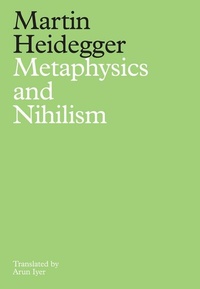
Metaphysics and Nihilism
Description

The two treatises The Overcoming of Metaphysics (1938/39) and The Essence of Nihilism (1946-1948) do not belong together temporally or formally, but they are brought together in this volume because they both treat a common thesis from the standpoint of different questions - namely, that nihilism is the essence of metaphysics in relation to the history of being.
The overcoming of metaphysics is, for Heidegger, the decisive historical moment in which metaphysics is experienced as the history of the abandonment by being and overcome at the same time. The abandonment of beings by being reveals itself in the final and most extreme intensification of metaphysics as the "unconditioned predominance of manipulation." Manipulation means here the all-dominating producibility of beings.
The Essence of Nihilism is linked to the idea of overcoming. This text deals with the attempt to elucidate the essence of nihilism through Nietzsche's words "God is dead." The killing of God springs from the will to power as the most extreme form of manipulation. The being of beings is grasped here as the positing of values emanating from the will to power. In this positing of being as value, it becomes clear that being itself remained unthought in metaphysics. Therefore, metaphysics as such is nihilism proper.
These key works by Heidegger, now available in English for the first time, will be of great interest to students and scholars of philosophy and to anyone interested in Heidegger's thought.
More details
Other editions
Additional editions
Persons
Content
The Overcoming of Metaphysics
1. The Overcoming of Metaphysics
2. The Overcoming of Metaphysics
3. The History of Beyng and the Overcoming of Metaphysics
4. The Vanishing of Being
5. Metaphysics and the Predominance of Beings: The Impotence and the Vanishing of Beyng
6. "Overcoming"
7. On the Formation of the Text
8. On the Correct Grasp of the Whole
9. The Overcoming of Metaphysics through Beyng
10. The Overcoming as the History of Beyng
11. The Other Inception
12. The Transition
13. Metaphysics and the Question of Possibility
14. The Question of Possibility as the Mode of the Question of Essence
15. The Truth of Beyng
16. "Truth" (Cf. Winter Semester 37/38)
17. Truth [Clearing of Beyng (Event) and the Correctness of Representing]
18. The Essence of History
19. On the Overcoming of Metaphysics
20. Correctness
21. The Overcoming of Metaphysics
22. The Overcoming of "Metaphysics"
23. Overcoming
24. "Overcoming" and "the Human"
25. The Overcoming of Metaphysics
26. The Overcoming of Metaphysics
27. The Overcoming of Metaphysics at its End
28. The Overcoming of Metaphysics
29. Over-coming is only in the Other Inception
30. "Worldview" - "Ideology"
31. The End of Metaphysics
32. The End of Metaphysics
33. The Clearing of Beyng
34. Nietzsche and the End of Western Metaphysics
35. The End of Metaphysics as Consummation in the Unconditional Corrupted Essence. (The Metaphysics of Nietzsche)
36. The Metaphysics of Nietzsche as the Consummation of Metaphysics
37. The Consummation of Metaphysics: The Positing of Value as Nihilism
38. The Consummation of Metaphysics Comes to Fruition
39. Beyng - (Event)
40. Metaphysics
41. Metaphysics
42. The Consummation of Modern Metaphysics
43. Metaphysics as the History of Beyng
44. Metaphysical Errancy
45. Metaphysics and the "Universal"
46. Metaphysics (cf. "Basic Words")
47. Basic concepts (of Metaphysics)
48. The Essence of Metaphysics in Terms of the History of Beyng
49. Metaphysics and "Physics"
50. The History of Being (The Overcoming of Metaphysics) - Being and Time (The Question of Being)
51. Metaphysics
52. "The Metaphysical"
53. The Role of "Science" and Philosophy as Metaphysics
54. On What is Metaphysics?
55. On What is Metaphysics? The Nothing
56. On the Essence of Ground: Ground - Freedom - Truth - Beyng
57. "Ground" and "Truth"
58. Projection and Eventuation [Er-eignung]
59. "Ground"
60. "Ground"
61. On the Essence of Ground
62. The Differentiation
63. Metaphysics and the Differentiation
64. Metaphysics
The Overcoming of Metaphysics I. Sequel
I. The Differentiation
65. The Differentiation
66. The Differentiation (and the Question concerning the Nothing)
67. The Differentiation (Beyng is the Nothing)
68. Being and Beings - Metaphysics - the Differentiation
69. Differentiation and Event
70. Differentiating Being from Beings and the Distinctness of the Two
71. The Differentiation and What is Borne Out
72. Metaphysics ("Being" - an Empty Word)
73. The Differentiation
74. Being and Beyng
75. The Differentiation - What is Borne Out
76. The Differentiation
II. On the Concept of Metaphysics
77. Metaphysics and the Thinking that is Responsive to the History of Beyng
78. The Overcoming of "Metaphysics"
79. The Transition of Metaphysics within the History of Beyng into the Other Inception of the Truth of Beyng
80. The A priori
81. Metaphysics and the A priori
82. The "A priori" - Character of "Being"
83. Metaphysics and the Differentiation
84. Metaphysics
85. "Metaphysics"
86. Being Conscious and Being (Modern Metaphysics)
87. Metaphysics and "Theology"
88. The Relation to Being within the History supported by Metaphysics
89. "Metaphysics" and the Thinking of Beyng
90. Metaphysics as Theology
91. Metaphysics and Modern Humanity
92. Metaphysics and "Theology"
93. Nietzsche and Heraclitus ("Metaphysics" and the First Inception of Philosophy)
94. The History of Beyng: "Overcoming"
95. Kant and Metaphysics
96. "Metaphysics" ("Subjectivity" and Substantiality)
97. The Overcoming of Metaphysics
98. The Essence of Metaphysics and its Overcoming
99. The Consummation of Metaphysics
100. The Overcoming of Metaphysics
101. The Consummation of Metaphysics
102. Metaphysics - Consummation (Inversion into the most Extreme)
103. The Interpretation of the Cogito
III. Art and Metaphysics
104. In the Lectures on the Origin of the Work of Art
105. "Art"
106. When Metaphysics Ends, so too does Art
IV. Metaphysics and "Worldview"
107. Metaphysics and Worldview
108. Worldview is the Perishing of Metaphysics
109. The Consummation of Metaphysics (Nietzsche)
110. &"Worldview"
111. "Worldview" and "Philosophy"
112. "World-view" ("Life")
113. Metaphysics - Worldview: The True, the Good, the Beautiful
114. Metaphysics and Worldview and the Thinking Responsive to the History of Beyng.
115. Metaphysics and Worldview
116. Metaphysics and Worldview
V. Being and Time in the History of Beyng Insofar as This History is Experienced as the Overcoming of Metaphysics
117. Being and Time and Metaphysics
118. Time and Eternity
119. On the History of the Concept of Time
120. The Essence of Time
121. Time and Being
122. Being and Time
123. Being and Time
124. Being and Time
125. "The Sense of Being"
126. Being and Time
127. Being and Time
128. Being, the Understanding of Being and Beyng
129. Da-sein and "Care" - "Attunement"
130. Being and Time
The Overcoming of Metaphysics II. Sequel
I. The Consummation of Metaphysics the Abandonment by Being and Devastation
131. Metaphysics and "Science"
132. At the End of Metaphysics
133. Inception and Metaphysics
134. The Essence of the Consummation of Metaphysics in terms of the History of Beyng
135. The Consummation of "Modernity" within the History of Beyng
136. The Nothing and Devastation
137. Abandonment by Being
138. Abandonment by Being
139. The Abandonment of Beings by Being
140. Manipulation - Technology - Beyng
141. &"Technology"
142. Manipulation
II. The Origin of Metaphysics in the History of Beyng the Origin of Metaphysics and the Essence of Truth in the First Inception
143. Overcoming
144. One of the Characteristic Features of Metaphysics
145. The Age of "Theologies"
146. The Essence of Metaphysics: Theology and Mathematics
147. "Truth" and Metaphysics (Grades of the True)
148. On the Essential Determination of Modern Metaphysics in its Consummation
149. If Being is "Will"
150. Metaphysics and "System"
151. The A priori
152. The First Inception and the Origin of Metaphysics
153. Being as ¿dÝa and the Collapse of ¿¿Þ¿e¿a
154. ¿ t¿¿ ää¿¿ ¿dÝa: The Beginning of Metaphysics and the Crash and Collapse of the Ungrounded ¿¿Þ¿e¿a
155. How Metaphysics Begins and Peters Out
156. "Watching" and "Thinking" (The End of Metaphysics)
157. The History of Being and Metaphysics
158. "Worldview" and "Metaphysics"
159. Animal rationale - absolutum (causa)
160. Truth as Certainty: Modern Metaphysics (Leibniz)
III. Metaphysics the Individual Basic Positions of Metaphysics
161. From Whence the Appearance that the Thinking Responsive to the History of Beyng is Only a Modification of Hegel's Metaphysics?
162. Hegel's Concept of History
163. Beyng - Event - Inception (Meant from the Standpoint of "Metaphysics")
164. Beings as a Whole and their Entirety (Metaphysics and Beyng)
The Essence of Nihilism
Appendix
Addendum to: The Essence of Nihilism
Translators' Introduction
This book in front of you is a translation of the second revised edition of volume 67 of Martin Heidegger's Gesamtausgabe titled Metaphysics and Nihilism. The volume contains two texts spanning ten years: The Overcoming of Metaphysics (1938/39) and The Essence of Nihilism (1946-1948).
It is clear for us to see, even as the editor informs us, that the two texts constituting this volume are formally different. The first text written in 1938/39 is part of the Ereignis-writings accompanying The Contributions to Philosophy (Of the Event), which exhibit the immediacy of thought in its emergence and do not possess the polish of a finished written text. We cannot say that of the second text, which is a polished piece of writing, two-thirds of which, as the editor points out, was revised by Heidegger and published under the title "Nihilism as Determined by the History of Being" in the second of the two Nietzsche volumes from 1961.
In abiding by Heidegger's wish to have the reader confront his text directly, this translation has eschewed any mediation in the form of a critical apparatus. There is no index. The only interventions made in this translation are to provide English translations of Heidegger's foreign language citations in footnotes in curly brackets, indicated by the abbreviation TN for Translator's Note, and the original German pagination, which is inserted into the text in square brackets.
A translation is a set of decisions that can always be challenged. In this sense, it is like a performance of a piece of classical music. Just like every performance of a piece, every translation of a text is different, and yet, all the different translations of a text, like all the different performances of a piece, are one and the same. For they are translations of one and the same text and performances of one and the same piece. Every translation has to take some decisions and follow the linguistic consequences of those decisions in the conviction that they render the text being translated into the language of the translation, as it is meant to be read, in much the same way as every musical performance has to take decisions and abide by the musical consequences of those decisions in the conviction that they render the piece as it is meant to be heard.
The following are some of the important decisions I have made as a translator:
1. Ereignis and Er-eignis and related words: Both words have been translated as "event," with the hyphenated German placed in brackets next to its English translation. I have avoided terms like "appropriative event" or "appropriating event" to translate Er-eignis for they end up misleading the reader into seeing acquisition and possession as the primary sense of these words, when in fact they are not. In addition to this, there are reasons of elegance and readability, which I believe are important virtues that aid the understanding of a text, especially a difficult text like this one.
2. Wesen and Wesung: Wesen has been translated as "to essence" and Wesung as the gerund "essencing." In this, I believe I have followed Heidegger's own directions in The Essence of Nihilism (p. 192):
. "[E]ssence" does not mean here what previous reflections unthinkingly assumed. "Essence" does not mean an essentiality, which as something non-sensuous and abstract floats over the actual understood as the sensibly perceptible. "Essence" thought verbally, and, that is to say, experienced in thinking, is the essencing of being itself, which leads all beings into becoming beings as such.
The translations are awkward, as the English language does not grant any conventional space to verbalize the noun essence or to use it as a gerund. The word, as we know, comes from the Latin essentia, which in turn renders the Greek ??s?a. The prefix "esse-" comes from the Latin esse meaning "to be" and the suffix "-ence," according to Klein's Comprehensive Etymological Dictionary of the English Language (1971), denotes action, process, state or quality and comes from the Latin -entia. So, one can see a verbal sense in the English word "essence" if one notes that the suffix "-ence" does also denote action and process in addition to a state and quality. The Deutsches Wörterbuch von Jacob Grimm und Wilhelm Grimm1 tells us that the verbal meaning of wesen is leben und weben, which means "to exist, to be there (often concretely elaborated) in a broadly inclusive sense of an intensive and concept-specific life-expression and activity." Now, Leben means "to live" and weben, it tells us, has three connotations: "to move back and forth," "to show oneself and be active" and "to waft or wave." In fact, this mellifluous combination of the words leben and weben was introduced by Luther in his translation of the Acts of the Apostles 17: 28, which in English reads: "For in him, we live, move, and have our being."2 Luther uses weben to translate the Greek ?????µe?a. Heidegger in these texts being translated makes it clear that he wishes to use the word wesen in a way that reminds us of the Latin noun essentia, understood as essentiality but, at the same time, shows us what is overlooked when we are transfixed by the static nature of the noun, namely, the essential moment of beings becoming beings. He does this by verbalizing the very same noun, which in the English language can be executed only in all its awkwardness.
3. Seyngeschichtliches/geschichtliches Denken: Seynsgeschichte translates to "history of beyng." Geschichtliches Denken is easily translated as "historical thinking," which means thinking in terms of history or thinking in a manner that is responsive to history. However, the transition from geschichtliches Denken to seynsgeschichtliches Denken is not grammatically and semantically possible in the English language. Moreover, it is necessary to translate seynsgeschichtliches Denken in a way that preserves the translation of Seynsgeschichte as "history of beyng," if the translation has to convey to an English-speaking reader, the meaning it possesses in German. I have done this by translating seynsgeschichtliches Denken as "thinking responsive to the history of beyng." Yes, one can legitimately complain that this is an inelegant paraphrase of a compact and self-evident term. But in this particular case, I believe that the need to convey the precise meaning of the term outweighs the need for elegance.
4. Machenschaft has been translated as "manipulation." It is usually translated as "machination." But, in the English language, "machination" always carries a morally negative connotation. Hence it is always used in English as a term of moral condemnation. But the German word Machenschaft, on the other hand, does not always carry a negative connotation. The Deutsches Wörterbuch von Jacob Grimm und Wilhelm Grimm tells us that Machenschaft is a southern German word meaning making, ordering, determining, erecting, which requires further qualifications to give it an explicitly morally negative sense. Moreover, Heidegger is adamant that the terms that he employs in his writings on being do not carry any moral connotation and are not used for the purposes of moral judgment. It is for these reasons that I have used the English word "manipulation" to translate Machenschaft. Manipulation does carry a morally negative connotation but it does not possess only such a connotation. It can also be used in a morally neutral sense to mean adjusting, operating, and working on something in order to make it work for our purpose. Heidegger's use of the word Machenschaft carries precisely this sense of being able to work on things and transform them into things that serve our needs, and viewing all beings as that which can be transformed into serving our needs without any explicit moral judgment on our needs and on our capacity to transform things to suit our needs.
In keeping with the wishes of the publisher, I have attempted to make the translation stand as a text on its own, which can be read and understood without referring to the original German text. This is of course particularly difficult to do in the case of Heidegger, who uses every resource the German language provides him with to express his difficult and highly original intuitions. However, this translation has, as far as possible, avoided the practice of placing the original German words next to their English counterparts in brackets, except in those cases where it is absolutely necessary for the reader to see the etymological kinship between the German words not reflected in the English words chosen to translate them, and there are quite a few instances where this has been done. But, in most instances, I have wagered that the specific significance that attaches to the etymological kinship between the German words will come through in the English language in the way that I have translated those words and the sentences containing those...
