

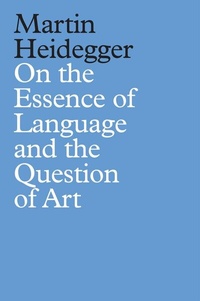
On the Essence of Language and the Question of Art
Description

The texts and notes collected in this volume offer unique insight into the development of Heidegger's thinking on language and art from the late 1930s to the early 1950s - a tumultuous period both for Heidegger personally and for Germany as a whole. Following Germany's defeat in World War II, Heidegger was banned from teaching at Freiburg University, where he had been a professor since 1928, and his thinking underwent significant changes as he began to cultivate different modes of silence and non-saying in his philosophy of language. This volume illuminates these shifts and charts the evolution of key terms in Heidegger's philosophy of language during this key period in the development of his thought.
The central theme of Heidegger's reflections on language in this volume is his repeated engagement with the character of the word, silence and the unsaid, and his rejection of the instrumental conception of language, where he instead prioritized conversation as the "homeland of language." Alongside references to Hölderlin and von Hofmannsthal and shrewd scrutiny of aural phenomena such as silent thought and speechlessness, speech is demonstrated to be intimately connected to the human essence. In a later section, Heidegger examines the place of art, in particular the plastic arts, and the role of the artist in conjunction with the new industrial landscape and architecture of his time, and in juxtaposition with ancient Greek attitudes to space and the polis.
This key work by Heidegger, now available in English for the first time, will be of great interest to students and scholars of philosophy and to anyone interested in Heidegger's thought.
More details
Other editions
Additional editions
Persons
Martin Heidegger (1889-1976) was one of the most influential philosophers of the twentieth century and the author of numerous works including Being and Time.
Content
Part One: On the Essence of Language
The Saga
1. The Resolution
2. The Characteristics of the Decision
3. The Question of Being
4. The Question of Being (The First and the Other Inception)
5. The Two Leaps in the Attempt to Think Being
6. The Three Insights and Knowledge
7. Beyng, "Spirit," Cognition
8. The Saga
9. The Beyng-Historical Inception
10. The History of Beyng
11. "The History of Philosophy" and the History of Being
12. Beyng-Historical "Thinking"
13. Steadfastness and Thinking
14. The "Concept" - Distancing - Naysaying
15. The No of Beyng-Historical Thinking
16. Naysaying and Questioning
17. The Word
18. Beyng and Word
19. Beyng as the Appropriating Event (The Human)
20. Beyng and Attunement
21. Beyng
22. The Nothing and Beyng
23. Beyng as Nothing
24. The Nothing
25. The Event of Appropriation
26. Event of Appropriation
27. Beyng
28. Beyng, God, the Human
29. Beyng
30. Beyng is and only Beyng Is
31. Abyssal Ground
32. Beyng
33. The More Inceptual Saga
34. The Untenability of the Differentiation between "Being" and "Becoming"
35. Truth and System
36. The Attunement of the Voice Determines
37. Where is a Measure?
38. Not What "is Coming"
39. What Are "We" To Do
40. Not a "New" Philosophy
41. Where Do We Stand? Directed Toward the History of Beyng
42. A Curious Delusion of this Age
43. Steadfastness and Duty
44. The Saga
45. The Crux of the Error
46. Time-Space (cf. Contributions, Grounding)
47. The Temporalization of Time
48. Time-Space
The Word. On the Essence of Language
The Quickening Element of the Word
The Birth of Language
The Beginning
The Unique Element
Addenda
Word - Sign - Conversation - Language
I. The Word and Language
II. The Sign (Its Essence Bound to the Event)
III. The Word. Conversation and Language
IV. The Word (CF. Poetizing and Thinking)
V. The Word and Language
VI. Word and "Language"
VII. The Essential Prevailing of the Word
VIII. Image and Sound - The Sensible
IX. Language
X. Language
On Eduard Mörike's Poems "September Morning" and "At Midnight"
ADDENDA Image and Word
Part Two: On the Question of Art
On the Question of Art
Art and Space
The Work of Art and "Art History"
Reflection upon the Essence and Conduct of the Art-Historical "Science"
Editor's Afterword
Glossaries
English-German
German-English
Translator's Introduction
The present volume contains notes, sketches, and sections of fully articulated treatises, which provide unique insight into the development of Heidegger's thinking on language and art in the 1940s. The German-language reader of this text might be inclined to describe Heidegger's writing in this volume with one particularly vivid adjective: wortkarg. Roughly translated, wortkarg means sparse with words, with karg meaning stingy, austere, and meager. A patch of soil that is karg is barren, desolate, and unyielding. Heidegger's language in this text is marked by a distinct barrenness. It is a language hewn down to the bone, with all unnecessary adornments stripped away. If the language is evocative or is even pleasant to read, then it is evocative and pleasant in the same way that a barren landscape might be pleasant to look at. Gazing at a barren landscape, the viewer is taken as much by what is there as by what is not there. Heidegger's spare prose is not a language that seeks to reach the flowery heights of the German language, but is instead the language of the roots. A writer of different inclinations might seek to use the German language to soar. With Heidegger, one trudges and plods open a rocky landscape, coursing through a barren terrain of sparse words. The task of the translator is to render that sparseness without filling it up with too many expository accoutrements - which creates a delicate balancing act when the task of the translator is also to render comprehensible philosophical prose.
Heidegger's cultivation of a sparse language creates a number of distinct challenges for the translator of this phase of Heidegger's writing. While many portions of the book consist of fully formulated manuscripts, other sections contain fragmentary formulations, sentences with a loose structure, and paths of thought which Heidegger intentionally leaves incomplete. Consequently, the fragmentary nature of the original text does not so much reveal a work that is incomplete, but instead one that is intentionally left open ended. I have attempted to replicate the open-ended nature of the work, but my first priority was always to produce a readable text in English. Hence, where necessary, I have furnished fragmentary sentences with finite verbs or missing parts and have broken up long sentences, which threatened to tax the limits of English syntax.
My decisions were guided by a fundamental distinction evident in the styles of writing Heidegger employs in the present volume. In the sections formatted as paragraphs and consisting primarily of complete sentences, I generally transformed the occasional fragmentary sentences Heidegger employs into complete sentences for the sake of rendering a comprehensible philosophical analysis. In the sections which consist of lists or series of fragments, I endeavored to maintain the sparse and barren nature of the prose as much as possible and left the fragmentary in its original state. This applies especially to §§ 149-163 in the notes on language. My goal in these sections was to keep the strangeness of the original intact. This allows the reader to experience the barrenness of Heidegger's prose without sacrificing comprehensibility in the more fully fleshed-out sections of analysis.
For the sake of readable English, I was unable to maintain another peculiarity which runs throughout the text. Often, Heidegger creates sentences beginning with interrogatory words and formulated grammatically as questions, though they are not furnished with a question mark. These formulations intensify the sense of inquisitive openendedness, which characterizes the text as a whole. For the most part, I have furnished these sentences with a question mark and rendered them as fully formed questions. Additionally, in many sections the title of the section serves as the beginning of the first sentence of the section. Given that the English sentence structure does not lend itself to replicating the order of the German sentence, it was often not possible to put the phrase from the title as the first element in the English sentence. Consequently, I was forced to abandon this feature for the most part and to start each section with a new sentence by imbedding the title in the sentence.
Individual terminological decisions are detailed in the Glossary at the conclusion of the book. The Glossary indicates the basic translation for a term; where situational flexibility demanded a different formulation, I varied from the basic translation. A few remarks are in order about fundamental terms in this work. Although they have their justified detractors, I followed two terminological decisions now common in many translations of Heidegger: (1) I translate Anfang and its cognate terms as "inception." (2) I translate Ereignis and its cognate terms with the basic translations of "event," "event of appropriation," and, in the verb form, "happening of the event." There is often no general felicitous rendering of the permutations of these terms and, while a translator might be tempted to render them with an array of different terms according to each unique setting, it is also necessary to situate this translation within the now well-established terminology used to render Heidegger in English. Employing the basic translations mentioned above risks lending a certain rigidity to the text, but it has the advantage of situating the translation within the formidable traditions of translating Heidegger.
A few remarks regarding specific terminological decisions in this text are in order. First, and perhaps most importantly, given the centrality of the word "word" in Heidegger's analysis of language, is Heidegger's play with the two plural forms of "word [Wort]." German possesses two plural forms of "word [Wort]": Wörter and Worte. Wörter indicates the totality of a language's lexicon. Hence, a dictionary is called a Wörterbuch and not a Wortebuch. Worte generally refers to a specific collection of words and would be used to render phrases such as the "words of Hamlet" or "words of a sentence." Heidegger draws a consistent distinction between the two plurals, which I have rendered by translating "Wörter" as "vocabulary" and "vocabulary words" and "Worte," the generic plural, as "words." This distinction is complicated by the further fact that the singular "Wort" also refers to a dictum or saying, applying to locutions such as "a word from Shakespeare," which of course refers to a phrase or plurality of words and not a single word. Heidegger's frequent use of the singular "word" ought to be read as resonating with this plurality. Throughout this text, Heidegger tends to associate "Wörter" (vocabulary) with the decline or downfall of language, linking it with a number of phenomena such as discourse (Rede), drivel (Faselei), the forgetting of being, the use of language as a tool, and logic. On the other hand, Heidegger associates Worte with terms such as saga (Sage), the mantra (der Spruch), saying (das Sagen), language (die Sprache), the authentic word (das eigentliche Wort), the inception (der Anfang), conversation (das Gespräch), the essential prevailing of the word (Wesung des Wortes), poetry (Dichten), and the event (Ereignis).
A somewhat awkward neologism was unavoidable, given that it is a precise rendering of the German original: isses [istet]. To create this term Heidegger plays with the third-person singular indicative form of the irregular verb "to be [Sein]": "is [ist]." He treats the third-person singular form as if it were derived from a correlating infinitive of a regular verb (to is; isten) and then conjugates that hypothetical infinitive in third-person singular. The outcome is the conjugated verb istet used to refer to the being of the beyng of beings. Heidegger uses this term both intransitively and transitively, i.e. with and without a direct object, combining it at times with "beyng" and "refusal" as direct objects. In German, copula verbs such as "to be" are strictly intransitive, meaning that they take no direct object. The use of the transitive with a form derived from a copula verb lends the construction an air of intentional uncanniness.
I follow the now well-established convention of employing "beyng" to render Heidegger's use of the antiquated spelling of "Sein" as "Seyn," while rendering the singular "das Seiende" as "beings," as opposed to the cumbersome yet more literal rendering of "that which is." "Dasein" has been left untranslated, except in a few instances where Heidegger divides the component parts of the word into "there [Da]" and "being [sein]." Heidegger frequently uses hyphens to draw terminological distinctions in words such as "Da-sein," always placing the hyphens in the natural breaks between parts of words (e.g. Aus-einander-setzung; Ver-ab-redung). Where the English word lends itself to hyphenation between the parts of the...
