

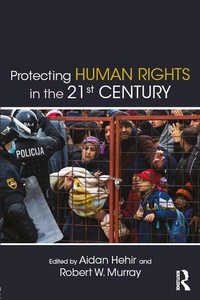
Protecting Human Rights in the 21st Century
Published on 12. April 2017
278 pages
978-1-315-43668-5 (ISBN)
Description

This book contributes to current debates on the protection of human rights in the 21st century.
With the global economic collapse, the rise of the BRICS, the post-intervention chaos in Libya, the migration crisis in Europe, and the regional conflagration sparked by the conflict in Syria, the need to protect human rights has arguably never been greater. In light of the precipitous decline in global respect for human rights and the eruption or escalation of intra-state crises across the world, this book asks 'what is the future of human rights protection?'. Seeking to avoid both denial and fatalism, this book thus aims to:
examine the principles at the very foundation of the debate on human rights;
diagnose the causes of the decline of liberal internationalism so as to offer guiding lessons for future initiatives;
identify those practices and developments that can, and should, be preserved in the new era;
question the parameters of the contemporary debate and advance perspectives that aim to identify the contours of future ideas and practices that may offer a way forward.
This book will be of much interest to students of humanitarian intervention, R2P, international organisations, human rights and security studies.
With the global economic collapse, the rise of the BRICS, the post-intervention chaos in Libya, the migration crisis in Europe, and the regional conflagration sparked by the conflict in Syria, the need to protect human rights has arguably never been greater. In light of the precipitous decline in global respect for human rights and the eruption or escalation of intra-state crises across the world, this book asks 'what is the future of human rights protection?'. Seeking to avoid both denial and fatalism, this book thus aims to:
examine the principles at the very foundation of the debate on human rights;
diagnose the causes of the decline of liberal internationalism so as to offer guiding lessons for future initiatives;
identify those practices and developments that can, and should, be preserved in the new era;
question the parameters of the contemporary debate and advance perspectives that aim to identify the contours of future ideas and practices that may offer a way forward.
This book will be of much interest to students of humanitarian intervention, R2P, international organisations, human rights and security studies.
Reviews / Votes
'Aidan Hehir and Robert Murray have chosen an innovative strategy for surmounting the entrenched divide between scholars who believe in human rights, come what may, and commentators fatalistically resigned to the rights' worthlessness on the ground. Instead of reflexively taking sides, the two collaborators present essays by international relations experts offering many alternative perspectives. This has freed the discourse from a straightjacket of dichotomous thinking and initiated a more generative process for finding consensus on how to move the human rights agenda forward.' -- Susan H. Bitensky, Michigan State University College of Law, USA'There is a trend among atrocity prevention norm entrepreneurs to gather in like-minded groups, extol their virtues and control narratives to avoid criticism. This timely volume adopts a more inclusive and reflective approach; motivated by a determination to "get atrocity prevention right," the contributions here will help practitioners to examine our motives, our policy inconsistencies, and the gaps in our analysis and practice.' -- Robert Zuber, Director, Global Action to Prevent War and Armed Conflict
'Refusing to be deluded by wishful thinking, the authors of this volume undertake a clear-eyed, critical analysis of R2P's successes and failures. Steering between fatalism and denial, they concede that our awareness of atrocity and the protection of civilians has been enhanced by R2P but that its time has passed. In thinking about what comes next, there is no better place to start than this provocative and highly insightful book.' -- Stephen Hopgood, SOAS, University of London, UK
More details
Series
Language
English
Place of publication
London
United Kingdom
Publishing group
Taylor & Francis Ltd
Target group
College/higher education
Professional and scholarly
File size
10,14 MB
ISBN-13
978-1-315-43668-5 (9781315436685)
Copyright in bibliographic data and cover images is held by Nielsen Book Services Limited or by the publishers or by their respective licensors: all rights reserved.
Schweitzer Classification
Other editions
Additional editions
Aidan Hehir | Robert W. Murray
Protecting Human Rights in the 21st Century
Book
04/2017
1st Edition
Routledge
€215.41
Shipment within 10-20 days
Aidan Hehir | Robert W. Murray
Protecting Human Rights in the 21st Century
Book
04/2017
1st Edition
Routledge
€63.50
Shipment within 10-20 days
Persons
Aidan Hehir is Reader in International Relations at the University of Westminster, UK. He is the author/editor of numerous titles, including Humanitarian Intervention: An Introduction (2nd edn, 2013) and The Responsibility to Protect: Rhetoric, Reality and the Future of Humanitarian Intervention (2012).
Robert W. Murray is Managing Director at Dentons Canada LLP's Government Affairs and Public Policy Practice Group and Research Fellow at the Centre for Military, Security and Strategic Studies, University of Calgary, Canada. He is the author/editor of numerous titles, including Multilateralism as State Strategy (2016) and International Relations and the Arctic (2014).
Robert W. Murray is Managing Director at Dentons Canada LLP's Government Affairs and Public Policy Practice Group and Research Fellow at the Centre for Military, Security and Strategic Studies, University of Calgary, Canada. He is the author/editor of numerous titles, including Multilateralism as State Strategy (2016) and International Relations and the Arctic (2014).
Content
Introduction: Denial, Fatalism and the Protection of Human Rights, Aidan Hehir
Part I: Rethinking Fundamental Principles
1. Global Constituent Power: Protests and Human Rights, Anthony F Lang, Jr
2. A Critical Examination of "Humanity", Samuel Jarvis
3. Failed Interventions and the Inherent Contradictions of Liberal Internationalism, Eric A. Heinze
4. Humanitarian Intervention in Post-American International Society, Robert W. Murray
Part II: "Protection" and Peacekeeping
5. The Uncertainties of International Protection, Kelly Staples
6. UN Peacekeeping and the Protection of Civilians Norm, Tom Keating
7. From Showpiece Interventions to Day-to-Day Civilian Protection: Western Humanitarian Intervention and UN Peacekeeping, Jonathan Gilmore and David Curran
8. The Responsibility to Protect or the Protection of Civilians: Which Policy Brand is more "Successful"?, Catherine Jones
Part III: The Responsibility to Protect and Beyond
9. Norm Complexity and Contestation: Unpacking the R2P, Alan Bloomfield
10. "Why is it that we keep failing?" The Responsibility to Protect as a Hollow Norm, Aidan Hehir
11. Guns Vs Troops: The Ethics of Supplying Arms, James Pattison
12. The Limits of R2P and the Case for Pacifism, Jeremy Moses
13. The Responsibility to Protect: A Long View, Justin Morris
Conclusion: The Future of Human Rights Protection, Robert W. Murray
Part I: Rethinking Fundamental Principles
1. Global Constituent Power: Protests and Human Rights, Anthony F Lang, Jr
2. A Critical Examination of "Humanity", Samuel Jarvis
3. Failed Interventions and the Inherent Contradictions of Liberal Internationalism, Eric A. Heinze
4. Humanitarian Intervention in Post-American International Society, Robert W. Murray
Part II: "Protection" and Peacekeeping
5. The Uncertainties of International Protection, Kelly Staples
6. UN Peacekeeping and the Protection of Civilians Norm, Tom Keating
7. From Showpiece Interventions to Day-to-Day Civilian Protection: Western Humanitarian Intervention and UN Peacekeeping, Jonathan Gilmore and David Curran
8. The Responsibility to Protect or the Protection of Civilians: Which Policy Brand is more "Successful"?, Catherine Jones
Part III: The Responsibility to Protect and Beyond
9. Norm Complexity and Contestation: Unpacking the R2P, Alan Bloomfield
10. "Why is it that we keep failing?" The Responsibility to Protect as a Hollow Norm, Aidan Hehir
11. Guns Vs Troops: The Ethics of Supplying Arms, James Pattison
12. The Limits of R2P and the Case for Pacifism, Jeremy Moses
13. The Responsibility to Protect: A Long View, Justin Morris
Conclusion: The Future of Human Rights Protection, Robert W. Murray
