

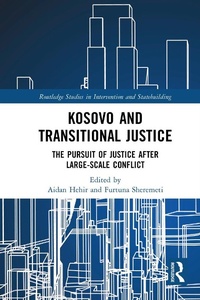
Kosovo and Transitional Justice
The Pursuit of Justice After Large Scale-Conflict
1st Edition
Published on 15. July 2021
232 pages
978-1-000-40994-9 (ISBN)
Description

This book analyses efforts to achieve justice in Kosovo for victims of crimes committed during the conflict in the 1990s, relating this to broader debates on transitional justice.
The war in Kosovo has come under the jurisdiction of a number of mechanisms which fit within the broader framework of transitional justice. These include international tribunals (the ICTY), international organisations with judicial mandates within Kosovo (UNMIK and EULEX), ad-hoc hybrid tribunals (the Kosovo Specialist Chambers) and truth-seeking mechanisms (RECOM and the Truth and Reconciliation Commission). Collectively, these developments make Kosovo a profoundly important case study on the contemporary efficacy of transitional justice. This volume analyses the nature and impact of the various mechanisms employed to date in Kosovo to determine their effects within the country, and their broader international significance. Various critical issues are examined through an exploration of the institutional mechanisms employed in each case, their coherence with existing theories on "best practice" principles, and the broader implications of their efficacy in Kosovo.
This book will be of much interest to students of transitional justice, statebuilding, Balkan politics, and International Relations in general.
The war in Kosovo has come under the jurisdiction of a number of mechanisms which fit within the broader framework of transitional justice. These include international tribunals (the ICTY), international organisations with judicial mandates within Kosovo (UNMIK and EULEX), ad-hoc hybrid tribunals (the Kosovo Specialist Chambers) and truth-seeking mechanisms (RECOM and the Truth and Reconciliation Commission). Collectively, these developments make Kosovo a profoundly important case study on the contemporary efficacy of transitional justice. This volume analyses the nature and impact of the various mechanisms employed to date in Kosovo to determine their effects within the country, and their broader international significance. Various critical issues are examined through an exploration of the institutional mechanisms employed in each case, their coherence with existing theories on "best practice" principles, and the broader implications of their efficacy in Kosovo.
This book will be of much interest to students of transitional justice, statebuilding, Balkan politics, and International Relations in general.
Reviews / Votes
'This book will rapidly become a standard point of reference for anyone seeking an understanding of the immense crimes of war and their mainly civilian victims during the war in Kosovo. The book highlights the international attempts to record the facts surrounding the horrific atrocities that took place, in particular also sexual violence, and to establish the responsibility of their authors-a process that has remained sadly unbalanced, patchy and incomplete to this day.'--Marc Weller, Director of the Lauterpacht Centre for International Law, University of Cambridge'Kosovo was a highwater mark of international transitional administration of a country after war and the former Yugoslavia a highwater mark for the level of international and national prosecutions of war crimes. That makes this treasure trove of information and insights about transitional justice in Kosovo such an important book. The contributors have deep knowledge and sophistication about what kind of justice Kosovo's victims received and the implications of this for the most central debates about the character of transitional justice. I thought I knew a bit about conflict in Kosovo, but learned so much that was new by reading this book. Those who engage with it will see more clearly how profound are the paradoxes of transitional justice.'--John Braithwaite, Australian National University
'The pursuit of justice, healing and repair after large-scale and devastating conflict is a never-ending, perpetually painful and rather frustrating journey. This book reckons unabashedly with this journey by critically analyzing the painstakingly ambivalent and complex work of 'justice' of both international and local judicial mechanisms and courts, but also by bringing into the picture alternative and courageous narratives in the search for justice as exemplified through grassroots and survivor-led activism and artistic engagements in Kosovo. Intellectually engaging and highly informative, this book must become required reading for all interested in transitional justice more generally and the case of the Kosovo conflict in particular.'--Brunilda Pali, Katholieke Universiteit Leuven
More details
Series
Edition
1. Auflage
Language
English
Place of publication
London
United Kingdom
Publishing group
Taylor & Francis Ltd
Target group
College/higher education
ISBN-13
978-1-000-40994-9 (9781000409949)
Copyright in bibliographic data and cover images is held by Nielsen Book Services Limited or by the publishers or by their respective licensors: all rights reserved.
Schweitzer Classification
Other editions
Additional editions
Aidan Hehir | Furtuna Sheremeti
Kosovo and Transitional Justice
The Pursuit of Justice After Large Scale-Conflict
Book
05/2023
1st Edition
Routledge
€65.20
Shipment within 15-20 days
Aidan Hehir | Furtuna Sheremeti
Kosovo and Transitional Justice
The Pursuit of Justice After Large Scale-Conflict
Book
07/2021
1st Edition
Routledge
€206.30
Shipment within 15-20 days
Persons
Dr Aidan Hehir is a reader in International Relations at the University of Westminster, UK.
Furtuna Sheremeti is a doctoral researcher at the Institute of Criminology in KU Leuven, Belgium.
Furtuna Sheremeti is a doctoral researcher at the Institute of Criminology in KU Leuven, Belgium.
Content
Introduction: power and the pursuit of "justice" in Kosovo Chapter 1 - Kosovo on trial at the ICTY: narratives of war, history, justice and injustice Chapter 2 - Frustrated justice: revisiting the ICTY's involvement in adjudicating crimes committed during the Kosovo war Chapter 3 - The effectiveness of UNMIK and EULEX in the pursuit of criminal justice in Kosovo Chapter 4 - Reparations after large-scale conflicts: can Kosovo learn from international courts and practises?' Chapter 5 - Authors of their own transitional justice: survivors of wartime sexual violence Chapter 6 - Sexual violence as a tool of war in Kosovo: where do we stand over 20 years later? Chapter 7 - The "re-appearing of the feminine": Kosovo's theatres of war memories after Yugoslavia Chapter 8 - A critical analysis of the evolution of the Kosovo Specialist Chambers and the Specialist Prosecutor's Office and the rationale for their existence Chapter 9 - The strategy behind the Serbian government's support for the Kosovo Specialist Chambers Chapter 10 - The strategic logic of ethnic cleansing in post-intervention Kosovo and its Implications for the Kosovo Specialist Chambers Conclusion: addressing the lack of justice in Kosovo
