

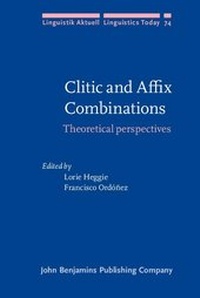
Clitic and Affix Combinations
Theoretical perspectives
1st Edition
Published on 18. March 2005
VIII, 390 pages
978-90-272-9459-3 (ISBN)
Description

In this volume, the relationship between clitics and affixes and their combinatorial properties has led to a serious discussion of the interface between syntax, morphology, semantics, and phonology that draws on a variety of theoretical perspectives (e.g., HPSG, Optimality Theory, Minimalism). Clitic/affix phenomena provide a rich range of data, not only for the identification of an affix vs. clitic, but also for the best way to explain ordering constraints, some of which are contradictory. A range of languages are considered, including Romance and Slavic languages, as well as Turkish, Greek, Icelandic, Korean, and Passamaquoddy. Moreover, several articles consider dialectal microparameterization, notably in Spanish, French, and Occitan. This volume thus reflects current debate on issues such as clitic ordering constraints, the relationship of clitics to inalienable possession and the left periphery, and templatic approaches to affixes vs. clitics while examining a broad range of languages.
More details
Other editions
Additional editions
Book
03/2005
John Benjamins Publishing Co
€148.40
Shipment within 10-15 days
Persons
Content
- Clitic and Affix Combinations
- Editorial page
- Title page
- LCC data
- Table of contents
- Names and addresses of contributors
- Clitic ordering phenomena
- 1. Affixes and clitics
- 2. Why is ''ordering'' an interesting issue?
- 3. Representative approaches to clitic combinations
- 3.1. Templatic approaches
- 3.2. A representational approach to clitic ordering
- 4. Future inquiries
- Notes
- References
- I. Clitic sequences
- Romance clitic clusters
- 1. Introduction
- 2. Basic assumptions
- 2.1. Feature inventory of French clitics
- 2.2. The representation of features
- 2.3. Constraints on features and the representations
- 3. Clitic movement
- 4. Clitic order
- 5. Spanish clitic clusters
- 6. The prominence of Case
- 6.1. Why does spurious se occur?
- 6.2. Evidence from Italian
- 6.3. Failure of double clitics in French
- 7. Clitic cooccurrence restrictions
- 8. Conclusion
- Notes
- References
- Constraining Optimality
- 1. Introduction
- 2. Grimshaw's OT accounts of clitic selection and ordering
- 2.1. Universal Markedness Hierarchies
- 2.2. A 'flat' feature inventory
- 2.3. ''Fault lines'' in Grimshaw's lexicon
- 3. An empirical 'detail': Clitic sequences are not always fixed
- 3.1. Number asymmetry
- 3.2. Theoretical and empirical desiderata
- 4. A Feature Geometry for Spanish clitics
- 5. Linearizing the geometry
- 5.1. Variable clitic orders
- 6. Conclusions
- Notes
- References
- The syntax of clitic climbing in Czech
- 1. Introduction
- 2. Clitic climbing and restructuring
- 2.1. Introduction
- 2.2. Clausal complements in Czech
- 2.3. Clitic climbing
- 2.4. Structure of restructuring infinitives
- 3. Clitic climbing, Case, and agreement
- 3.1. Interaction between Case and climbing
- 3.2. The Case Licensing Generalization
- 3.3. The A-system
- 3.4. The Person-Case Constraint
- 3.5. Appendix: The double dative ban
- 4. Conclusion: Clitic movement in the syntax
- Notes
- References
- Romance clitic clusters
- The facts
- 1. Theoretical assumptions
- 1.1. Affixation and case checking
- 1.2. On the derivation of clusters
- 1.3. On direct object first and second persons
- 2. Generalization to Romance
- 2.1. Parametrization of Morphological Opacity
- 2.2. Syntactic reduction of morphological opacity
- 2.3. Generalization to oblique clusters
- 2.4. On the autonomy of morphological opacity effects
- 2.5. On case syncretism
- 3. Discussion of the case-syncretic group
- 3.1. Valencia Catalan, Spanish
- 3.2. Portuguese and Galician
- 3.3. Italian, Basilicatese, Piedmontese, Sardinian, Veneto
- 3.4. Modern Occitan
- 3.5. Modern Rumanian
- 4. Discussion of the conservative group
- 4.1. Aragonese, Majorca Catalan
- 4.2. Modern Provencal: Nicois
- 4.3. Old French/Occitan/Provencal
- Modern Occitan: Limousin, Gévaudan, Béarnais
- 4.4. Corsican
- 5. Mixed orderings
- 5.1. Aragonese
- 5.2. Barcelona and Minorca Catalan
- 5.3. Modern Gascon
- 5.4. Modern French
- 6. Related theoretical issues and unsolved problems
- 6.1. On morphological case assignment
- 6.2. Causatives and Generalized affixation
- 6.3. French third person constraint on cluster switch
- 6.4. A syntactic reduction of the Weak Person-Case constraint
- 6.5. Syntactic reduction of the csp
- 6.6. Reducing morphological case complexity
- 7. Concluding remarks: On ``strongly lexicalist'' theories
- Notes
- References
- Strong and Weak Person Restrictions
- Introduction
- 1. Two versions of the Person-Case Constraint
- 2. The restriction on nominative objects
- 3. The Strong Version of the PCC and the restriction on nominative objects in Icelandic: Similarities and Differences
- 4. A common analysis in terms of split feature checking
- 5. The Weak Version of the PCC and the Multiple Agree parameter
- 6. A comparison to inverse systems
- 7. Summary
- Notes
- References
- II. Clitics vs. Affixation
- Non-morphological determination of nominal particle ordering in Korean
- 1. Introduction - Morphosyntactic status of nominal particles
- 2. Lexicalist critique of syntactic analyses
- 2.1. Non-local c-selection
- 2.2. Problem of underlying structure
- 2.3. Paradox of movement and selection
- 3. Lexicalist solution of the problems - An evaluation
- 3.1. Lexicalist solution using morphological templates
- 3.2. Is Korean nominal morphology templatic?
- 4. Non-morphological accounts of nominal particle ordering
- 4.1. -kkeyse is a Postposition
- 4.2. The Copula is not a Z-Lim
- 5. Conclusion
- Notes
- References
- Clitic positions within the left periphery
- 1. Introduction
- 2. The proposal and data
- 3. The analysis
- 3.1. Reconstruction effects
- 4. Phonological filter
- Notes
- References
- The Wh/Clitic Connection
- 1. Outline
- 2. Multiple Wh-Fronting: Some Refinements
- 3. Clitic placement
- 4. Accounting for the Wh/Clitic-Connection
- 5. Conclusion
- Notes
- References
- Morphosyntax of two Turkish subject pronominal paradigms
- Introduction
- 1. Pronominal subject endings in Turkish
- 1.1. The basics
- 1.2. Ending order variation
- 2. Clitics vs. lexical affix-hood of the Turkish subject pronominal endings
- 2.1. Phonological evidence
- 2.2. Suspended affixation
- 2.3. Conclusion
- 3. Historical perspective
- 4. Analysis
- 4.1. Morphological realization of the k-paradigm endings
- 4.2. Syntactic realization of the z-paradigm
- 4.3. The behavior of the plural suffix -lEr
- 5. Notes on the morphology-syntax interface in the analysis
- 6. Discussion
- 7. Conclusion
- Notes
- References
- On the syntax of doubling
- Introduction
- 1. Inalienability and context confinement
- 2. A separation of conceptual and intentional relations
- 3. The Inalienable Double Hypothesis
- 4. Syntactic questions faced by the IDH
- 5. Consequences of D incorporation
- 6. Conclusions
- Acknowledgements
- Notes
- References
- Author index
- Languages index
- Subject index
- The series Linguistik Aktuell/Linguistics Today
