

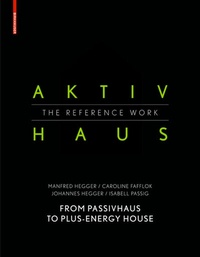
Aktivhaus - The Reference Work
Description

Das erste umfassende Grundlagenwerk über energieautarke Aktivhäuser
Das Aktivhaus ist eine logische Weiterentwicklung bisheriger Gebäudestandards. Es gewinnt regenerativ Energie aus Sonne und Wind mit dem Ziel, möglichst den eigenen Energiebedarf vollständig zu decken. Die Grundlagen der Aktiv-haus-Idee werden in diesem Standardwerk ausführlich beschrieben und dienen allen am Bau Beteiligten als Leitfaden zur Planung von Aktivhäusern.
Von den Grundsätzen des nachhaltigen und energieeffizienten Bauens bis hin zu Planungswerkzeugen und technischen Details erfährt der Leser, was Aktivhäuser ausmacht, wie man sie entwickelt und welche Komponenten bei ihrer Umsetzung infrage kommen. 14 realisierte Bauten aus den Bereichen Wohnungsbau, Nichtwohnungsbau, Neubau und Sanierung veranschaulichen die Aktivhaus-Architektur.
More details
Other editions
Additional editions
Persons
Content
- Intro
- Contents
- Foreword
- The Aktivhaus Principle
- Design
- Principles
- Basic needs of building and living
- The role of energy
- Consequences of energy use
- Population growth and resource conservation
- The price of energy
- Energy in the building sector
- Building energy standards in selected countries
- Energy in a broader sense
- Electrical energy
- Embodied energy
- Contributing to sustainable development
- Efficiency
- Eco-effectiveness
- Sufficiency
- Aktivhaus
- Strategies
- Programme
- Construction measures
- Building services
- Energy generation
- One planning strategy - no energy standard
- Emotions
- Energy balance
- Developing the building energy balance
- Principles of an energy balance
- Balance scope
- Balance criterion
- Balance boundaries
- Balance interval
- Balance regulations
- An overview of building energy standards
- Efficiency House
- Passivhaus
- Nearly zero-energy and zero-energy house
- Efficiency House Plus
- Active House
- MINERGIE standard
- Italy
- Beyond energy
- Life cycle considerations
- 2,000-watt society
- Other energy balance fields
- Sustainability evaluation
- Aktivhaus design
- Fundamental requirements of the building project
- Interior requirements
- External boundary conditions
- Development of a conceptual idea
- Design strategies
- Building design
- Building envelope design
- Energy supply
- Examples of integrated design
- New building
- Refurbishment
- Toolkit
- Building envelope
- Receiving and retaining heat
- Insulation
- Windows and glazing
- Ventilation
- Solar shading
- Building envelope qualities
- Minimising cold bridges
- Airtightness
- Storage mass
- Generating energy
- Photovoltaics
- Solar thermal technology
- Geothermal technology
- Heat pumps
- Lighting
- Natural lighting / daylight
- Artificial lighting
- Qualities and details
- Building services
- Collecting and converting renewable energies
- Solar radiation
- Biomass
- Water, groundwater, ground
- Wind
- Outside air
- Waste heat
- Generation of electrical energy, heat and cold
- Storage and distribution
- Heat
- Cold
- Moisture
- Electricity
- Heat and cold transfer
- Control and regulation
- Installation systems
- User intervention
- Load management, smart grid
- Monitoring
- Projects
- Presentation of the projects
- Energy-Plus House Luchliweg, Münsingen (CH)
- LichtAktiv Haus, Hamburg (DE)
- Zero-Energy House, Driebergen (NL)
- Energy Flex House, Taastrup, Copenhagen (DK)
- Home for Life, Aarhus (DK)
- Residential and office buildings, Zurich (CH)
- Kraftwerk B, Bennau (CH)
- Multifamily dwelling, Dübendorf (CH)
- Solar-Werk 01, Kassel (DE)
- Positions and Perspectives
- Positions
- Which is the more sustainable solution: the passive or the active building concept? Interview with Dr. Winfried Heusler
- Tomorrow's sustainable buildings, today: a holistic approach Interview with Michael K. Rasmussen
- Energy efficiency in the heating market Interview with Prof. Martin Viessmann
- Perspectives
- Performance
- Aktiv-Stadthaus, Frankfurt (DE)
- Users and operation
- The Aktivhaus in existing contexts
- From Aktivhaus to Active City
- Sustainable building as model
- Choice of materials
- Construction
- Site selection
- Building programme
- Planning and design
- Conclusion
- Appendix
- Glossary
- Bibliography and Illustration credits
- Index
- Authors
