

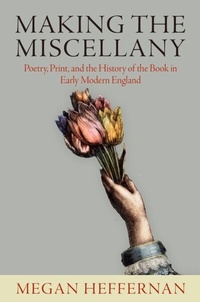
Making the Miscellany
Poetry, Print, and the History of the Book in Early Modern England
1st Edition
Published on 5. March 2021
336 pages
978-0-8122-9802-4 (ISBN)
Description

In Making the Miscellany Megan Heffernan examines the poetic design of early modern printed books and explores how volumes of compiled poems, which have always existed in practice, responded to media change in sixteenth- and seventeenth-century England. Heffernan's focus is not only the material organization of printed poetry, but also how those conventions and innovations of arrangement contributed to vernacular poetic craft, the consolidation of ideals of individual authorship, and centuries of literary history.
The arrangement of printed compilations contains a largely unstudied and undertheorized archive of poetic form, Heffernan argues. In an evolving system of textual transmission, compilers were experimenting with how to contain individual poems within larger volumes. By paying attention to how they navigated and shaped the exchanges between poems and their organization, she reveals how we can witness the basic power of imaginative writing over the material text.
Making the Miscellany is also a study of how this history of textual design has been differently told by the distinct disciplines of bibliography or book history and literary studies, each of which has handled-and obscured-the formal qualities of early modern poetry compilations and the practices that produced them. Revisiting these editorial and critical approaches, this book recovers a moment when compilers, poets, and readers were alert to a poetics of organization that exceeded the limits of the individual poem.
The arrangement of printed compilations contains a largely unstudied and undertheorized archive of poetic form, Heffernan argues. In an evolving system of textual transmission, compilers were experimenting with how to contain individual poems within larger volumes. By paying attention to how they navigated and shaped the exchanges between poems and their organization, she reveals how we can witness the basic power of imaginative writing over the material text.
Making the Miscellany is also a study of how this history of textual design has been differently told by the distinct disciplines of bibliography or book history and literary studies, each of which has handled-and obscured-the formal qualities of early modern poetry compilations and the practices that produced them. Revisiting these editorial and critical approaches, this book recovers a moment when compilers, poets, and readers were alert to a poetics of organization that exceeded the limits of the individual poem.
Reviews / Votes
"In Making the Miscellany, Megan Heffernan makes a significant contribution to the study of the poetic design of early modern printed books, how volumes of compiled poems responded to changes in media, the material organization of printed poetry, the contribution of conventions and innovations of arrangement to vernacular poetic craft, and the consolidation of individual authorship...Heffernan has untangled the tangled tale of book matter, design, printing, culture, and history in relation to the making and reading of poetry then and now." (Renaissance and Reformation) "Upon first notice,Making the Miscellany appears as another well-stated and strong scholarly contribution to literary studies, but that would be deceiving; it is much more. The author has thrown new light upon previously understood conventions and scholarship focused on poetry and compilations and miscellanies of poetry...Beyond the in-depth scholarly apparatus utilized inMaking the Miscellany, the author has provided a very engaging and highly readable style. Rich in technical asides in text and notes, this book opens up new scholarly ground and serves as a requisite and indispensable measure of scholarship that traverses different scholarship fields as well as opportunities for further exploration." (Publishing Research Quarterly) "By decentering the author as the imagined source and originator of the poetry collection, Megan Heffernan is able to attend to the agency of stationers and compilers, as well as the agency of poetry itself. In one of her most exciting claims, Heffernan argues that the poetry shapes the material form of the printed book in these early poetry collections. Indeed, she shows, these innovative arrangements shaped the development of vernacular poetic craft and notions of authorship in the seventeenth century and after." (Jenny C. Mann, author of The Trials of Orpheus: Poetry, Science, and the Early Modern Sublime)More details
Series
Language
English
Place of publication
Pennsylvania
United States
Target group
College/higher education
Illustrations
33 illus.
File size
11,55 MB
ISBN-13
978-0-8122-9802-4 (9780812298024)
Copyright in bibliographic data and cover images is held by Nielsen Book Services Limited or by the publishers or by their respective licensors: all rights reserved.
Schweitzer Classification
Other editions
Additional editions
Megan Heffernan
Making the Miscellany
Poetry, Print, and the History of the Book in Early Modern England
Book
03/2021
University of Pennsylvania Press
€60.50
Shipment within 10-20 days
Person
Megan Heffernan is Associate Professor of English at DePaul University.
Content
- Cover
- Making the Miscellany
- Title
- Copyright
- CONTENTS
- Note on Transcriptions
- Introduction. Delight in Disorder: The Miscellany as History
- Chapter 1. Plain Parcels: The Poetics of Compiling in Tottel's Songes and Sonettes
- Chapter 2. Stationers' Figures: Mixed Forms and Material Poetics
- Chapter 3. Gascoigne's Inventions: Inference and Compiled Form
- Chapter 4. These Ensuing Sonnets: Genre and Mediation After Sidney
- Chapter 5. Books Called Poems: Authorship and the Miscellany
- Coda. Shakespeare's Miscellanies: The Poetic History of the Book
- Notes
- Selected Bibliography
- Index
- Acknowledgments
