

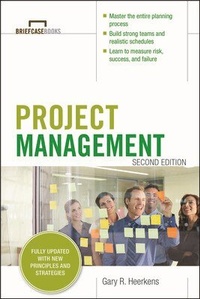
Project Management, Second Edition (Briefcase Books Series)
2nd Edition
Published on 16. January 2014
235 pages
978-0-07-181852-0 (ISBN)
Available for download
Description

ON TIME, ON BUDGET. MANAGE EVERY PROJECT LIKE A PROIn today's environment of tight turnarounds and even tighter budgets, the effective project manager is often considered the most valuable member of a workplace team.Project Management, Second Edition, provides a step-by-step introduction to the tools and techniques necessary to successfully spearhead your next project. This new edition has everything that made the original so popular, plus it has been updated to reflect new principles and strategies in team building, planning, estimating costs, managing project interfaces, and more--providing you with the kind of business savvy today's project manager is expected to possess. Learn how to: - Stay on top of all aspects of your project: process, interpersonal, and organizational
- Forge a spirit of cooperation--and achievement--among diverse team members
- Manage all the contingencies--foreseen and unforeseen--that come up in every project
- Forge a spirit of cooperation--and achievement--among diverse team members
- Manage all the contingencies--foreseen and unforeseen--that come up in every project
More details
Other editions
Additional editions
Book
12/2013
2nd Edition
McGraw-Hill Professional
€23.70
Shipment within 15-20 days
Person
Content
- Cover
- Project Management, Second Edition
- Copyright Page
- Contents
- Acknowledgments
- Introduction
- 1. Congratulations! You're the Project Manager!
- The Accidental Project Manager
- What Might You Encounter Out There?
- About the Art and Science of Project Management
- About This Book
- Manager's Checklist for Chapter 1
- 2. An Overview of Projects and Project Management
- Project Management: The Business Perspective
- Project Management: The Process Perspective
- Project Management: The Interpersonal and Behavioral Perspective
- Project Management: The Organizational Management Perspective
- Defining Project Success
- Manager's Checklist for Chapter 2
- 3. About the Role of Project Manager
- The Inherent Responsibilities of a Project Manager
- Common Challenges You Can Expect to Face
- Skill Requirements of the Project Manager
- Functional Competencies of the Project Manager
- The Project Manager's "Unofficial" Job Duties
- The Value of Introspection and Self-Awareness
- Communication Skills and the Project Manager
- Conducting High-Quality Meetings
- Manager's Checklist for Chapter 3
- 4. How Companies Identify and Select the "Right" Projects
- Where Projects Should Come From
- Critical Process #1: Identify Projects Through a Needs Analysis
- Critical Process #2: Ensure a Solid Return on Investment
- Critical Process #3: Assess the Relative Value of Your Project
- Getting Off to a Good Start
- Manager's Checklist for Chapter 4
- 5. Planning and Estimating: The Foundation of Project Management
- An Introduction to Project Planning
- An Introduction to Estimating
- Manager's Checklist for Chapter 5
- 6. Defining and Launching Your Project
- A Common Challenge in Project Definition
- First, Thoroughly Understand the Problem, Need, or Opportunity
- Second, Determine the Optimum Solution to the Problem, Need, or Opportunity
- Third, Refine the Optimum Solution and Develop a Preliminary Project Plan
- Fourth, Formally Launch the Project
- The Unspoken Imperative: Evaluate the Political Environment
- Key Documentation Used in the Project Definition Stage
- Manager's Checklist for Chapter 6
- 7. Building and Maintaining an Effective Team
- The Mechanics of Building a Team
- Team Leadership Starts on Day 1!
- Getting the Most from Your Team
- Getting the Most from Individual Team Members
- Manager's Checklist for Chapter 7
- 8. Managing the Project Interfaces
- What Are Project Interfaces?
- Internal Stakeholders and Their Roles
- External Stakeholders and Their Roles
- Other Interfaces
- Special Considerations in Interface Management
- Manager's Checklist for Chapter 8
- 9. Preparing an Integrated Project Plan
- But First . Develop a Project Management Configuration Plan
- Identifying What Needs to Be Done (Scope Management)
- Identifying How Long It Will Take to Do Everything (Time Management)
- Identifying How Much You'll Spend (Cost Management)
- What About Project Management Software?
- Key Documentation Used to Develop an Integrated Project Plan
- Manager's Checklist for Chapter 9
- 10. Addressing Risk and Uncertainty
- Overview of Risk and Uncertainty
- Managing Risk: An Overview
- Step 1. Identifying What Can Hurt You (Risk Identification)
- Step 2. Assessing the Potential Damage (Risk Quantification)
- Step 3. Determining the Biggest Threats to Your Project (Risk Analysis)
- Step 4. Address the High-Threat Problems (Risk Response)
- Managing Project Risk Is a Mindset
- You Can't Fix Everything: Learn to Accommodate Uncertainty
- Manager's Checklist for Chapter 10
- 11. Ensuring Successful Project Execution
- What Project Control Really Means
- Establishing a Baseline of Measurement
- What Information Do You Need?
- How Do You Gather Information?
- Making Sure You Get Good Information
- Analyzing the Information
- How Should You React to the Information?
- Manager's Checklist for Chapter 11
- 12. Bringing the Project to a Successful Conclusion
- Early Termination: Not as Bad as You Think
- Management Challenges at the End of the Project
- Key Elements of Successful Project Closure
- A Few More Words About Punch List Management
- Developing a Project Completion Checklist
- Transferring What You've Learned to Others
- And So We've Reached the End
- Manager's Checklist for Chapter 12
- Index
- About the Author

