

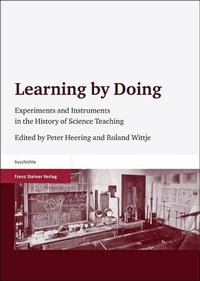
Learning by Doing
Description

"Learning by Doing" is about the history of experimentation in science education. The teaching of science through experiments and observation is essential to the natural sciences and its pedagogy. These have been conducted as both demonstration or as student exercises. The experimental method is seen as giving the student vital competence, skills and experiences, both at the school and at the university level. This volume addresses the historical development of experiments in science education, which has been largely neglected so far.
The contributors of "Learning by Doing" pay attention to various aspects ranging from economic aspects of instrument making for science teaching, to the political meanings of experimental science education from the 17th to the 20th century. This collected volume opens the field for further debate by emphasizing the importance of experiments for both, historians of science and science educators.
Reviews / Votes
"Insofern ist das Buch sehr empfehlenswert für Studenten und für Wissenschaftler im Berufsleben."More details
Other editions
Additional editions
Persons
ISNI:
Content
- Intro
- CONTENTS
- INTRODUCTION: NEGLECTED USES OF INSTRUMENTS AND EXPERIMENTS IN SCIENCE EDUCATION
- TOOLS FOR INVESTIGATION, TOOLS FOR INSTRUCTION: POTENTIAL TRANSFORMATIONS OF INSTRUMENTS IN THE TRANSFER FROM RESEARCH TO TEACHING
- THE AUDIENCE IS LISTENING: READING WRITING ABOUT LEARNING BY DOING.
- THE ROLE OF CHEMISTRY TEXTBOOKS AND TEACHING INSTITUTIONS IN FRANCE AT THE BEGINNING OF THE NINETEENTH CENTURY IN THE CONTROVERSY ABOUT BERTHOLLET'S CHEMICAL AFFINITIES
- INSTRUMENTS OF SCIENCE AND CITIZENSHIP: SCIENCE EDUCATION FOR DUTCH ORPHANS DURING THE LATE EIGHTEENTH CENTURY
- THE SCIENTIFIC CULTURE IN EIGHTEENTH TO NINETEENTH CENTURY GREEK SPEAKING COMMUNITIES: EXPERIMENTS AND TEXTBOOKS
- THE MAGIC LANTERN FOR SCIENTIFIC ENLIGHTENMENT AND ENTERTAINMENT
- THE ESTABLISHMENT AND DEVELOPMENT OF PHYSICS AND CHEMISTRY COLLECTIONS IN NINETEENTH-CENTURY SPANISH SECONDARY EDUCATION (1845 - 1861)1
- THE DEATH AND LIFE OF THE PLANT SPECIMEN
- LEARNING IN THE LABORATORY: THE INTRODUCTION OF "PRACTICAL" SCIENCE TEACHING IN ONTARIO'S HIGH SCHOOLS IN THE 1880S
- CHANGING IMAGES OF THE INCLINED PLANE, 1880-1920: A CASE STUDY OF A REVOLUTION IN AMERICAN SCIENCE EDUCATION
- REFORMING AMERICAN PHYSICS PEDAGOGY IN THE 1880S: INTRODUCING 'LEARNING BY DOING' VIA STUDENT LABORATORY EXERCISES
- THE EVOLUTION OF TEACHING INSTRUMENTS AND THEIR USE BETWEEN 1800 AND 1930
- "SIMPLEX SIGILLUM VERI": ROBERT POHL AND DEMONSTRATION EXPERIMENTS IN PHYSICS AFTER THE GREAT WAR
- THE ROLE OF INSTRUMENTS IN TEACHING SCIENCE: A MACHIAN VIEW
- NOTES ON CONTRIBUTORS
