

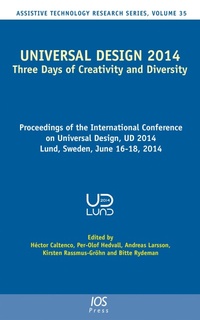
Universal Design 2014: Three Days of Creativity and Diversity
Proceedings of the International Conference on Universal Design, UD 2014 Lund, Sweden, June 16-18, 2014
1st Edition
Published on 15. May 2014
472 pages
978-1-61499-403-9 (ISBN)
Description

Universal Design, Design for All and Inclusive Design are all aimed at dismantling physical and social barriers to inclusion in all areas of life. Engagement in universal design is on the increase worldwide as practitioners and researchers explore creative and desirable solutions to shape the future of universal design products and practices. This book is a collection of the papers presented at UD2014, the International Conference on Universal Design, held in Lund, Sweden, in June 2014. The conference offered a creative and diverse meeting place for all participants to exchange knowledge, experiences and ideas, and to build global connections and creative networks for future work on universal design. The themes of UD2014 span many aspects of societal life, and the papers included here cover areas as diverse as architecture, public transport, educational and play environments, housing, universal workspaces, and the Internet of things, as well as designs and adaptations for assistive technology. The book clearly demonstrates the breadth of universal design and its ongoing adoption in societies all over the world, and will be of interest to anyone whose work involves building a more inclusive environment for all.
More details
Series
Language
English
Place of publication
London
Netherlands
Publishing group
IOS Press
Target group
Professional and scholarly
File size
10,92 MB
ISBN-13
978-1-61499-403-9 (9781614994039)
Copyright in bibliographic data and cover images is held by Nielsen Book Services Limited or by the publishers or by their respective licensors: all rights reserved.
Schweitzer Classification
Other editions
Additional editions
Per-Olof Hedvall | Andreas Larsson | Kirsten Rassmus-Groehn
Universal Design 2014: Three Days of Creativity and Diversity
Proceedings of the International Conference on Universal Design, UD 2014 Lund, Sweden, June 16-18, 2014
Book
05/2014
1st Edition
IOS Press,US
€177.07
Article exhausted; check different version
Content
- Title Page
- Preface
- Organization
- Contents
- Keynotes
- Variation, Multifoldness and Dynamics as the Mothers of Learning, Universality and Design
- A History of UD: Today's Exemplars and Tomorrow's Opportunities
- Universal Design, a Methodological Approach
- Accessible Information - How Hard Can It Be?
- Turning Societal Challenges into Creative Opportunities
- Towards the Universal Design of Tourism Services
- Long Papers
- All Senses Matter
- An Analytical Approach to People with Disabilities Mainstreaming Policies in Western and Arab Countries - Case Study: The American Swedish Example and the Egyptian Saudi
- Can Touch Substitute Vision? An Empirical Study About How the Visually Impaired Comprehend Shapes
- A Case Study for Universal Design in the Internet of Things
- Challenges with Assistive Technology Compatibility in Universal Design
- Creating Enabling Environments for Indian Elderly
- Methodology for Identification of Environmental Challenges
- Designing Universal Workspaces
- Developing Accessibility Plans: Methods and Tools. Case study
- Developing Evidence-Based Standards: A Case Study in Knowledge Translation
- Developing Interactive Interfaces for People with Developmental Disabilities to Be Used in Snoezelen Environments
- Developing Perception-Based Criteria of Inclusive (Architectural) Design
- DIY Home Modifications: An Australian Case-Study of Choice and Control
- Downsizers and Other Movers: The Housing Options, Choices and Dilemmas of Older Australians
- Effectiveness of Universal Design Education at Japanese Schools
- Effects of Color Combinations on the Discrimination Performance of Elderly People Using a LCD Monitor
- The Effects of Interactive Stairways on User Behavior and Safety
- Evidence on the Need of Housing Renovation in the Next Decades
- Inclusive Design for Assistive Technology
- Inclusive Housing (Lab) for All: A Home for Research, Demonstration and Information on Universal Design (UD)
- Inclusive Informal Campus Spaces Through Universal Design India Principles
- Making Architecture Visible to the Visually Impaired
- Making Navigation Simple? Initial User Studies Within the NavMem Project
- Mapping the Common Ground: Inclusive Playscapes for Children in Jerusalem - From Global to Local
- A Multi-Dimensional Framework for Understanding Accessible Built Environments for All in `All Weather Conditions': The Study of Small Towns in Nordic Region
- New Wheeled Mobility Aids and Parking Spaces
- Norwegian Acoustic Building Criteria and Socio-Acoustic Study on Accessibility for All
- The Potential of a Home Modification Strategy - A Universal Design Approach to Existing Housing
- Research Tools to Study Vulnerable Populations
- A Case of Designing Inclusive Spaces for Autism
- A Study on the Natural Manipulation of Multi-Touch Gestures for 3D Object Rotation Using a Large Touch Screen
- UD Principles for Home Appliances and Some Talking Devices to Support Independent Life for Dementia or MCI
- Universal Design and Accessibility: Towards Sustainable Built Environment in Malaysia
- Universal Design and Standardisation - Can User Participation Be Standardized?
- Universal Design as an Added Value for Heritage Valorization: The Cases of Brazil and Italy
- Universal Design Awareness of Survey Software Manufacturers
- Universal Design Education in India
- Design Challenge as Design Pedagogy
- Universal Design Practice in Malaysia: Architect's Perceptions of Its Terminology
- Usefulness in Architecture Accessibility, Inclusion and Usability as Spatial Sensory Experiences
- Using Elderly as Lead Users for Universal Engineering Design
- Using Technological-Pedagogical-and-Content Knowledge (TPACK) to Support Universal Design for Learning: A Case Study
- The Web as a Site of Intractable Governance
- Which Visual Cues are Important in Way-Finding? Measuring the Influence of Travel Mode on Visual Memory for Built Environments
- WorkStar: Involving Young Adults to Design a Serious Game for Working Life Integration
- Short Papers
- Accessible Service Network - Lauttasaari Case Study
- Challenges and Opportunities for Inclusive Design in Graduate Architecture
- Cinema and Theatre: Accessible Entertainment, with Benefits for All
- Elderly People's Opinions on Housing
- Exploring Issues for Indian Elderly Through Intense User Centric Design Studio
- Falls in the Elderly and Accessibility Traffic Environment in Neighborhood Districts
- Guidelines for Technology that Supports Physical Activity by Elderly
- How Usable Is the City for Older Bicyclists?
- The Missing Link in Implementation of Universal Design: The Barrier Between Legislative Framework and Architectural Practice
- Research on Continuity Among Assistive Devices for Personal Mobility of Visually Impaired Persons Around Crossings
- The Smart Bathroom: UD Through Integrating Physical and Digital Worlds
- A Tangible Interface for Information Exchange Addressing Deaf-Blind Users
- Universal Design for Indian Public Transportation Systems
- Universal Design for Mass Pilgrimage `Kumbh' at Ujjain, India - Berkeley Prize Teaching Fellowship 2013
- Universal Design in School Competitions
- Subject Index
- Author Index
