

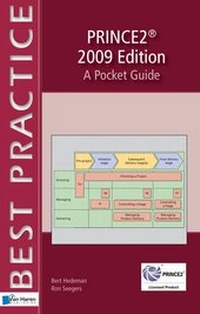
PRINCE2TM 2009 Edition - A Pocket Guide
1st Edition
Published on 11. September 2009
194 pages
978-90-8753-600-8 (ISBN)
Description

This Pocket Guide supplies a summary of the PRINCE2 method, to provide a quick introduction as well as a structured overview of the method;
Main target Group for this pocket guide is anyone who wants to get to know the method PRINCE2 or a methodical approach for project management. The book is also very useful for members of a project management team on a project using the PRINCE2 method. Furthermore this pocket guide can be used as literature for the preparation of the PRINCE2 2009 Edition Foundation exam;
This pocket guide is based on PRINCE2 2009 Edition;
This pocket book deals with processes, themes and principles within project management and PRINCE2.
Tailoring PRINCE2 explains how to fit the PRINCE2 method onto the specific project circumstances;
A complete but concise description of PRINCE2 2009 Edition, for anyone involved in projects or project management.
Available in English, Dutch and French.
More details
Other editions
Additional editions
Book
09/2009
Van Haren Publishing BV
€36.00
Shipment within 10-15 days
Content
1 - Colophon [Seite 5]
2 - Chapter 1 Introduction [Seite 10]
2.1 - 1.1 The purpose of this guide [Seite 10]
2.2 - 1.2 What is a project? [Seite 10]
2.3 - 1.3 Why are projects important? [Seite 11]
2.4 - 1.4 What makes a project different from regular business? [Seite 11]
2.5 - 1.5 What is project management? [Seite 12]
2.6 - 1.6 What does a Project Manager do? [Seite 13]
2.7 - 1.7 What is it all parties involved wish to control? [Seite 14]
3 - Chapter 2 Introduction to PRINCE2 [Seite 16]
3.1 - 2.1 Structure of PRINCE2 [Seite 17]
3.2 - 2.2 Related OGC guidance [Seite 18]
3.3 - 2.3 What PRINCE2 does not provide [Seite 19]
3.4 - 2.4 Benefits of PRINCE2 [Seite 20]
3.5 - 2.5 How to use this pocket guide [Seite 21]
4 - Chapter 3 PRINCE2 2009 Edition versus 2005 Edition [Seite 22]
4.1 - 3.1 Main structural changes [Seite 22]
4.2 - 3.2 Changes to the manual [Seite 23]
4.3 - 3.3 Detailed changes [Seite 23]
5 - Chapter 4 Principles [Seite 28]
5.1 - 4.1 Continued business justification [Seite 28]
5.2 - 4.2 Learn from experience [Seite 29]
5.3 - 4.3 Defined roles and responsibilities [Seite 29]
5.4 - 4.4 Manage by stages [Seite 30]
5.5 - 4.5 Manage by exception [Seite 30]
5.6 - 4.6 Focus on products [Seite 31]
5.7 - 4.7 Tailor to suit the project environment [Seite 31]
6 - Chapter 5 Introduction to PRINCE2 Themes [Seite 32]
7 - Chapter 6 Business Case [Seite 34]
7.1 - 6.1 Purpose [Seite 34]
7.2 - 6.2 Business Case defined [Seite 34]
7.3 - 6.3 PRINCE2 approach to Business Case [Seite 35]
7.4 - 6.4 The contents of a Business Case [Seite 37]
7.5 - 6.5 Responsibilities of the Business Case theme [Seite 39]
8 - Chapter 7 Organization [Seite 40]
8.1 - 7.1 Purpose [Seite 40]
8.2 - 7.2 Organization defined [Seite 40]
8.3 - 7.3 Levels of organization [Seite 41]
8.4 - 7.4 Project management team [Seite 43]
8.5 - 7.5 Communication Management Strategy [Seite 46]
9 - Chapter 8 Quality [Seite 48]
9.1 - 8.1 Purpose [Seite 48]
9.2 - 8.2 Quality definitions [Seite 48]
9.3 - 8.3 Quality management [Seite 49]
9.4 - 8.4 PRINCE2 approach to quality [Seite 51]
9.5 - 8.5 Responsibilities of the Quality theme [Seite 53]
10 - Chapter 9 Plans [Seite 54]
10.1 - 9.1 Purpose [Seite 54]
10.2 - 9.2 Plans defined [Seite 54]
10.3 - 9.3 PRINCE2 approach to plans [Seite 56]
10.4 - 9.4 Product-based planning technique [Seite 57]
10.5 - 9.5 Responsibilities of the Plans theme [Seite 60]
11 - Chapter 10 Risks [Seite 62]
11.1 - 10.1 Purpose [Seite 62]
11.2 - 10.2 Risk defined [Seite 62]
11.3 - 10.3 Risk Management Strategy [Seite 63]
11.4 - 10.4 Risk Register [Seite 63]
11.5 - 10.5 Risk management procedures [Seite 64]
11.6 - 10.6 Responsibilities of the Risk theme [Seite 68]
12 - Chapter 11 Change [Seite 70]
12.1 - 11.1 Purpose [Seite 70]
12.2 - 11.2 Change defined [Seite 70]
12.3 - 11.3 PRINCE2 approach to Change [Seite 71]
12.4 - 11.4 Configuration Management procedure [Seite 73]
12.5 - 11.5 Issue and change control procedure [Seite 74]
12.6 - 11.6 Responsibilities of the Change theme [Seite 76]
13 - Chapter 12 Progress [Seite 78]
13.1 - 12.1 Purpose [Seite 78]
13.2 - 12.2 Progress defined [Seite 78]
13.3 - 12.3 Management by Exception [Seite 79]
13.4 - 12.4 PRINCE2 approach to Progress [Seite 79]
13.5 - 12.5 Delegating authority [Seite 79]
13.6 - 12.6 Management stages [Seite 81]
13.7 - 12.7 Event- and time-driven controls [Seite 82]
13.8 - 12.8 Raising exceptions [Seite 84]
13.9 - 12.9 Responsibilities of the Progress theme [Seite 85]
14 - Chapter 13 Introduction to PRINCE2 processes [Seite 86]
14.1 - 13.1 Pre-project [Seite 87]
14.2 - 13.2 Initiation stage [Seite 88]
14.3 - 13.3 Subsequent delivery stage(s) [Seite 88]
14.4 - 13.4 Final delivery stage [Seite 88]
15 - Chapter 14 Starting up a Project [Seite 90]
15.1 - 14.1 Purpose [Seite 90]
15.2 - 14.2 Objectives [Seite 91]
15.3 - 14.3 Context [Seite 91]
15.4 - 14.4 Activities and recommended actions [Seite 91]
16 - Chapter 15 Directing a Project [Seite 96]
16.1 - 15.1 Purpose [Seite 96]
16.2 - 15.2 Objectives [Seite 96]
16.3 - 15.3 Context [Seite 97]
16.4 - 15.4 Activities and recommended actions [Seite 97]
17 - Chapter 16 Initiating a Project [Seite 100]
17.1 - 16.1 Purpose [Seite 100]
17.2 - 16.2 Objectives [Seite 100]
17.3 - 16.3 Context [Seite 101]
17.4 - 16.4 Activities and recommended actions [Seite 101]
18 - Chapter 17 Controlling a Stage [Seite 106]
18.1 - 17.1 Purpose [Seite 106]
18.2 - 17.2 Objectives [Seite 106]
18.3 - 17.3 Context [Seite 107]
18.4 - 17.4 Activities and recommended actions [Seite 107]
19 - Chapter 18 Managing Product Delivery [Seite 112]
19.1 - 18.1 Purpose [Seite 112]
19.2 - 18.2 Objectives [Seite 112]
19.3 - 18.3 Context [Seite 113]
19.4 - 18.4 Activities and recommended actions [Seite 113]
20 - Chapter 19 Managing a Stage Boundary [Seite 116]
20.1 - 19.1 Purpose [Seite 116]
20.2 - 19.2 Objectives [Seite 117]
20.3 - 19.3 Context [Seite 117]
20.4 - 19.4 Activities and recommended actions [Seite 117]
21 - Chapter 20 Closing a Project [Seite 122]
21.1 - 20.1 Purpose [Seite 122]
21.2 - 20.2 Objectives [Seite 123]
21.3 - 20.3 Context [Seite 123]
21.4 - 20.4 Activities and recommended actions [Seite 124]
22 - Chapter 21 Tailoring PRINCE2 [Seite 128]
22.1 - 21.1 What is tailoring? [Seite 128]
22.2 - 21.2 General approach to tailoring [Seite 129]
22.3 - 21.3 Examples of tailoring [Seite 130]
22.4 - 21.4 Projects in a programme environment [Seite 130]
22.5 - 21.5 Project scale [Seite 133]
22.6 - 21.6 Commercial customer/supplier environment [Seite 135]
22.7 - 21.7 Multi-organization projects [Seite 137]
22.8 - 21.8 Project type [Seite 137]
22.9 - 21.9 Sector differences [Seite 139]
22.10 - 21.10 Bodies of Knowledge [Seite 139]
23 - Appendix A. Outline Product Descriptions for the management products [Seite 142]
24 - Appendix B. Roles and responsibilities [Seite 160]
25 - Appendix C. Example of product-based planning [Seite 168]
26 - Appendix D. Glossary [Seite 171]
27 - Appendix E. Governance [Seite 191]
28 - Appendix F. Organizations [Seite 192]
29 - Appendix G. References [Seite 193]
30 - About the authors [Seite 193]
2 - Chapter 1 Introduction [Seite 10]
2.1 - 1.1 The purpose of this guide [Seite 10]
2.2 - 1.2 What is a project? [Seite 10]
2.3 - 1.3 Why are projects important? [Seite 11]
2.4 - 1.4 What makes a project different from regular business? [Seite 11]
2.5 - 1.5 What is project management? [Seite 12]
2.6 - 1.6 What does a Project Manager do? [Seite 13]
2.7 - 1.7 What is it all parties involved wish to control? [Seite 14]
3 - Chapter 2 Introduction to PRINCE2 [Seite 16]
3.1 - 2.1 Structure of PRINCE2 [Seite 17]
3.2 - 2.2 Related OGC guidance [Seite 18]
3.3 - 2.3 What PRINCE2 does not provide [Seite 19]
3.4 - 2.4 Benefits of PRINCE2 [Seite 20]
3.5 - 2.5 How to use this pocket guide [Seite 21]
4 - Chapter 3 PRINCE2 2009 Edition versus 2005 Edition [Seite 22]
4.1 - 3.1 Main structural changes [Seite 22]
4.2 - 3.2 Changes to the manual [Seite 23]
4.3 - 3.3 Detailed changes [Seite 23]
5 - Chapter 4 Principles [Seite 28]
5.1 - 4.1 Continued business justification [Seite 28]
5.2 - 4.2 Learn from experience [Seite 29]
5.3 - 4.3 Defined roles and responsibilities [Seite 29]
5.4 - 4.4 Manage by stages [Seite 30]
5.5 - 4.5 Manage by exception [Seite 30]
5.6 - 4.6 Focus on products [Seite 31]
5.7 - 4.7 Tailor to suit the project environment [Seite 31]
6 - Chapter 5 Introduction to PRINCE2 Themes [Seite 32]
7 - Chapter 6 Business Case [Seite 34]
7.1 - 6.1 Purpose [Seite 34]
7.2 - 6.2 Business Case defined [Seite 34]
7.3 - 6.3 PRINCE2 approach to Business Case [Seite 35]
7.4 - 6.4 The contents of a Business Case [Seite 37]
7.5 - 6.5 Responsibilities of the Business Case theme [Seite 39]
8 - Chapter 7 Organization [Seite 40]
8.1 - 7.1 Purpose [Seite 40]
8.2 - 7.2 Organization defined [Seite 40]
8.3 - 7.3 Levels of organization [Seite 41]
8.4 - 7.4 Project management team [Seite 43]
8.5 - 7.5 Communication Management Strategy [Seite 46]
9 - Chapter 8 Quality [Seite 48]
9.1 - 8.1 Purpose [Seite 48]
9.2 - 8.2 Quality definitions [Seite 48]
9.3 - 8.3 Quality management [Seite 49]
9.4 - 8.4 PRINCE2 approach to quality [Seite 51]
9.5 - 8.5 Responsibilities of the Quality theme [Seite 53]
10 - Chapter 9 Plans [Seite 54]
10.1 - 9.1 Purpose [Seite 54]
10.2 - 9.2 Plans defined [Seite 54]
10.3 - 9.3 PRINCE2 approach to plans [Seite 56]
10.4 - 9.4 Product-based planning technique [Seite 57]
10.5 - 9.5 Responsibilities of the Plans theme [Seite 60]
11 - Chapter 10 Risks [Seite 62]
11.1 - 10.1 Purpose [Seite 62]
11.2 - 10.2 Risk defined [Seite 62]
11.3 - 10.3 Risk Management Strategy [Seite 63]
11.4 - 10.4 Risk Register [Seite 63]
11.5 - 10.5 Risk management procedures [Seite 64]
11.6 - 10.6 Responsibilities of the Risk theme [Seite 68]
12 - Chapter 11 Change [Seite 70]
12.1 - 11.1 Purpose [Seite 70]
12.2 - 11.2 Change defined [Seite 70]
12.3 - 11.3 PRINCE2 approach to Change [Seite 71]
12.4 - 11.4 Configuration Management procedure [Seite 73]
12.5 - 11.5 Issue and change control procedure [Seite 74]
12.6 - 11.6 Responsibilities of the Change theme [Seite 76]
13 - Chapter 12 Progress [Seite 78]
13.1 - 12.1 Purpose [Seite 78]
13.2 - 12.2 Progress defined [Seite 78]
13.3 - 12.3 Management by Exception [Seite 79]
13.4 - 12.4 PRINCE2 approach to Progress [Seite 79]
13.5 - 12.5 Delegating authority [Seite 79]
13.6 - 12.6 Management stages [Seite 81]
13.7 - 12.7 Event- and time-driven controls [Seite 82]
13.8 - 12.8 Raising exceptions [Seite 84]
13.9 - 12.9 Responsibilities of the Progress theme [Seite 85]
14 - Chapter 13 Introduction to PRINCE2 processes [Seite 86]
14.1 - 13.1 Pre-project [Seite 87]
14.2 - 13.2 Initiation stage [Seite 88]
14.3 - 13.3 Subsequent delivery stage(s) [Seite 88]
14.4 - 13.4 Final delivery stage [Seite 88]
15 - Chapter 14 Starting up a Project [Seite 90]
15.1 - 14.1 Purpose [Seite 90]
15.2 - 14.2 Objectives [Seite 91]
15.3 - 14.3 Context [Seite 91]
15.4 - 14.4 Activities and recommended actions [Seite 91]
16 - Chapter 15 Directing a Project [Seite 96]
16.1 - 15.1 Purpose [Seite 96]
16.2 - 15.2 Objectives [Seite 96]
16.3 - 15.3 Context [Seite 97]
16.4 - 15.4 Activities and recommended actions [Seite 97]
17 - Chapter 16 Initiating a Project [Seite 100]
17.1 - 16.1 Purpose [Seite 100]
17.2 - 16.2 Objectives [Seite 100]
17.3 - 16.3 Context [Seite 101]
17.4 - 16.4 Activities and recommended actions [Seite 101]
18 - Chapter 17 Controlling a Stage [Seite 106]
18.1 - 17.1 Purpose [Seite 106]
18.2 - 17.2 Objectives [Seite 106]
18.3 - 17.3 Context [Seite 107]
18.4 - 17.4 Activities and recommended actions [Seite 107]
19 - Chapter 18 Managing Product Delivery [Seite 112]
19.1 - 18.1 Purpose [Seite 112]
19.2 - 18.2 Objectives [Seite 112]
19.3 - 18.3 Context [Seite 113]
19.4 - 18.4 Activities and recommended actions [Seite 113]
20 - Chapter 19 Managing a Stage Boundary [Seite 116]
20.1 - 19.1 Purpose [Seite 116]
20.2 - 19.2 Objectives [Seite 117]
20.3 - 19.3 Context [Seite 117]
20.4 - 19.4 Activities and recommended actions [Seite 117]
21 - Chapter 20 Closing a Project [Seite 122]
21.1 - 20.1 Purpose [Seite 122]
21.2 - 20.2 Objectives [Seite 123]
21.3 - 20.3 Context [Seite 123]
21.4 - 20.4 Activities and recommended actions [Seite 124]
22 - Chapter 21 Tailoring PRINCE2 [Seite 128]
22.1 - 21.1 What is tailoring? [Seite 128]
22.2 - 21.2 General approach to tailoring [Seite 129]
22.3 - 21.3 Examples of tailoring [Seite 130]
22.4 - 21.4 Projects in a programme environment [Seite 130]
22.5 - 21.5 Project scale [Seite 133]
22.6 - 21.6 Commercial customer/supplier environment [Seite 135]
22.7 - 21.7 Multi-organization projects [Seite 137]
22.8 - 21.8 Project type [Seite 137]
22.9 - 21.9 Sector differences [Seite 139]
22.10 - 21.10 Bodies of Knowledge [Seite 139]
23 - Appendix A. Outline Product Descriptions for the management products [Seite 142]
24 - Appendix B. Roles and responsibilities [Seite 160]
25 - Appendix C. Example of product-based planning [Seite 168]
26 - Appendix D. Glossary [Seite 171]
27 - Appendix E. Governance [Seite 191]
28 - Appendix F. Organizations [Seite 192]
29 - Appendix G. References [Seite 193]
30 - About the authors [Seite 193]
