

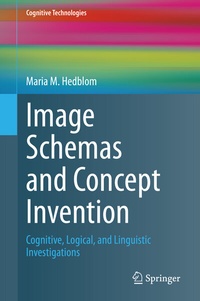
Image Schemas and Concept Invention
Description

In this book the author's theoretical framework builds on linguistic and psychological research, arguing that similar image-schematic notions should be grouped together into interconnected family hierarchies, with complexity increasing with regard to the addition of spatial and conceptual primitives. She introduces an image schema logic as a language to model image schemas, and she shows how the semantic content of image schemas can be used to improve computational concept invention.
The book will be of value to researchers in artificial intelligence, cognitive science, psychology, and creativity.
More details
Other editions
Additional editions
Content
Creating Concepts: Considerations from Psychology and Artificial Intelligence.- Image Schemas: Spatiotemporal Relationships Used as Conceptual Building Blocks.- Formal Structure: Image Schemas as Families of Theories.- Introducing ISLFOL: A Logical Language for Image Schemas.- Modelling Conceptualisations: Combining Image Schemas to Model Event Conceptualisations.- Generating Concepts: How Image Schemas Can Help Guide Computational.- Conceptual Blending.- Defining Concepts: Experiment on the Role of Image Schemas in Object Conceptualisation.- Identifying Image Schemas: Experiment Towards Automatic Image Schema Extraction.- Discussion and Conclusions.
