

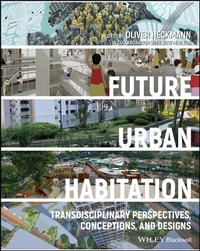
Future Urban Habitation
Description

Presents forward-looking concepts, innovative research, and transdisciplinary perspectives for developing strategies for future urban habitation
Around the globe, urban populations are growing at an unpreceded rate, in particular in Asia and Africa. In view of pressing social and environmental challenges it is essential to reimagine current design strategies to build affordable, sustainable, and inclusive communities that can respond to future demographic dynamics, new social practices, and the consequences of climate change. Future Urban Habitation presents an integrative, transdisciplinary approach for developing long-term strategies for urban housing at a different scales.
With focus on the rapidly growing cities of Asia, and urban processes in Europe and North-America this volume offers perspectives from both researchers and practitioners involved in multiple aspects of urban habitation. The authors address a range of challenges to urban habitation with four intersecting thematic frameworks: Inclusive Urbanism, High-Dense Typologies for Building Community, Adaptable and Responsive Habitation, and New Tools and Approaches.
Throughout the text, readers are presented with innovative design ideas from different fields, new concepts for social practices and sustainable housing policies, recent research on urban housing, and more. Exploring both social and architectural strategies for sustainable and livable dwelling models, Future Urban Hanitation:
- Addresses challenges associated with urbanization, population growth, societal segregation, shifting demographics and the crisis of care, and climate change
- Discusses advanced approaches for design thinking and design research and the impact of inclusive people-centric social design
- Explores the building of collaboration-based, cohesive neighborhoods and community-based social and health services
- Describes the use of innovative tools and methods affecting design practices and decision-making processes, such as co-design, social design, parametric design, performance simulation and sustainable construction to develop urban housing
- Includes perspectives and concepts from policy makers in housing boards and social service administrations, urban planners, architectural and social designers, innovators in sustainable construction, and researchers working on urban society
Future Urban Habitation is an invaluable resource for designers from various fields including architecture, urban planning, and social design, for researchers from social science and design fields, and for policymakers, and other practitioners working on the provision of housing and the facilitation of social services in urban environments.
Oliver Heckmann leads the Urban Housing lab founded at Singapore University of Technology and Design and now based in Berlin. His research, teaching, and practice focuses on innovative housing typology, urban habitation, sustainable design, urban revitalization, and adaptive reuse. He is the co-author and co-editor of Floor Plan Manual Housing and Editor-in-Chief of Building Types Online.
More details
Other editions
Additional editions
Person
Oliver Heckmann leads the Urban Housing lab founded at Singapore University of Technology and Design and now based in Berlin. His research, teaching, and practice focuses on innovative housing typology, urban habitation, sustainable design, urban revitalization, and adaptive reuse. He is the co-author and co-editor of Floor Plan Manual Housing and Editor-in-Chief of Building Types Online.
Content
List of Contributors ix
Introduction 1
Oliver Heckmann
Section 1 Inclusive Urbanism 11
Introduction 13
Oliver Heckmann
1 Towards a New Social Model of the City: Barcelona's Integral Superblocks 25
Lluís Torrens, Sebastià Riutort, and Marta Juan
2 Link by Link: Blurring the Lines and Creating an Inclusive Society in Singapore 37
Vincent Chua
3 Inclusive Smart Community - Towards A Socially Integrated and Enabling Community 49
Chong Keng Hua, Ha Tshui Mum, To Kien, and Yuen Chau
4 Design for Depopulating Conditions - Formulating a Strategic Neighborhood Framework for Detroit 67
Ian Dickenson
5 Multi-Programmatic Urbanity for Indonesia 101
Florian Heinzelmann and Daliana Suryawinata
6 Affordable Housing and Social Inclusion - the Case of Vienna and Austria 115
Gerald Kössl
Section 2 High-Dense Typologies For Building Communities 131
Introduction 133
Oliver Heckmann
7 Fostering Community Bonding in High-Density Habitations 149
Im Sik Cho
8 HDB: High-Density Typologies for Building Community 165
Jeremiah Lim
9 Building Communities in High-Density Singapore - a Look at Integrated Design Typology 185
Siew Man Kok
10 Making Sense of 'Community': A Call for New Kinds of Knowledge to Shape Urban Futures 209
Saffron Woodcraft
Section 3 Adaptive and Responsive Habitation 223
Introduction 225
Oliver Heckmann
11 Alternative Housing for a Diverse and Inclusive Society 241
Gérald Ledent
12 Type-Figurations - Comfort Zones and Active Grounds 261
Bernd Vlay
13 Promoting Healthy Longevity: The Role of Social Innovation 287
Yee Wei Lim, Kimberly Teo, Cherylanne Tan, and Junyu Ong
14 Experiments in Living Together 301
Colin Neufeld and Sharon Wohl
15 Beyond the Unit - Future Hybrid High-Rise Commune 335
Oliver Heckmann
Section 4 New Tools, New Approaches 359
Introduction 361
Oliver Heckmann
16 Toolkits for Renewable and Regenerative Buildings 371
Devni Acharya, Emma Boucher, Richard Boyd, Michael Budig, Elisa Magnini, and Neil Walmsley
17 Social Design - Principles & Practices to Foster Caring Urban Communities 391
Lekshmy Parameswaran, László Herczeg, Airí Dordas Perpinyà, and Adrià Garcia i Mateu
18 Computational Design Futures in Housing 415
Trevor Ryan Patt
19 Retooling Architectural Performance Analysis 429
Timur Dogan and John Alstan Jakubiec
Index 443
