

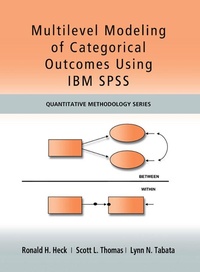
Multilevel Modeling of Categorical Outcomes Using IBM SPSS
1st Edition
Published on 7. May 2013
456 pages
978-1-136-67235-4 (ISBN)
Description

This is the first workbook that introduces the multilevel approach to modeling with categorical outcomes using IBM SPSS Version 20. Readers learn how to develop, estimate, and interpret multilevel models with categorical outcomes. The authors walk readers through data management, diagnostic tools, model conceptualization, and model specification issues related to single-level and multilevel models with categorical outcomes. Screen shots clearly demonstrate techniques and navigation of the program. Modeling syntax is provided in the appendix. Examples of various types of categorical outcomes demonstrate how to set up each model and interpret the output. Extended examples illustrate the logic of model development, interpretation of output, the context of the research questions, and the steps around which the analyses are structured. Readers can replicate examples in each chapter by using the corresponding data and syntax files available at www.psypress.com/9781848729568.
The book opens with a review of multilevel with categorical outcomes, followed by a chapter on IBM SPSS data management techniques to facilitate working with multilevel and longitudinal data sets. Chapters 3 and 4 detail the basics of the single-level and multilevel generalized linear model for various types of categorical outcomes. These chapters review underlying concepts to assist with trouble-shooting common programming and modeling problems. Next population-average and unit-specific longitudinal models for investigating individual or organizational developmental processes are developed. Chapter 6 focuses on single- and multilevel models using multinomial and ordinal data followed by a chapter on models for count data. The book concludes with additional trouble shooting techniques and tips for expanding on the modeling techniques introduced.
Ideal as a supplement for graduate level courses and/or professional workshops on multilevel, longitudinal, latent variable modeling, multivariate statistics, and/or advanced quantitative techniques taught in psychology, business, education, health, and sociology, this practical workbook also appeals to researchers in these fields. An excellent follow up to the authors' highly successful Multilevel and Longitudinal Modeling with IBM SPSS and Introduction to Multilevel Modeling Techniques, 2nd Edition, this book can also be used with any multilevel and/or longitudinal book or as a stand-alone text introducing multilevel modeling with categorical outcomes.
The book opens with a review of multilevel with categorical outcomes, followed by a chapter on IBM SPSS data management techniques to facilitate working with multilevel and longitudinal data sets. Chapters 3 and 4 detail the basics of the single-level and multilevel generalized linear model for various types of categorical outcomes. These chapters review underlying concepts to assist with trouble-shooting common programming and modeling problems. Next population-average and unit-specific longitudinal models for investigating individual or organizational developmental processes are developed. Chapter 6 focuses on single- and multilevel models using multinomial and ordinal data followed by a chapter on models for count data. The book concludes with additional trouble shooting techniques and tips for expanding on the modeling techniques introduced.
Ideal as a supplement for graduate level courses and/or professional workshops on multilevel, longitudinal, latent variable modeling, multivariate statistics, and/or advanced quantitative techniques taught in psychology, business, education, health, and sociology, this practical workbook also appeals to researchers in these fields. An excellent follow up to the authors' highly successful Multilevel and Longitudinal Modeling with IBM SPSS and Introduction to Multilevel Modeling Techniques, 2nd Edition, this book can also be used with any multilevel and/or longitudinal book or as a stand-alone text introducing multilevel modeling with categorical outcomes.
Reviews / Votes
"This text has artistically balanced ... advanced multilevel concepts and a depth and breadth of topics in a reader-friendly, accessible fashion. ... [It] is poised to make a great splash in the methodological world. ... I have a copy of every text written by these authors and use them consistently for a number of reasons including clarity in writing, comprehensive coverage, and accuracy. This text ... offers these same characteristics. ... Appropriate for graduate level courses ... as well as individual researchers that use multilevel modeling-regardless of discipline." - Debbie L. Hahs-Vaughn, University of Central Florida, USA"This book is a natural extension to a well-received and highly successful previous project by the same authors. Using essentially the same strategy and approach, this book extends the coverage to advanced models and thereby moves the field even further along. I highly endorse this product." - George Marcoulides, Quantitative Methodology Series Editor, University of California, Riverside, USA
"It fills a significant gap in the literature. ... I would purchase this book and recommend it to colleagues who do multilevel modeling with SPSS ... [and] to students who take my courses and workshops. ...The conceptual material is very clear." - Jason T. Newsom, Portland State University, USA
More details
Series
Language
English
Place of publication
London
United Kingdom
Publishing group
Taylor & Francis Ltd
Target group
College/higher education
File size
12,39 MB
ISBN-13
978-1-136-67235-4 (9781136672354)
Copyright in bibliographic data and cover images is held by Nielsen Book Services Limited or by the publishers or by their respective licensors: all rights reserved.
Schweitzer Classification
Other editions
Additional editions
Ronald H. Heck | Scott Thomas | Lynn Tabata
Multilevel Modeling of Categorical Outcomes Using IBM SPSS
Book
04/2012
Routledge
€215.41
Shipment within 3-4 weeks
Ronald H. Heck | Scott Thomas | Lynn Tabata
Multilevel Modeling of Categorical Outcomes Using IBM SPSS
Book
04/2012
1st Edition
Routledge
€75.50
Shipment within 3-4 weeks
Persons
Ronald Heck is professor of education at the University of Hawai'i at Manoa. His areas of interest include organizational theory, leadership, policy, and quantitative research methods.
Scott L. Thomas is professor in the School of Educational Studies at Claremont Graduate University. His specialties include sociology of education, policy, and quantitative research methods.
Lynn Tabata is an affiliate graduate faculty member and research consultant at the University of Hawai'i at Manoa. Her research interests focus on faculty, distance learning, and technology issues in higher education.
Scott L. Thomas is professor in the School of Educational Studies at Claremont Graduate University. His specialties include sociology of education, policy, and quantitative research methods.
Lynn Tabata is an affiliate graduate faculty member and research consultant at the University of Hawai'i at Manoa. Her research interests focus on faculty, distance learning, and technology issues in higher education.
Content
1. Introduction to Multilevel Models with Categorical Outcomes. 2. Preparing and Examining the Data for Multilevel Anayses. 3. Specification of Generalized Linear Models. 4. Multilevel Models with Dichotomous Outcomes. 5. Multilevel Models with a Categorical Repeated Measures Outcome. 6. Two-Level Models with Multinomial and Ordinal Outcomes. 7. Two-Level Models with Count Data. 8. Concluding Thoughts.
