

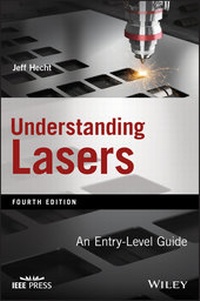
Understanding Lasers
Description

The revised and updated fourth edition of Understanding Lasers offers an essential guide and introduction that explores how lasers work, what they do, and how they are applied in the real world. The author--a Fellow of The Optical Society--reviews the key concepts of physics and optics that are essential for understanding lasers and explains how lasers operate. The book also contains information on the optical accessories used with lasers.
Written in non-technical terms, the book gives an overview of the wide-variety laser types and configurations. Understanding Lasers covers fiber, solid-state, excimer, helium-neon, carbon dioxide, free-electron lasers, and more. In addition, the book also explains concepts such as the difference between laser oscillation and amplification, the importance of laser gain, and tunable lasers. The updated fourth edition highlights the most recent research and development in the field. This important resource:
* Includes a new chapter on fiber lasers and amplifiers
* Reviews new topics on physics of optical fibers and fiber lasers, disk lasers, and Ytterbium lasers
* Contains new sections on Laser Geometry and Implications, Diode Laser Structures, Optimal Parametric Sources, and 3D Printing and Additive Manufacturing
* Puts the focus on research and emerging developments in areas such as spectroscopy, slow light, laser cooling, and extremely precise measurements
* Contains appendices, glossary, and index that help make this book a useful reference
Written for engineering and physics students, engineers, scientists, and technicians, the fourth edition of Understanding Lasers contains the basic concepts of lasers and the most recent advances in the technology.
More details
Other editions
Additional editions
Person
Jeff Hecht, B.S. EE. Caltech, is a contributing editor for Laser Focus World, and a freelance science and technology writer for IEEE Spectrum, New Scientist, and other publications. Mr. Hecht is also a consultant in laser and fiber-optic technology, applications, and markets. He is a life senior member of the IEEE, Fellow of the Optical Society of America, and a member of the National Association of Science Writers.
Content
Preface xiii
CHAPTER 1 Introduction and Overview 1
1.1 Lasers, Optics, and Photonics 1
1.2 Understanding the Laser 3
1.3 What Is a Laser? 4
1.4 Laser Materials and Types 8
1.5 Optical Properties of Laser Light 10
1.6 How Lasers Are Used? 14
1.7 What Have We Learned? 17
CHAPTER 2 Physical Basics 21
2.1 Electromagnetic Waves and Photons 21
2.2 Quantum and Classical Physics 29
2.3 Interactions of Light and Matter 39
2.4 Basic Optics and Simple Lenses 47
2.5 Fiber Optics 51
2.6 What Have We Learned? 54
CHAPTER 3 How Lasers Work 59
3.1 Building a Laser 59
3.2 Producing a Population Inversion 60
3.3 Resonant Cavities 66
3.4 Laser Beams and Resonance 73
3.5 Wavelength Selection and Tuning 81
3.6 Laser Excitation and Efficiency 85
3.7 What Have We Learned? 89
CHAPTER 4 Laser Characteristics 95
4.1 Coherence 95
4.2 Laser Wavelengths 98
4.3 Properties of Laser Beams 103
4.4 Laser Power 108
4.5 Laser Efficiency 110
4.6 Pulse Characteristics 115
4.7 Polarization 120
4.8 What Have We Learned? 121
CHAPTER 5 Optics, Laser Accessories, and Measurements 127
5.1 Classical Optical Devices 127
5.2 Optical Materials 136
5.3 Optical Coatings and Filters 141
5.4 Beam Delivery, Direction, and Propagation 145
5.5 Mounting and Positioning Equipment 148
5.6 Nonlinear Optics 149
5.7 Beam Modulation and Output Control 156
5.8 Measurements in Optics 159
5.9 What Have We Learned? 164
CHAPTER 6 Laser Types, Features, and Enhancements 169
6.1 Perspectives on Laser Types 169
6.2 Laser Media 171
6.3 Pumping and Energy Storage 177
6.4 Laser Pulse Characteristics 182
6.5 Wavelength Conversion 195
6.6 Laser Oscillators and Optical Amplifiers 201
6.7 Wavelength Options 207
6.8 Laser-Like Light Sources 209
6.9 What Have We Learned? 211
CHAPTER 7 Gas Lasers 217
7.1 The Gas-Laser Family 217
7.2 Gas-Laser Basics 218
7.3 Helium-Neon Lasers 225
7.4 Argon- and Krypton-Ion Lasers 229
7.5 Metal-Vapor Lasers 232
7.6 Carbon Dioxide Lasers 235
7.7 Excimer Lasers 240
7.8 Nitrogen Lasers 243
7.9 Chemical Lasers 243
7.10 Other Gas Lasers 246
7.11 What Have We Learned? 247
CHAPTER 8 Solid-State Lasers 253
8.1 What Is a Solid-State Laser? 253
8.2 Solid-State Laser Materials 258
8.3 Solid-State Laser Configurations 265
8.4 Major Solid-State Laser Materials 271
8.5 Optically Pumped Semiconductor Lasers 284
8.6 Broadband and Tunable Solid-State Lasers 288
8.7 Pulsed Solid-State Lasers 294
8.8 What Have We Learned? 295
CHAPTER 9 Fiber Lasers and Amplifiers 301
9.1 What Are Fiber Lasers? 301
9.2 Optical Fiber Structures 306
9.3 Fiber Laser Design and Efficiency 310
9.4 Rare-Earth-Doped Fiber Lasers 318
9.5 Rare-Earth-Doped Fiber Amplifiers 328
9.6 Raman Fiber Lasers and Amplifiers 332
9.7 What Have We Learned? 335
CHAPTER 10 Diode and Other Semiconductor Lasers 341
10.1 Types of Semiconductor Lasers 341
10.2 Development of Diode Lasers 342
10.3 Semiconductor Basics 344
10.4 Comparing LED and Diode-Laser Emission 353
10.5 Confining Light and Current 359
10.6 Edge-Emitting Diode Lasers 370
10.7 Surface-Emitting Diode Lasers 375
10.8 Optical Properties of Diode Lasers 379
10.9 Diode-Laser Materials and Wavelengths 381
10.10 Quantum Cascade Lasers and Related Types 390
10.11 What Have We Learned? 393
CHAPTER 11 Other Lasers and Laser-Like Sources 399
11.1 Tunable Dye Lasers 399
11.2 Optical Parametric Sources 404
11.3 Supercontinuum Sources 408
11.4 Frequency Combs 408
11.5 Extreme Ultraviolet Sources 410
11.6 Free-Electron Lasers 416
11.7 What Have We Learned? 420
CHAPTER 12 Low-Power Laser Applications 425
12.1 Advantages of Laser Light 426
12.2 Reading with Lasers 433
12.3 Optical Disks and Data Storage 437
12.4 Laser Printing 440
12.5 Lasers in Fiber-Optic Communications 442
12.6 Laser Measurement 447
12.7 Laser Light Shows, Pointers, and Projection Displays 453
12.8 Low-Power Defense Applications 456
12.9 Sensing and Spectroscopy 459
12.10 Holography 464
12.11 Other Low-Power Applications 468
12.12 What Have We Learned? 469
CHAPTER 13 High-Power Laser Applications 475
13.1 High- Versus Low-Power Laser Applications 475
13.2 Attractions of High-Power Lasers 476
13.3 Important Considerations and Trends 477
13.4 Materials Working 481
13.5 Additive Manufacturing and Three-Dimensional Printing 489
13.6 Semiconductor Electronics Fabrication 491
13.7 Laser Medical Treatment 493
13.8 Photochemistry and Isotope Separation 501
13.9 Laser-Driven Nuclear Fusion 503
13.10 High-Energy Laser Weapons 505
13.11 What Have We Learned? 510
CHAPTER 14 Lasers in Research 515
14.1 Lasers Open New Opportunities 515
14.2 Laser Spectroscopy 516
14.3 Manipulating Tiny Objects 521
14.4 Atom Lasers and Bose-Einstein Condensates 522
14.5 Detection of Gravitational Waves 524
14.6 Laser Guide Stars for Astronomy 525
14.7 Slow Light 526
14.8 Nanoscale Lasers 527
14.9 Strange Lasers 529
14.10 Extreme Power Ultrashort Pulse Lasers 530
14.11 X-Ray Free-Electron Lasers 535
14.12 Other Emerging Research 536
14.13 What Have We Learned? 538
Answers to Quiz Questions 543
Appendix A: Laser Safety 547
Appendix B: Handy Numbers and Formulas 553
Appendix C: Resources and Suggested Readings 557
Glossary 561
Index 575
CHAPTER 1
Introduction and Overview
About This Chapter
This chapter will introduce you to lasers. It will give you a basic idea of their use, their operation, and their important properties. This basic understanding will serve as a foundation for the more detailed descriptions of lasers and their operation in later chapters. After a brief introduction to lasers, this chapter will introduce important laser properties and applications.
1.1 LASERS, OPTICS, AND PHOTONICS
To understand lasers, you should first understand where lasers fit into the broader science and technology of light. That field was long called optics, but now part of it is sometimes called photonics. The differences in the meanings of the two words reflect how the field has changed since the mid-20th century, and understanding those differences will help you understand both lasers and the larger world of light, optics and photonics.
Optics dates back to the origin of lenses in ancient times. It is the science of telescopes, spectacles, microscopes, binoculars, and other optical instruments that manipulate light using lenses, mirrors, prisms, and other transparent and reflective objects. Isaac Newton famously described the fundamentals of optics in his 1704 book Opticks. He thought light was made of tiny particles, but a century later an experiment by Thomas Young indicated light was made of waves, and opinion shifted for a while.
In the late 19th century, physicists discovered that light was a type of electromagnetic radiation, along with radio, infrared, ultraviolet, X-rays, and gamma rays. They differ in the lengths of the waves and in how fast they oscillate. The wavelength and frequency depend on each other because electromagnetic waves always travel at the speed of light. In the early 20th century, Albert Einstein showed that electromagnetic radiation could behave both as particles-called photons-and as waves, depending on how you looked at them. The only fundamental difference among electromagnetic waves was their wavelength, which could also be measured as frequency or (photon) energy.
The science and technology of light have also grown increasingly connected with electronics in the past century. Electronic devices can measure light by converting it into electronic signals and measuring them. Television cameras and displays include both optics and electronics. The first electronic circuits used vacuum tubes, but semiconductor devices began replacing tubes in the mid-20th century. That brought a new generation of electro-optic devices, including semiconductor electronics that emitted and detected light, converting signals and energy back and forth between photons and electrons.
In the late 20th century, the word photonics was coined to describe devices that manipulate photons, like electronics manipulate electrons. The use of the new term became controversial because many people who worked in optics in the field saw it as an attempt to "rebrand" their profession. Photonics has come to refer to things that manipulate light when it acts more like a particle (a photon) than a wave. By that definition, a laser or a sensor that converts light (a series of photons) into an electronic signal is considered photonics, but a lens that refracts and focuses light waves is considered optics. However, that definition remains somewhat hazy. Today, both terms are used, but at this writing, Google tells us that optics remains far ahead, indexed on 622 million web pages, compared to a mere 17.6 million for photonics.
Whatever you want to call the field, you should learn the physical basics of light, optics and photonics, to understand how lasers work. Chapter 2 will go into more detail.
1.2 UNDERSTANDING THE LASER
The laser was born in 1960, long before the word "photonics" came into use. Lasers retain a youthful image, thanks largely to continuing advances in the technology. They vary widely. Some lasers are tremendously sophisticated and incredibly precise scientific instruments costing tens or hundreds of thousands of dollars. Others are tiny semiconductor chips hidden inside optical disk players or pen-shaped red pointers used as cat toys. The world's biggest laser, the National Ignition Facility at the Lawrence Livermore National Laboratory, cost over a billion dollars and fills an entire building. The tiny lasers inside CD or DVD players are the size of grains of sand and cost pennies apiece. Red laser pointers sell for only a few dollars and are often given away.
We now take many laser applications for granted. For decades, laser scanners at store checkouts have read bar codes printed on packages to tally prices and manage their inventory. Laser pulses carried through optical fibers are the backbone of the global telecommunications network. Builders use laser beams to make sure walls and ceilings are flat and smooth. Offices use laser printers to produce documents. Medical and scientific instruments use lasers to make precise measurements. Lasers cut sheets of metals, plastics, and other materials to desired shapes, so some parts of your car are likely made with a laser. Chapters 12-14 describe many more examples.
Laser light has special properties that make it useful in many ways. You can think of a laser as a very well-behaved light bulb, emitting a narrow beam of a single color rather than spreading white light all around a room. You would not use a laser to illuminate a room, but you can use a tightly focused single-color laser beam to make precise measurements, to transport information around the world at the speed of light, or to cut sheets of metal. Lasers have become tools in industry, medicine, engineering, and science, as well as components in optical systems.
Lasers come in many forms. The most common lasers are tiny semiconductor chips that look like tiny pieces of metallic confetti; untold millions of them are hidden inside electronic devices, measuring devices, and communication systems. Others are glassy or crystalline solids in the form of rods, slabs, or fibers. Some are tubes filled with gases that emit laser light. Some emit light so feeble that the eye can barely detect it; others are blindingly bright; and many emit infrared or ultraviolet light outside the human visible spectrum. Some perform delicate surgery; others weld sheets of metal. Lasers are used by construction workers installing ceilings and by scientists detecting gravitational waves.
What makes them all lasers is that they generate light in the same way, by a process called "light amplification by the stimulated emission of radiation" that gave us the word "LASER." We will start by explaining what makes laser light differ from that from the sun, light bulbs, flames, and other light sources.
1.3 WHAT IS A LASER?
Each part of the phrase "light amplification by the stimulated emission of radiation" has a special meaning, so we will look at it piece by piece, starting from the final word.
Radiation means electromagnetic radiation, a massless form of energy that travels at the speed of light. It comes in various forms, including visible light, infrared, ultraviolet, radio waves, microwaves, and X-rays. Light and other forms of electromagnetic radiation behave like both waves and particles (called photons). You will learn more details in Chapter 2.
Stimulated emission tells us that lasers produce light in a special way. The sun, flames, and light bulbs all emit light spontaneously, on their own, in order to release extra internal energy. Lasers contain atoms or molecules that release their extra energy when other light stimulates them. You will learn more about that process, called stimulated emission, in Chapter 3.
Amplification means increasing the amount of light. In stimulated emission, an input light wave stimulates an atom or molecule to release its energy as a second wave, which is perfectly matched to the input wave. The stimulated wave, in turn, can stimulate other atoms or molecules to emit duplicate waves, amplifying the light signal more. It may be easier to think of stimulated emission as one light photon tickling or stimulating an atom or molecule so it releases an identical photon, which in turn can stimulate the emission of another identical photon, producing a cascade of photons that amplifies the light.
Light describes the type of electromagnetic radiation produced. In practice, that means not just light visible to the human eye, but also adjacent parts of the electromagnetic spectrum that our eyes cannot see because it is either longer in wavelength (infrared) or shorter in wavelength (ultraviolet.)
It took decades to put the pieces together. Albert Einstein suggested the possibility of stimulated emission in a paper published in 1917. Stimulated emission was first observed in the 1920s, but physicists long expected it to be much weaker than spontaneous emission. The first hints that stimulated emission could be stronger came in radio-frequency experiments shortly after World War II. In 1951, Charles H. Townes, then at Columbia University, thought of a way to stimulate the emission of microwaves. His idea was to direct ammonia molecules carrying extra energy into a cavity that would reflect the microwaves back and forth through the gas. He called his device a maser, an acronym for "microwave amplification by the stimulated...
