

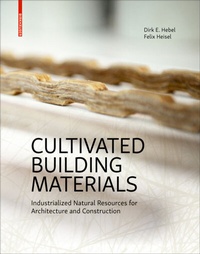
Cultivated Building Materials
Description

baumaterialien einer neuen generation
Die Produktion von Baumaterialien verändert sich im 21. Jahrhundert radikal: Künftige Ressourcen werden vermehrt, angebaut oder gezüchtet - sie werden organisch erzeugt.
Dieses Buch stellt innovative industrialisierte Produktionsmethoden für die organische Erzeugung von Baumaterialien vor. Dazu gehören zum Beispiel durch Bakterien erzeugter Zement, aus Pilzzellen gewonnene Ziegel oder die Verwendung von Bambusfasern für die Betonarmierung.
Die Darstellung schlägt einen Bogen von der wissenschaftlichen Forschung über die Produktentwicklung bis hin zu Anwendungen in Architektur und Bauwesen. Sie schlägt eine Brücke vom akademischen zum praktischen Bereich des Entwerfens und Bauen.
Der erste Teil beschreibt Herausforderungen, Strategien und Ziele, gefolgt von einem zweiten Teil über Bambus als einem organisch erzeugten Baumaterial und einem dritten Teil mit zahlreichen Beispielen für Entwicklungen von Bauprodukten aus organisch erzeugten Baumerialien.
Reviews / Votes
"[...] eine facettenreiche Tour d'horizon in ein sehr komplexes Thema [...] nicht nur für Fachleute, sondern auch für Laien ein Gewinn [...]"
In: archtektur atuell 1/2 (2019), 148
More details
Other editions
Additional editions
Persons
Prof. Dirk E. Hebel; Felix Heisel , Lehrstuhl Sustainable Construction, KIT Karlsruhe
Content
- Intro
- Contents
- Challenges, Strategies, and Goals
- Introduction: Cultivated Building Materials
- Production Back to The City
- The Ape of Materials
- The Industrialization of Timber - A Case Study
- Standardization of a Natural Resource
- Bamboo, a Cultivated Building Material
- Introduction
- Constructing with Engineered Bamboo
- Upscaling The Bamboo Industry
- The Ecological Impact of Industrially Cultivated Bamboo
- Engineered Bamboo Products - A Sustainable Choice?
- From Cultivated Materials to Building Products
- Soil-Dependent Products. Agriculture
- Wood Foam
- Biopolymers: Cement Replacement
- Biopolymers and Biocomposites Based on Agricultural Residues
- Lignin-based Carbon Fibres
- Nutrient-Dependent, Soil-Independent Products. Biotechnology
- Fungal Mycelium Bio-Materials
- Limestone-producing Bacteria: Self-healing Concrete
- Microbially Induced Calcium Carbonate: Multilayer/Multimaterial Coatings on Non-conductive Materials
- Bio-Inspired Products. Biomimicry
- Replicating Natural Design Strategies In Bio-Inspired Composites
- Living Architecture (Liar): Metabolically Engineered Building Units
- About the Authors and Contributors
- Acknowledgments
- Illustration Credits
- Index of Persons, Firms, and Institutions
- Index of Projects, Buildings, and Places
