

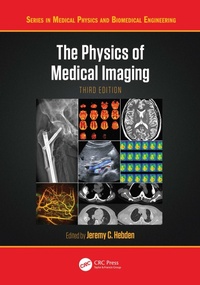
The Physics of Medical Imaging
3rd Edition
Published on 9. April 2026
448 pages
978-1-040-47918-6 (ISBN)
Description

This third edition of The Physics of Medical Imaging provides completely new and comprehensive descriptions of the physical principles and concepts which underpin all the medical imaging technologies found in modern hospitals, including x-ray imaging, magnetic resonance imaging, nuclear medicine imaging, and ultrasound. In addition, this edition describes a range of new imaging techniques whose clinical impact is beginning to emerge or broaden significantly. With the aid of numerous illustrations, descriptions cover the basic mathematical principles, the design and operation of the imaging technology, and a review of the clinical applications. The criteria which determine imaging system performance are described, with an examination of the advantages and limitations of each modality, and the image artefacts to which each is prone. Additional chapters cover the basic principles of image formation, digital image processing methods, and image registration.
Key Features:
? This thoroughly updated and modernised edition includes descriptions of many new innovations such as ultrasound tomography, susceptibility contrast MRI, and multimodality imaging (e.g. SPECT-CT), and new chapters on emerging imaging modalities such as optical coherence tomography, phase contrast x-ray imaging, and photoacoustic imaging.
? Contributors are leading scientists, engineers, and clinicians working on cutting edge research in medical imaging.
? The conceptual and mathematical descriptions of the imaging methods are accompanied by over 250 new diagrams and images.
? Contributors have extensive experience of teaching medical imaging physics, ensuring that the content is strongly informed by students' learning experiences, and by an appreciation of the intellectual challenges confronting students encountering new concepts in medical imaging.
This book has been designed to be accessible to readers with a basic physics knowledge wishing to learn about medical imaging for the first time, or to deepen their understanding of diagnostic imaging techniques. This includes undergraduates in physics and engineering, research students, scientists, and healthcare professionals with interests in imaging
Key Features:
? This thoroughly updated and modernised edition includes descriptions of many new innovations such as ultrasound tomography, susceptibility contrast MRI, and multimodality imaging (e.g. SPECT-CT), and new chapters on emerging imaging modalities such as optical coherence tomography, phase contrast x-ray imaging, and photoacoustic imaging.
? Contributors are leading scientists, engineers, and clinicians working on cutting edge research in medical imaging.
? The conceptual and mathematical descriptions of the imaging methods are accompanied by over 250 new diagrams and images.
? Contributors have extensive experience of teaching medical imaging physics, ensuring that the content is strongly informed by students' learning experiences, and by an appreciation of the intellectual challenges confronting students encountering new concepts in medical imaging.
This book has been designed to be accessible to readers with a basic physics knowledge wishing to learn about medical imaging for the first time, or to deepen their understanding of diagnostic imaging techniques. This includes undergraduates in physics and engineering, research students, scientists, and healthcare professionals with interests in imaging
More details
Series
Edition
3rd edition
Language
English
Place of publication
London
United Kingdom
Publishing group
Taylor & Francis Ltd
Target group
College/higher education
Professional and scholarly
Illustrations
13 Tables, black and white; 6 Line drawings, color; 191 Line drawings, black and white; 14 Halftones, color; 43 Halftones, black and white; 20 Illustrations, color; 234 Illustrations, black and white
File size
95,65 MB
ISBN-13
978-1-040-47918-6 (9781040479186)
Copyright in bibliographic data and cover images is held by Nielsen Book Services Limited or by the publishers or by their respective licensors: all rights reserved.
Schweitzer Classification
Other editions
Additional editions
Jeremy C. Hebden
The Physics of Medical Imaging
Book
05/2026
3rd Edition
CRC Press
€100.50
Article not available at the moment
Jeremy C. Hebden
The Physics of Medical Imaging
Book
05/2026
3rd Edition
CRC Press
€247.50
Article not available at the moment
Person
Professor Jem Hebden is former head of the UCL Department of Medical Physics & Biomedical Engineering (2008-2019), and director of the UCL Biomedical Optics Research Laboratory (BORL), which represents a federation of four research groups, each involved in internationally-leading research.
I joined the UCL Department of Medical Physics & Bioengineering in 1992 when I vacated a tenure-track position at the University of Utah to take up a 5-year Wellcome Trust Senior Fellowship (later renewed for a further 5 years). I immediately established my own group devoted to the development of clinical prototypes for optical imaging of human subjects, with particular emphasis on the study of the premature infant brain at risk of damage resulting from hypoxia-ischaemia. I have pioneered the technique of time-resolved diffuse optical imaging, and (with Wellcome Trust and industrial support) developed a prototype which is widely regarded as the most sophisticated clinical instrument in optical tomography, utilising unique, ground-breaking technology. My group has published the first (and so far the only) three-dimensional (3D) optical images of the entire infant brain, including 3D functional images. We have also developed a novel optical topography system for real-time display of functional activity in the cortex of adults and children.
I joined the UCL Department of Medical Physics & Bioengineering in 1992 when I vacated a tenure-track position at the University of Utah to take up a 5-year Wellcome Trust Senior Fellowship (later renewed for a further 5 years). I immediately established my own group devoted to the development of clinical prototypes for optical imaging of human subjects, with particular emphasis on the study of the premature infant brain at risk of damage resulting from hypoxia-ischaemia. I have pioneered the technique of time-resolved diffuse optical imaging, and (with Wellcome Trust and industrial support) developed a prototype which is widely regarded as the most sophisticated clinical instrument in optical tomography, utilising unique, ground-breaking technology. My group has published the first (and so far the only) three-dimensional (3D) optical images of the entire infant brain, including 3D functional images. We have also developed a novel optical topography system for real-time display of functional activity in the cortex of adults and children.
Content
1 Image formation and physical characteristics of images. 2 X-ray radiography. 3 X-ray computed tomography. 4 Nuclear medicine imaging. 5 Diagnostic ultrasound. 6 Magnetic resonance imaging. 7: X-ray phase contrast imaging. 8 Electromagnetic source imaging with EEG and MEG. 9: Electrical impedance tomography. 10 Optical coherence tomography. 11 Diffuse optical tomography. 12 Photoacoustic imaging. 13 Digital image processing. 14 Medical image analysis
