

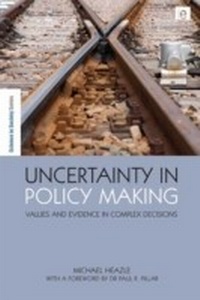
Uncertainty in Policy Making
Values and Evidence in Complex Decisions
1st Edition
Published on 21. August 2012
204 pages
978-1-136-53033-3 (ISBN)
Description

Uncertainty in Policy Making explores how uncertainty is interpreted and used by policy makers, experts and politicians. It argues that conventional notions of rational, evidence-based policy making - hailed by governments and organisations across the world as the only way to make good policy - is an impossible aim in highly complex and uncertain environments; the blind pursuit of such a 'rational' goal is in fact irrational in a world of competing values and interests.
The book centres around two high-profile and important case studies: the Iraq war and climate change policy in the US, UK and Australia. Based on three years' research, including interviews with experts such as Hans Blix, Paul Pillar, and Brian Jones, these two case studies show that the treatment of uncertainty issues in specialist advice is largely determined by how well the advice fits with or contradicts the policy goals and orientation of the policy elite. Instead of allowing the debates to be side-tracked by arguments over whose science or expert advice is 'more right', we must accept that uncertainty in complex issues is unavoidable and recognise the values and interests that lie at the heart of the issues. The book offers a 'hedging' approach which will enable policy makers to manage rather than eliminate uncertainty.
The book centres around two high-profile and important case studies: the Iraq war and climate change policy in the US, UK and Australia. Based on three years' research, including interviews with experts such as Hans Blix, Paul Pillar, and Brian Jones, these two case studies show that the treatment of uncertainty issues in specialist advice is largely determined by how well the advice fits with or contradicts the policy goals and orientation of the policy elite. Instead of allowing the debates to be side-tracked by arguments over whose science or expert advice is 'more right', we must accept that uncertainty in complex issues is unavoidable and recognise the values and interests that lie at the heart of the issues. The book offers a 'hedging' approach which will enable policy makers to manage rather than eliminate uncertainty.
Reviews / Votes
'Insightfully and skilfully strips away the widespread misconceptions about how information and expertise do, and do not, play into the making of public policy...The messages that Heazle presents in this book are by no means comforting or reassuring, but both scholars and practitioners would be wise to heed them.'From the Foreword by Paul R. Pillar, Georgetown University and Center for Peace and Security Studies
'In a world in which 'evidence-based policy' has become a buzzword, this book offers a timely note of sobriety. Governments that rely on an increasing number of advisers, studies and data will not necessarily make better policy, particularly on wicked problems such as climate change or nuclear proliferation. The politics of how expertise and uncertainty are selectively used is a strong shaper of policy, and needs to be understood by all citizens.'
Dr Michael Wesley, Executive Director, Lowy Institute for International Policy
'In 'Uncertainty in Policy Making' Michael Heazle critically assesses the evolving role of science in society and particularly in policy making. He makes a strong case that in spite of the peta-bytes of data being generated and ever-increasing reductionist understanding of fundamental processes, the role of science in decision making is not making similar progress. Simply, Michael sees that the supply of science is mismatched with demand. That we need to critically link knowledge with evolving values and issues. This is not an argument to try to reduce irreducible uncertainty or for over-precision, at great cost, but rather to ask the right questions, to identify the critical gaps and to develop a respectful partnership between scientists, policy and political decision makers and the broader community. Uncertainty is here to stay, we need to learn to live and revel in it. A must read for those who are looking for better solutions in our complex world.'
Dr Mark Howden, Chief Research Scientist and Theme Leader, Adaptive Primary Industries and Enterprises, Australian Commonwealth Scientific and Research Organisation (CSIRO)
'What [Heazle] has to say about Iraq is well worth reading in its entirety, not least because, on the basis of much study and many interviews, he offers an important degree of professional independence and distance'
brian Jones, Iraq Inquiry Digest
More details
Series
Language
English
Place of publication
London
United Kingdom
Publishing group
Taylor & Francis Ltd
Target group
College/higher education
File size
0,84 MB
ISBN-13
978-1-136-53033-3 (9781136530333)
Copyright in bibliographic data and cover images is held by Nielsen Book Services Limited or by the publishers or by their respective licensors: all rights reserved.
Schweitzer Classification
Other editions
Additional editions
Book
01/2016
1st Edition
Routledge
€36.70
Shipment within 10-20 days
Book
09/2010
1st Edition
Earthscan Ltd
€62.30
Shipment within 3-4 weeks
Persons
Michael Heazle is Associate Professor in International Relations with the Griffith Asia Institute and the Department of International Business and Asian Studies at Griffith University
Content
Foreword by Paul Pillar
Acknowledgements
Abbreviations
1. Introduction: A Story of (Irrational) Great Expectations
2: Policy Making and Specialist Advice: Concepts and Approaches
3: Empowering Nightmares: Uncertainty and the Precautionary Principle
4: Legitimizing the Iraq Intervention: Threat Inflation versus Precaution
5: Climate Change and the Politics of Precaution
6: Uncertainty, Ideology, and the Politics of Denial
7: Revealing Values and Uncertainty in Policy Debate
8: Alternative Responses to Uncertainty: Bringing Politics Back in
9: Uncertainty as Deus Ex Machina: Some Concluding Remarks
Notes
Bibliography
Acknowledgements
Abbreviations
1. Introduction: A Story of (Irrational) Great Expectations
2: Policy Making and Specialist Advice: Concepts and Approaches
3: Empowering Nightmares: Uncertainty and the Precautionary Principle
4: Legitimizing the Iraq Intervention: Threat Inflation versus Precaution
5: Climate Change and the Politics of Precaution
6: Uncertainty, Ideology, and the Politics of Denial
7: Revealing Values and Uncertainty in Policy Debate
8: Alternative Responses to Uncertainty: Bringing Politics Back in
9: Uncertainty as Deus Ex Machina: Some Concluding Remarks
Notes
Bibliography
