

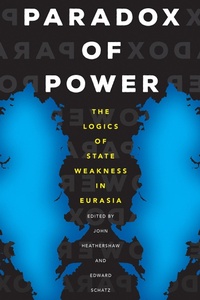
Paradox of Power
The Logics of State Weakness in Eurasia
Published on 13. February 2024
329 pages
978-0-8229-9170-0 (ISBN)
Description

"State weakness" is seen to be a widespread problem throughout Central Asia and other parts of post-socialist space, and more broadly in areas of the developing world. Challenging the widespread assumption that these "weak states" inevitably slide toward failure, Paradox of Power takes careful stock of the varied experiences of Eurasian states to reveal a wide array of surprising outcomes. The case studies show how states teeter but do not collapse, provide public goods against all odds, interact with societies in creative ways, utilize coercion effectively against internal opponents, and establish practices that are far more durable than the language of "weakness" would allow. While deepening our understanding of the phenomenon in Eurasia in particular, the essays also contribute to more general theories of state weakness.
More details
Other editions
Additional editions
Book
06/2017
University of Pittsburgh Press
€58.00
Shipment within 10-20 days
Persons
John Heathershaw (Editor)
John Heathershaw is associate professor of international relations at the University of Exeter, UK. He has served on the board of the Central Eurasian Studies Society and the European Society for Central Asian Studies. He is the author of Post-Conflict Tajikistan: The Politics of Peacebuilding and the Emergence of Legitimate Order and coauthor of Dictators without Borders: Power and Money in Central Asia.
Edward Schatz (Editor)
Edward Schatz is associate professor of political science at the University of Toronto, where he is also director of its Central Asia Program. A former president of the Central Eurasian Studies Society, he is the editor of Political Ethnography: What Immersion Contributes to the Study of Power and the author of Modern Clan Politics: The Power of "Blood" in Kazakhstan and Beyond.
John Heathershaw is associate professor of international relations at the University of Exeter, UK. He has served on the board of the Central Eurasian Studies Society and the European Society for Central Asian Studies. He is the author of Post-Conflict Tajikistan: The Politics of Peacebuilding and the Emergence of Legitimate Order and coauthor of Dictators without Borders: Power and Money in Central Asia.
Edward Schatz (Editor)
Edward Schatz is associate professor of political science at the University of Toronto, where he is also director of its Central Asia Program. A former president of the Central Eurasian Studies Society, he is the editor of Political Ethnography: What Immersion Contributes to the Study of Power and the author of Modern Clan Politics: The Power of "Blood" in Kazakhstan and Beyond.
Content
- Intro
- Contents
- Preface
- CHAPTER 1. The Logics of State Weakness in Eurasia: An Introduction
- Part One. Logics of Consolidation
- CHAPTER 2. Consolidating a Weak State after Civil War: A Tajik Fable
- CHAPTER 3. Power, Peripheries, and Pyramids in Post-Soviet Kyrgyzstan and Georgia
- CHAPTER 4. Organized Crime and the State in Post-Soviet Eurasia
- CHAPTER 5. License to Seek Rents: "Corruption" as a Method of Post-Soviet Governance
- CHAPTER 6. Punishment and State-Building in Post-Soviet Georgia
- Part Two. Logics of Internationalization
- CHAPTER 7. The International State: Comparing Statehood in Central Asia and Sub-Saharan Africa
- CHAPTER 8. The Contested State in Post-Soviet Armenia
- CHAPTER 9. The Post-Soviet Myth of the Strong State in Russia
- CHAPTER 10. Adjudicating Sovereignty: From State Weakness to Improvisation
- Part Three. Logics of Performance
- CHAPTER 11. The Taming ofthe Sacred: How "Weak" State Structures Regulate Religion in Uzbekistan
- CHAPTER 12. Cracks in the System: What the Zhanaozen Incident Says about Regime Performance in Kazakhstan
- CHAPTER 13. Anarchy, the State, and Ukraine
- CHAPTER 14. The Ashar-State: Communal Commitment and State Elicitation in Rural Kyrgyzstan
- CHAPTER 15. Beyond the Neo-Weberian Yardstick?: Thinking of the State in Multiple Registers
- Notes
- References
- Contributors
- Index
