

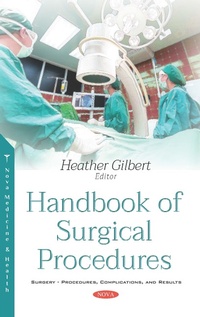
Handbook of Surgical Procedures
Published on 28. December 2018
224 pages
978-1-5361-4581-6 (ISBN)
Description

In this compilation, the authors begin with a focus on the indications for surgery in hepatocarcinoma and how to perform a liver resection. Long-term outcomes and different theories on the causes of recurrence after resection are also discussed. Most patients with hepatocarcinoma have underlying chronic liver disease and are thus at high risk for development of postoperative complications, which can sometimes be fatal. The authors propose that we may be able to prolong the overall survival of patients by using laparoscopic liver resection as a powerful local therapy, which can be applied repeatedly with minimal deterioration of liver function. Bronchoscopy has become an important procedure for diagnostic and therapeutic purposes, particularly in the context of lung cancer. As such, the medical and surgical advances in bronchoscopy are described herein. Post-operative pancreatic fistula is one of the most dreaded complications in any pancreatic operation given its associated morbidity and mortality. This collection examines how the amylase-rich fluid can cause inflammation, become infected, or cause serious bleeding from neighboring vasculature. The authors go on to discuss cystic fibrosis, the most common life-threatening autosomal recessive disorder affecting Caucasians. The indications of endoscopic sinus surgery in cystic fibrosis patients are discussed, drawing from personal experience in the diagnosis and treatment of cystic fibrosis-related sinus disorders. Following this, the origins of functional sinus surgery as it relates to the evolution of functional endoscopic sinus surgery and minimally invasive sinus technique are discussed. The rationale for our departure from Messerklinger's "e;functional"e; concepts is also analyzed. Additionally, endoscopic sinus surgery complications should be distinguished in minor and major based on the treatment they need and the permanent sequelae they can cause. Over the years, the incidence of complications in endoscopic surgery has gone from 8% for the major and 21% for the minor to a percentage of 0 -1.5% and 1.1 - 20.8%, respectively. Sphenoid sinus is very close to important and vulnerable structures of the skull base and therefore a delayed diagnosis and treatment can be lethal. Thus, the authors provide a review of classification of transsphenoidal skull base approaches and show the main transnasal corridors to the sphenoid sinus based on the anatomical sphenoidal target and extension of pathology. Lastly, a synopsis of the pathophysiology of post-craniotomy temporomandibular dysfunction and a practical approach to its evaluation and treatment is provided. Several surgical procedures can be used to perform craniotomy, such as the classical pterional, pre-temporal and other fronto-temporal approaches. However, they are all based on the dissection of the temporal muscle, which can lead to a variety of negative side effects.
More details
Other editions
Additional editions
Heather Gilbert
Handbook of Surgical Procedures
Book
01/2019
Nova Science Publishers Inc
€276.30
Shipment within 15-20 days
Content
- Intro
- Contents
- Preface
- Chapter 1
- The Role of Surgical Resection in Hepatocellular Carcinoma: Anatomic versus Parenchyma-Sparing Resection and Their Oncological Outcomes
- Abstract
- 1. Introduction
- 2. Indication to Surgery
- 3. Anatomic Resection (AR) and Parenchyma-Sparing-Resection (PSR)
- 3.1. Generalities
- 3.2. Anatomical Resection
- 3.2.1. Glissonian Approach
- 3.2.2. Indocyanine Green
- 3.3. Parenchyma Sparing Liver Resection
- 3.3.1. Preoperative and Intraoperative Planning
- 3.3.2. Surgical Techniques
- 4. Long Term Outcomes and Risk Factors
- 5. Recurrence Pattern after Resection: Intra-Hepatic Metastasis or De-Novo Recurrence
- 6. Extending the Role of Surgery: From Benchmark to Bedside
- References
- Chapter 2
- Laparoscopic Liver Resection for Hepatocellular Carcinoma Patients: Indications and Benefits
- Abstract
- Introduction
- General Situation of the Treatments for Hepatocellular Carcinoma (HCC) Patients with Chronic Liver Disease (CLD)
- LLR for HCC Patients with CLD
- Repeat LLR
- LLR Indications to Severe CLD Patients
- Our Experiences of LLR for HCC Patients with CLD
- Conclusion
- References
- Chapter 3
- Medical and Surgical Advances in Bronchoscopy
- Abstract
- Introduction
- Flexible Fibreoptic Bronchoscopy
- Photodynamic Therapy
- Endobronchial Valves
- Endobronchial Ultrasound
- Virtual Bronchoscopic Navigation
- Conclusion
- References
- Chapter 4
- Postoperative Pancreatic Fistula Following Distal Pancreatectomy
- 1. Introduction
- 2. Definition
- 3. Clinical Course
- 4. Patient Factors
- 5. Surgical Techniques
- 5.1. Approach
- 5.2. Division
- 5.3. Reinforcement
- 5.3.1. Oversewing
- 5.3.2. Fibrin
- 5.3.3. Mesh
- 5.3.4. Intraductal Injection
- 5.3.5. Biologic Patches
- 5.3.6. Pancreaticoenteric Anastomoses
- 5.4. Spleen-Preserving Distal Pancreatectomy
- 5.5. Preoperative Endoscopic Adjuncts
- 5.5.1. Botox Injection
- 5.5.2. Stent Placement
- 6. Perioperative Drain Placement
- 6.1. Prophylactic Surgical Drainage
- 7. Postoperative Management
- 7.1. Postoperative Minimally Invasive Drain Placement
- 7.2. Somatostatin Analogue
- 7.3. Dietary Management
- 7.3.1. Oral Nutrition
- 7.3.2. Fluid Restriction
- 7.4. Endoscopic Intervention
- Conclusion
- References
- Chapter 5
- The Role of Endoscopic Sinus Surgery in Pediatric Patients with Cystic Fibrosis
- Abstract
- Introduction
- Physiopathology
- Alteration of the Anatomy of the Paranasal Sinuses
- Nasal Polyposis
- Mucocele
- Microbiology
- Clinical Manifestations
- Diagnosis
- Treatment
- Surgical Notes
- Outcomes
- Conclusion
- References
- Chapter 6
- Mininvasive Surgical Approach in Endoscopic Sinus Surgery (ESS)
- Abstract
- Introduction
- Discussion
- References
- Chapter 7
- Complications and Their Management in Endoscopic Sinus Surgery (ESS)
- Abstract
- Introduction
- Uncinectomy
- Middle Antrostomy
- Frontal Sinus
- Ethmoidectomy
- Sphenoidotomy
- References
- Chapter 8
- Surgical Corridors in the Transphenoidal Skull Base Surgery
- Abstract
- Introduction
- 1. Nasal Corridors
- 1.1. Direct Transnasal (Paraseptal) Corridor
- 1.2. Transethmoidal Corridor
- 1.3. Transethmoido-Pterygoidal Corridor
- 2. Sphenoid Regions
- 2.1. Sellar Region
- 2.2. Lateral Parasellar Region
- 2.3. Suprasellar Region
- 2.4. Clival Region
- Discussion
- References
- Chapter 9
- Canine Fossa Puncture for the Management of Maxillary Sinusitis
- Abstract
- Introduction
- Canine Fossa Puncture Technique
- Discussion
- Conclusion
- References
- Chapter 10
- Post-Craniotomy Temporomandibular Dysfunction: Pathophysiology, Diagnosis and Treatment
- Abstract
- Introduction
- Pathophysiology
- Muscle Components
- Innervation
- Vascular Components
- Effects of the Surgery on the Temporal Muscle
- Consequences of Denervation
- Consequences of Devascularisation
- Integrity of the Fibres and Muscle Tension
- Post-Craniotomy TMD
- Diagnosis
- Treatment
- References
- Biographical Sketches
- Index
- Blank Page
