

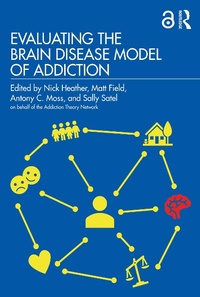
Evaluating the Brain Disease Model of Addiction
1st Edition
Published on 7. March 2022
572 pages
978-1-000-54005-5 (ISBN)
Description

This ground-breaking book advances the fundamental debate about the nature of addiction. As well as presenting the case for seeing addiction as a brain disease, it brings together all the most cogent and penetrating critiques of the brain disease model of addiction (BDMA) and the main grounds for being skeptical of BDMA claims.
The idea that addiction is a brain disease dominates thinking and practice worldwide. However, the editors of this book argue that our understanding of addiction is undergoing a revolutionary change, from being considered a brain disease to a disorder of voluntary behavior. The resolution of this controversy will determine the future of scientific progress in understanding addiction, together with necessary advances in treatment, prevention, and societal responses to addictive disorders. This volume brings together the various strands of the contemporary debate about whether or not addiction is best regarded as a brain disease. Contributors offer arguments for and against, and reasons for uncertainty; they also propose novel alternatives to both brain disease and moral models of addiction. In addition to reprints of classic articles from the addiction research literature, each section contains original chapters written by authorities on their chosen topic. The editors have assembled a stellar cast of chapter authors from a wide range of disciplines - neuroscience, philosophy, psychiatry, psychology, cognitive science, sociology, and law - including some of the most brilliant and influential voices in the field of addiction studies today.
The result is a landmark volume in the study of addiction which will be essential reading for advanced students and researchers in addiction as well as professionals such as medical practitioners, psychiatrists, psychologists of all varieties, and social workers.
The idea that addiction is a brain disease dominates thinking and practice worldwide. However, the editors of this book argue that our understanding of addiction is undergoing a revolutionary change, from being considered a brain disease to a disorder of voluntary behavior. The resolution of this controversy will determine the future of scientific progress in understanding addiction, together with necessary advances in treatment, prevention, and societal responses to addictive disorders. This volume brings together the various strands of the contemporary debate about whether or not addiction is best regarded as a brain disease. Contributors offer arguments for and against, and reasons for uncertainty; they also propose novel alternatives to both brain disease and moral models of addiction. In addition to reprints of classic articles from the addiction research literature, each section contains original chapters written by authorities on their chosen topic. The editors have assembled a stellar cast of chapter authors from a wide range of disciplines - neuroscience, philosophy, psychiatry, psychology, cognitive science, sociology, and law - including some of the most brilliant and influential voices in the field of addiction studies today.
The result is a landmark volume in the study of addiction which will be essential reading for advanced students and researchers in addiction as well as professionals such as medical practitioners, psychiatrists, psychologists of all varieties, and social workers.
Reviews / Votes
"This book is an exceptionally wide-ranging exploration of the contested terrain of human troubles labelled addiction. The distinguished editors have invited the best brains across the various fields that bear upon addiction -- those who advocate the brain disease view, those opposed, and those carving creative paths in between. It will stand as the definitive inter-disciplinary collection on the brain disease paradigm and its alternatives, providing lively, point-for-point debates about the nature of addiction and why this matters."Craig Reinarman, University of California, Santa Cruz, USA
"This collection presents an excellent, well-balanced overview of different views on the brain disease model of addiction. Eminent international authors from a variety of theoretical and disciplinary perspectives discuss the emergence of the model and its growing popularity, challenges to the model and possible novel alternatives. Divided into four sections - for, against, unsure and innovative ideas - the book is informative, stimulating and a welcome reminder that the brain disease model is still far from universally accepted."
Betsy Thom, Middlesex University, UK
"What an exceptional book this is! Although understanding addiction as a 'brain disease' is accepted by many, it is in fact a controversial approach, contested by a large number of leading researchers, theoreticians and practitioners. This book offers a wonderfully encyclopaedic and yet very clear road map of this contested space. Divided into four stimulating sections (for, against, unsure, alternatives) the book brings together almost all of the leading figures in this debate, allowing all voices to be heard and yet also offering a clear set of statements from the Editors of the position that they hold. I strongly recommend this book to anyone interested in this area, from novices through to 'experts'."
Richard Velleman, University of Bath, UK and Addictions Research Group, Sangath, India
"This book provides a rich compendium of seminal papers in the addiction field positioned alongside ground-breaking new contributions that consider the biopsychosocial, policy, and public health implications of a variety of models of addiction, as well as the specific benefits and downsides of the brain disease model. This book does way more than evaluate the brain disease model - it also provides a compelling retrospective and encourages introspection of our beliefs and attitudes about addiction. It also provides fascinating and thoughtful alternative models that have great potential to change how we study, treat, and frame addiction. Over the course of 44 chapters, Evaluating the Brain Disease Model of Addiction presents a paradigm shift and a call for us to reconsider how we study and conceptualize addiction. The overarching conclusion that is quite evident from reading this book is that, as a field, we have been asking the wrong questions. The chapters in this exceptionally curated book provide a plethora of ideas for alternative questions and conceptualizations that might ultimately reduce human suffering."
Katie Witkiewitz, University of New Mexico, USA "This book is an exceptionally wide-ranging exploration of the contested terrain of human troubles labelled addiction. The distinguished editors have invited the best brains across the various fields that bear upon addiction -- those who advocate the brain disease view, those opposed, and those carving creative paths in between. It will stand as the definitive inter-disciplinary collection on the brain disease paradigm and its alternatives, providing lively, point-for-point debates about the nature of addiction and why this matters."
Craig Reinarman, University of California, Santa Cruz, USA
"This collection presents an excellent, well-balanced overview of different views on the brain disease model of addiction. Eminent international authors from a variety of theoretical and disciplinary perspectives discuss the emergence of the model and its growing popularity, challenges to the model and possible novel alternatives. Divided into four sections - for, against, unsure and innovative ideas - the book is informative, stimulating and a welcome reminder that the brain disease model is still far from universally accepted."
Betsy Thom, Middlesex University, UK
"What an exceptional book this is! Although understanding addiction as a 'brain disease' is accepted by many, it is in fact a controversial approach, contested by a large number of leading researchers, theoreticians and practitioners. This book offers a wonderfully encyclopaedic and yet very clear road map of this contested space. Divided into four stimulating sections (for, against, unsure, alternatives) the book brings together almost all of the leading figures in this debate, allowing all voices to be heard and yet also offering a clear set of statements from the Editors of the position that they hold. I strongly recommend this book to anyone interested in this area, from novices through to 'experts'."
Richard Velleman, University of Bath, UK and Addictions Research Group, Sangath, India
"This book provides a rich compendium of seminal papers in the addiction field positioned alongside ground-breaking new contributions that consider the biopsychosocial, policy, and public health implications of a variety of models of addiction, as well as the specific benefits and downsides of the brain disease model. This book does way more than evaluate the brain disease model - it also provides a compelling retrospective and encourages introspection of our beliefs and attitudes about addiction. It also provides fascinating and thoughtful alternative models that have great potential to change how we study, treat, and frame addiction. Over the course of 44 chapters, Evaluating the Brain Disease Model of Addiction presents a paradigm shift and a call for us to reconsider how we study and conceptualize addiction. The overarching conclusion that is quite evident from reading this book is that, as a field, we have been asking the wrong questions. The chapters in this exceptionally curated book provide a plethora of ideas for alternative questions and conceptualizations that might ultimately reduce human suffering."
Katie Witkiewitz, University of New Mexico, USA
"As well as giving an excellent overview of the debate on how to conceptualize addiction, this book also raises questions about the essence of science. Rejecting a neopositivist view, according to which science is almost exclusively data driven, the debate on the brain disease model of addiction (BDMA) shows that science is about the interpretation of data and model building, and that these models can have a profound impact on the way we deal with social realities. While no pathognomonic brain lesions have been identified that can be used for diagnosing addiction, proponents of the BDMA have argued that understanding addiction as a brain disease would be helpful for overcoming stigma and improving treatment. However, 25 years after the first seminal paper introducing the BDMA, effects on treatment and public policies are, at best, modest, and the 'othering' associated with the BDMA apparently has unintended side effects. This book brings together a plethora of perspectives on the validity and utility of the BDMA from distinguished experts from addiction research as well as from the humanities, including proponents and critics of the model as well as authors who consider themselves 'undecided'."
Gallus Bischof, University of Lubeck, Germany
More details
Edition
1. Auflage
Language
English
Place of publication
London
United Kingdom
Publishing group
Taylor & Francis Ltd
Target group
Professional and scholarly
College/higher education
Illustrations
4 Tables, black and white; 29 Line drawings, black and white; 11 Halftones, black and white; 40 Illustrations, black and white
ISBN-13
978-1-000-54005-5 (9781000540055)
Copyright in bibliographic data and cover images is held by Nielsen Book Services Limited or by the publishers or by their respective licensors: all rights reserved.
Schweitzer Classification
Other editions
Additional editions
Nick Heather | Matt Field | Antony Moss
Evaluating the Brain Disease Model of Addiction
Book
03/2022
1st Edition
Routledge
€109.80
Shipment within 15-20 days
Nick Heather | Matt Field | Antony Moss
Evaluating the Brain Disease Model of Addiction
Book
03/2022
1st Edition
Routledge
€315.00
Shipment within 15-20 days
Persons
Nick Heather is Emeritus Professor of Alcohol & Other Drug Studies in the Department of Psychology, School of Life Sciences at Northumbria University, UK. A clinical psychologist by training, he is mainly interested in research on treatment and brief interventions for alcohol problems and in theories of addiction.
Matt Field is Professor of Psychology at the University of Sheffield, UK, where he conducts research into the psychological mechanisms that underlie the development and persistence of, and recovery from, addiction.
Antony C. Moss is Professor of Addictive Behaviour Science in the Centre for Addictive Behaviours Research, London South Bank University, UK. His interests include theories of addiction, public health aspects and prevention of addictive behaviour, and understanding the needs of individuals and groups who have historically been overlooked in research, treatment, and policy.
Sally Satel is an addiction psychiatrist. She treats patients at a methadone clinic in Washington DC, USA, and is interested in conceptual frameworks of addiction.
Matt Field is Professor of Psychology at the University of Sheffield, UK, where he conducts research into the psychological mechanisms that underlie the development and persistence of, and recovery from, addiction.
Antony C. Moss is Professor of Addictive Behaviour Science in the Centre for Addictive Behaviours Research, London South Bank University, UK. His interests include theories of addiction, public health aspects and prevention of addictive behaviour, and understanding the needs of individuals and groups who have historically been overlooked in research, treatment, and policy.
Sally Satel is an addiction psychiatrist. She treats patients at a methadone clinic in Washington DC, USA, and is interested in conceptual frameworks of addiction.
Content
General introduction; SECTION I FOR THE BRAIN DISEASE MODEL OF ADDICTION 1. Introduction to Section I; 2. Addiction is a brain disease, and it matters; 3. Neurobiologic advances from the brain disease model of addiction; 4. Time to connect: bringing social context into addiction neuroscience; 5. Drug addiction: updating actions to habits to compulsions ten years on; 6. Is addiction a brain disease? The incentive-sensitization view; 7. Addiction is a brain disease (but does it matter?); SECTION II AGAINST THE BRAIN DISEASE MODEL OF ADDICTION 8. Introduction to Section II; 9. Giving the neurobiology of addiction no more than its due; 10. The brain disease model of addiction: is it supported by the evidence and has it delivered on its promises?; 11. Brain disease model of addiction: why is it so controversial?; 12. Brain disease model of addiction: misplaced priorities?; 13. Addiction and the brain-disease fallacy; 14. Recovery is possible: overcoming 'addiction' and its rescue hypotheses; 15. Superpower rivalry, the American Grand Narrative, and the BDMA; 16. My brain disease made me do it: bioethical implications of the Brain Disease Model of Addiction; 17. Addiction is a human problem, but brain disease models divert attention and resources away from human-level solutions; 18. Before 'rock bottom'? Problem framing effects on stigma and change among harmful drinkers; 19. Brain change in addiction: disease or learning? Implications for science, policy, and care; 20. Brains or persons? Is it coherent to ascribe psychological powers to brains?; 21. The persistence of addiction is better explained by socioeconomic deprivation-related factors powerfully motivating goal-directed drug choice than by automaticity, habit or compulsion theories favored by the brain disease model; 22. Addiction and criminal responsibility: the law's rejection of the disease model; 23. One cheer for the brain-disease interpretation of addiction; SECTION III UNSURE ABOUT THE BRAIN DISEASE MODEL OF ADDICTION 24. Introduction to Section III; 25. In search of addiction in the brains of laboratory animals; 26. Addiction treatment providers' engagements with the Brain Disease Model of Addiction; 27. Balancing the ethical and methodological pros and cons of the BDMA; 28. The making of the epistemic project of addiction in the brain; 29. Addiction and the meaning of disease; 30. The pitfalls of recycling substance-use disorder criteria to diagnose behavioral addictions; SECTION IV ALTERNATIVES TO THE BRAIN DISEASE MODEL OF ADDICTION 31. Introduction to Section IV; 32. Addiction is socially engineered exploitation of natural biological vulnerability; 33. Toward an ecological understanding of addiction; 34. Addiction biases choice in the mind, brain, and behavior systems: beyond the brain disease model; 35. Multiple enactments of the brain disease model: which model, when, for whom, and at what cost?; 36. The social perspective and the BDMA's entry into the non-medical stronghold in Sweden and other Nordic countries; 37. Beyond the medical model: addiction as a response to trauma and stress; 38. Psychotherapeutic strategies to enhance motivation and cognitive control; 39. Addiction is not (only) in the brain: molar behavioral economic models of etiology and cessation of harmful substance use; 40. Understanding substance use disorders among veterans: virtues of the Multitudinous Self Model; 41. How an addiction ontology can unify competing conceptualizations of addiction; 42. Looping processes in the development of and desistance from addictive behaviors; 43. Recovery and identity: a socially focused challenge to brain disease models; 44. Replacing the BDMA: a paradigm shift in the field of addiction; Concluding comments
