

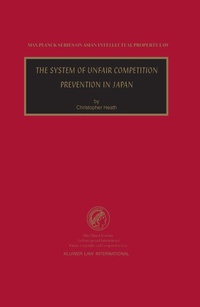
The System of Unfair Competition Prevention in Japan
Published on 1. May 2001
356 pages
978-90-411-7684-4 (ISBN)
Description

This is the first in-depth treatment in English of Japanese law and practice governing unfair competition. The author analyzes the interaction of the relevant laws - and the case law derived from each - to present a systematic description of how business reputation, trade secrets, well-known marks, and other aspects of business achievement and investment are protected against undue exploitation in Japan.
Prohibited acts of unfair competition covered include:
- misappropriation by confusion or passing-off;
- misappropriation through breach of trust or fiduciary duty;
- slavish imitation of distinct product features;
- trade mark piracy;
- tortious acts of denigration, libel, and slander;
- direct interference by, e.g., boycott or bribery;
- undue exercise of intellectual property rights; and
- misleading indications on goods and services (e.g., of geographical origin).
Several problematic areas - in particular, the obstacles to effective enforcement, and the lack of adequate protection for consumers against acts of unfair competition - are given particular emphasis. The book concludes with cogent proposals on how the Japanese system could be improved and developed, referring to the model provisions of the World Intellectual Property Organization and offering a new and original draft Unfair Competition Act.
Any business person or investor interested in the Japanese market will benefit enormously from this practical and insightful volume.
Prohibited acts of unfair competition covered include:
- misappropriation by confusion or passing-off;
- misappropriation through breach of trust or fiduciary duty;
- slavish imitation of distinct product features;
- trade mark piracy;
- tortious acts of denigration, libel, and slander;
- direct interference by, e.g., boycott or bribery;
- undue exercise of intellectual property rights; and
- misleading indications on goods and services (e.g., of geographical origin).
Several problematic areas - in particular, the obstacles to effective enforcement, and the lack of adequate protection for consumers against acts of unfair competition - are given particular emphasis. The book concludes with cogent proposals on how the Japanese system could be improved and developed, referring to the model provisions of the World Intellectual Property Organization and offering a new and original draft Unfair Competition Act.
Any business person or investor interested in the Japanese market will benefit enormously from this practical and insightful volume.
More details
Other editions
Additional editions
Christopher Heath
The System of Unfair Competition Prevention in Japan
Book
05/2001
1st Edition
Kluwer Law International
€128.94
Shipment within 10-20 days
Content
- Cover
- Half Title Page
- Editorial Board
- Title Page
- Copyright Page
- Dedication
- Table of Contents
- Acknowledgements
- Preface
- About the Author
- List of abbreviations
- CHAPTER 1 Historical overview
- I. The early Meiji Period
- II. Accession to the Paris Convention
- III. After World War I
- IV. The Unfair Competition Act of 1934
- V. Changes under the Allied Occupation
- VI. Complementary legislation
- VII. Protection of commercial achievements
- VIII. Latest developments
- IX. Enforcement figures
- X. Main sources of reference
- CHAPTER 2 Protection against "all acts" of unfair competition
- I. General overview
- 1. Unfair competition and the Paris Convention
- 2. Legal development in Japan
- 3. Unfair competition and the courts
- 4. Systematic considerations
- II. Protection under the Unfair Competition Act
- 1. Purpose
- 2. Prohibited acts
- 3. Exceptions
- 4. Remedies and standing to sue
- 5. Remedies for consumers?
- 6. Standing to sue and the public interest
- 7. Criminal sanctions
- III. Protection under the Anti-Monopoly Act and its by-laws
- 1. General outline
- 2. "Unfair business practices
- 3. Unfair trade practices and civil law in general
- 4. Free gifts and trade misrepresentations
- 5. Other legal instruments
- 6. Enforcement
- IV. Unfair competition and intellectual property rights
- 1. General outline
- 2. Unfair competition and technical rights
- 3. Unfair competition and aesthetic rights
- 4. Unfair competition and trade mark rights
- V. Protection under the Commercial Code
- 1. Legal framework
- 2. Requirements of application
- 3. Relationship to the Unfair Competition Act
- 4. Use and protection of foreign trade names
- VI. Protection under general tort law
- 1. General principles
- 2. Scope of application
- 3. Case material
- 4. Remedies
- VII. Unfair competition prevention in the context of Japanese legal culture
- 1. Institutional peculiarities
- 2. Political peculiarities
- 3. Legal consciousness
- 4. The style of decisions
- 5. Style of academic writings
- CHAPTER 3 Misappropriation of commercial achievements
- A. Misappropriation by confusion
- I. Introduction and international developments
- II. Statutory provisions of Japanese law
- III. The object of protection: indications for goods and business enterprises
- 1. CONFUSION WITH GOODS
- 2. CONFUSION WITH THE BUSINESS ESTABLISHMENT
- 3. INTERDEPENDENCE OF ELEMENTS
- IV. The requirement of recognition ("widely-known")
- 1. GENERAL CONCEPT
- 2. GEOGRAPHICAL RANGE OF RECOGNITION
- 3. THE RELEVANT CIRCLES IN TRADE
- 4. MARKETING EFFORTS TO ESTABLISH GOODWILL
- 5. DETERMINING WHAT IS RECOGNITION
- V. The requirement of confusion
- 1. SIMILARITY IN TRADE MARK AND UNFAIR COMPETITION LAW
- 2. THE CLASSIC CONCEPT OF CONFUSION
- 3. CONFUSION AS TO SPONSORSHIP/CONFUSION IN THE BROAD SENSE
- 4. CONFUSION BY ASSOCIATION WITH A KEIRETSU-GROUP
- 5. FRANCHISING SYSTEMS
- VI. Defences
- 1. LACK OF STANDING TO SUE
- 2. LACK OF CONFUSION
- 3. BETTER RIGHTS
- 4. UNCLEAN HANDS
- 5. TIME-BAR THROUGH INACTION
- B. Misappropriation by other means
- I. General remarks
- II. Protection of trade secrets
- 1. DEFINITION
- 2. PROTECTION UNDER TORT LAW
- 3. PROTECTION UNDER THE UNFAIR COMPETITION ACT
- 4. RESTRICTIVE COVENANTS
- 5. PROTECTION UNDER CRIMINAL LAW
- III. Protection against slavish imitation
- 1. GENERAL OUTLINE AND INTERNATIONAL DEVELOPMENTS
- 2. LEGISLATIVE BACKGROUND
- 3. PROTECTION UNDER INTELLECTUAL PROPERTY LAWS
- 4. INTERPRETATION
- 5. SLAVISH IMITATION AND THE FREEDOM TO COPY
- IV. The protection of well-known indications
- 1. INTERNATIONAL AND FOREIGN DEVELOPMENTS
- 2. PROTECTION OF FAMOUS TRADE MARKS IN JAPAN
- 3. ANALYSIS
- V. Misappropriation by an agent
- 1. HISTORY AND INTERNATIONAL DEVELOPMENTS
- 2. LEGAL PROVISION IN JAPAN
- VI. Application of foreign famous marks by domestic applicants
- 1. DOMESTIC APPLICATIONS AND DOMESTIC ECONOMIC INTERESTS
- 2. LEGAL REMEDIES UNDER THE UCA
- 3. OTHER REMEDIES
- VII. Publicity rights
- 1. GENERAL REMARKS
- 2. SCOPE AND LIMITS OF THE RIGHT OF PUBLICITY
- CHAPTER 4 Acts designed to interfere unreasonably with a competitor's business
- I. Introduction
- II. International and foreign developments
- III. Acts of interfering with a competitor's business under Japanese law
- 1. Unfair Competition Act
- 2. Actions based on civil law in general
- 3. Anti-trust law
- IV. Undue exercise of intellectual property rights
- 1. Acts of denigration
- 2. Other cases of improper exercise of an intellectual property right
- V. Comparative advertising
- 1. General remarks
- 2. Japanese law on comparative advertising
- VI. Unfair trade practices against a competitor's business
- 1. Acts specified under the Anti-Monopoly Act
- 2. Unjust interference and private actions
- VII. Acts and remedies outside competitive relationships
- 1. General remarks
- 2. General legal framework
- 3. Details of Sec. 2(1) (x) and (xi) UCA
- CHAPTER 5 Misleading indications
- I. International and foreign developments
- 1. International conventions and agreements
- 2. The dawn of consumerism
- 3. Consumer protection and free trade
- II. Misleading indications on goods and services under the UCA
- III. Advertising, free gifts, and representations
- 1. The Free Gifts and Trade Misrepresentations Act (Trade Misrepresentations Act)
- 2. Other administrative regulations designed to control deceptive forms of commercial activity
- 3. Self-disciplinary rules
- IV. Geographical indications
- 1. International agreements
- 2. Protection in Japan
- CHAPTER 6 Enforcement and legal remedies
- I. Civil law enforcement in general
- 1. Litigation and legal consciousness
- 2. Legal foundation and problems of Japanese civil procedure
- 3. Foreign reception, traditional perception and enforcement
- II. Particular rules on enforcing intellectual property and unfair competition matters
- 1. National and international jurisdiction
- 2. Selection of the basis of claim
- 3. Production of documents
- 4. Presumption of damages
- 5. Particular problems of in-camera proceedings
- III. Remedies
- 1. Temporary and final measures
- 2. Injunctive relief
- 3. Monetary compensation
- 4. Seizure of infringing goods
- 5. Destruction of goods
- 6. Apology
- IV. Administrative measures
- 1. Under the Anti-Monopoly Act
- 2. Under customs procedures
- V. Criminal enforcement
- 1. Criminal prosecution in cases of passing-off
- 2. Misleading indications
- 3. Criminal protection of trade secrets
- CHAPTER 7 Towards a comprehensive system of unfair competition prevention?
- I. Analysis in the context of Japanese law
- 1. The discussion for introducing a general clause
- 2. Setting up a comprehensive system for the control of unfair competition without a general clause
- 3. Paris Convention and domestic legislation
- 4. Considerations on a system of unfair competition prevention
- II. Unfair competition models and unfair competition system
- 1. General remarks
- 2. Germany as a model for Japan?
- III. The author's model Unfair Competition Act
- Summary
- Appendix of Legal Statutes and Provisions
- 1. Japanese Constitution (excerpts)
- 2. Civil Code (excerpts)
- 3. Code of Civil Procedure (excerpts)
- 4. Commercial Code (excerpts)
- 5. Criminal Code (excerpts)
- 6. Unfair Competition Prevention Act
- 7. Trade Mark Act (excerpts)
- 8. Act Concerning the Prohibition of Private Monopolies and the Maintenance of Fair Trade (Anti-Monopoly Act) (excerpts)
- 8. Free Gifts and Trade Misrepresentations Act
- 10. FTC Guideline on Unfair Trade Practices
- 11a. FTC Guideline on Misleading Indications as to the Origin of Goods
- 11b. FTC Application Guidelines for Misleading Indications with Respect to the Origin of Goods
- 12. FTC Guideline on Bait Advertising
- 13. FTC Legal Opinion on Comparative Advertising as of 21 April 1987 (slightly abbreviated)
- 14. FTC Legal Opinion on Sales Below Costs
- Chronological list of cases cited
- Index
- Back Cover
