

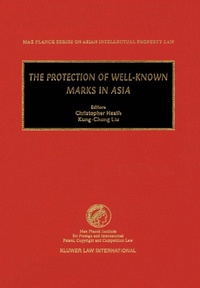
The Protection of Well-Known Marks in Asia
Published on 1. March 2000
252 pages
978-90-411-7676-9 (ISBN)
Description

Trade mark law has become an increasingly important field of law in the context of a rapidly globalizing economy. The promotion and protection of marks is widely viewed as the most important tool for a successful expansion of business, particularly in areas of economic transformation such as the Asia-Pacific region. The importance of the Asian market for global competition makes the appearance of a book on the protection of well-known marks in Asia extremely timely.
This collection of expert essays examines the legal protection of well-known marks both under trade mark and unfair competition law in 10 different jurisdictions of the Asia-Pacific region, analysing the still widespread piracy of well-known marks in the context of the underlying legal and cultural concepts.
It explores the significance of trade marks in an information society, highlighting the tensions between those seeking to protect their well-established brands globally in an age of electronic commerce, and those concerned to prevent large firms from being granted indiscriminate control over certain marks without having made the corresponding marketing efforts. It examines the opportunities and problems arising from the advent of the new digital technology, and looks at some of the issues the technology gives rise to, such as the protection of domain names.
The papers collected in this volume are the revised and updated proceedings of a conference on Trade Marks, Domain Names and Unfair Competition in the Information Age, held in Taipei in January 1999, as the result of the co-operation by the Sun Yat-Sen Institute for Social Sciences and Philosophy, Academia Sinica, Taipei, and the Max Planck Institute, Munich.
This collection of expert essays examines the legal protection of well-known marks both under trade mark and unfair competition law in 10 different jurisdictions of the Asia-Pacific region, analysing the still widespread piracy of well-known marks in the context of the underlying legal and cultural concepts.
It explores the significance of trade marks in an information society, highlighting the tensions between those seeking to protect their well-established brands globally in an age of electronic commerce, and those concerned to prevent large firms from being granted indiscriminate control over certain marks without having made the corresponding marketing efforts. It examines the opportunities and problems arising from the advent of the new digital technology, and looks at some of the issues the technology gives rise to, such as the protection of domain names.
The papers collected in this volume are the revised and updated proceedings of a conference on Trade Marks, Domain Names and Unfair Competition in the Information Age, held in Taipei in January 1999, as the result of the co-operation by the Sun Yat-Sen Institute for Social Sciences and Philosophy, Academia Sinica, Taipei, and the Max Planck Institute, Munich.
More details
Other editions
Additional editions
Christopher Heath
The Protection of Well-Known Marks in Asia
Book
03/2000
1st Edition
Kluwer Law International
€106.47
Shipment within 10-20 days
Content
- Cover
- Half Title Page
- Editorial Board
- Title Page
- Copyright Page
- Table of Contents
- Preface
- List of Contributors
- Introduction
- CHAPTER 1 Protection of Well-known Marks and Prevention of Trade Mark Piracy
- A. Protection of Well-known Indications
- I. Territoriality and Specificity of Marks
- II. Article 6bis of the Paris Convention
- III. Subsequent Developments
- IV. Article 16(2) and (3) of the TRIPs Agreement
- V. After TRIPs
- VI. Comparative Overview
- B. Prevention of Trade Mark Piracy
- I. General Introduction
- II. Principles of Unfair Competition and Prevention of Trade Mark Piracy
- CHAPTER 2 The Protection of Well-known Marks in China
- A. Introduction
- B. Basic Design and Principles of the Current Trade Mark System
- C. Protection of Well-known Marks in Judicial Practice
- I. The Substantive 'Average Consumer' Test of Similarity
- II. Names, Get-Ups and Decorations Unique to Well-Known Goods
- III. Damages to Goodwill with Respect to Well-Known Marks
- IV. Challenge to the Trade Mark Review and Adjudication Board Decisions
- V. Limited First-to-use Protection for Well-known Marks
- CHAPTER 3 The Protection of Well-known Marks in Taiwan
- A. Well-known Marks: From Foreign Imposition to Domestic Necessity
- B. The Evolution of the Trade Mark Law: Its Provisions and Practices
- I. Statutory Provisions
- II. Practical Application
- C. The Fair Trade Law
- I. Section 20
- II. Section 24
- III. Remedies
- D. Other Remedies
- E. Some Thoughts on the Protection of Well-known Marks
- I. The Concept of 'Well-known Marks'
- II. The Scope of Protection for Well-known Marks
- CHAPTER 4 The Protection of Well-known Marks in Japan
- A. Introduction
- I. History, Legal System and International Agreements
- II. Cultural and Legal Peculiarities
- B. Protection under Trade Mark Law
- I. General Principles
- II. Obstacles to Registration
- III. Defensive Marks
- IV. Associated Marks
- V. Reasons for Cancellation
- C. Protection under Unfair Competition Prevention Law
- I. General Introduction and Legal Framework
- II. Protection of Widely Known Indications Against Confusion
- III. The Protection of Famous Marks
- D. Remedies
- I. Opposition/Cancellation
- II. Injunctive Relief
- III. Damages
- IV. Apology
- V. Seizure and Destruction
- VI. Penal Sanctions
- CHAPTER 5 The Protection of Well-known Marks in Korea
- A. Introduction
- B. Protection under the Trade Mark Act
- I. Historical Development
- II. Basic Principles of Trade Mark Protection
- III. Protection of Unregistered Well-known Marks
- IV. Remedies
- C. Protection of Well-known Marks Under the Korean Act Against Unfair Competition
- I. Historical Development
- II. Causing Confusion with Respect to Another's Enterprises or its Activities
- D. Remedies
- E. Conclusion
- CHAPTER 6 The Protection of Well-known Marks in Singapore
- A. Introduction
- B. The Protection of 'Well-known Marks' under the 1998 Acts
- I. The Trade Marks Act 1998
- II. The Geographical Indications Act 1998
- C. International Trends in the Protection of Well-known Marks
- D. Conclusion
- CHAPTER 7 The Protection of Well-known Marks in Vietnam
- A. Introduction
- B. Applicable Trade Mark Law
- I. 1975 to 1 July 1996
- II. After 1 July 1996
- III. Transitional Provisions
- C. Registration
- I. Definition of a Trade Mark
- II. Who May Apply
- III. What May Be Registered
- IV. What May Not Be Registered
- V. First-to-file Principle and Right of Prior Use
- VI. Application Procedure
- D. Protection of Well-known Marks
- I. Concept
- II. Precedents
- E. Enforcement
- I. General Situation
- II. Administrative Action
- III. Civil Action
- IV. Criminal Action
- V. Future Prospects for Enforcing Intellectual Property Rights in Vietnam
- F. Conclusion
- CHAPTER 8 The Protection of Well-known Marks in Thailand
- A. Overview
- I. In General
- II. Trade Mark Law
- B. The 1991 Trade Marks Act
- I. In General
- II. Provisions on Well-known Marks
- III. Case Law
- IV. Criteria for Affirming Recognition
- CHAPTER 9 The Protection of Well-known Marks in the Philippines
- A. Introduction
- B. The IP Code and the Protection of Marks in General
- C. Special Considerations for the Protection of Well-known Marks
- D. Criteria for Determining whether a Mark is Well-known
- E. Remedies Available to the Trade Mark Owner
- F. Test of infringement
- I. Test of Comparing the Dominant Features
- II. Test of Comparing Marks in their Entirety
- III. Doctrine of Secondary Meaning
- IV. Phonetic Similarity
- V. Use of a Similar Mark on Non-related Goods
- G. Action for Unfair Competition
- H. Conclusion
- CHAPTER 10 The Protection of Well-known Marks in Malaysia
- A. Introduction
- B. Characteristics of a Well-known Mark
- I. Reputation Without Use
- II. Protection Beyond the Same Field of Activity
- III. Protection Against Dilution
- C. Defensive Trade Marks
- D. Conclusion
- CHAPTER 11 The Protection of Well-known Marks in Indonesia
- A. Introduction: 'Trade Mark Entrepreneurs' and the Indonesian Trade Mark System
- B. Lack of Good Faith in Using and Registering the Trade Mark
- C. Protection of Well-Known Trade Marks Via Legislation: The Trade Marks Act of 1992
- D. Well-Known Trade Marks After the 1997 Amendment of the Trade Marks Act
- E. Conclusion
- Further Reading
- Index
- Back Cover
