

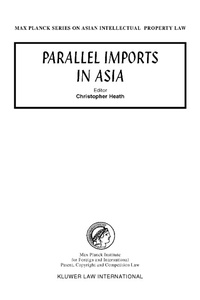
Parallel Imports in Asia
Published on 13. January 2004
240 pages
978-90-411-5760-7 (ISBN)
Description

In the absence of international rules governing parallel imports and exhaustion of intellectual property rights, issues arising in this context are left to the individual countries concerned. Asian countries, although generally more open towards parallel imports than Europe or the U.S., show marked differences both among their individual approaches and among the various intellectual property rights in question. Increasingly, permitting or blocking parallel imports of intellectually protected goods is regarded as a political decision to accommodate foreign pressure, domestic consumers, or right holders.
Due to the diversity of legal regimes in the jurisdictions covered, reliable information on the regimes of parallel imports in Asia has been hard to come by. Now, Parallel Imports in Asia brings together the insight and experience of fourteen academics and practitioners in this specialized but highly significant field, each highly respected in his or her particular country. Two concise introductory chapters clearly present the economic and legal foundations of the subject matter. Then, thirteen chapters offer in-depth analysis of exhaustion of intellectual property rights and parallel imports for each of twelve Asian jurisdictions-China, Taiwan, Japan, Korea, Vietnam, Thailand, Indonesia, The Philippines, Malaysia, Singapore, Hong Kong, and India-plus the Australasian bloc. With this book, businesses in all of these countries-and in particular India and the Australasian countries-can assess the strength of their IP rights against parallel importation in other parts of Asia.
All country reports are written in a uniform structure and take into account legal, political and economic considerations with respect to the parallel importation of patented, trademarked and copyrighted goods. A useful appendix provides a synoptical overview on the rules of parallel importation in Asia.
While academics will find here a thought-provoking survey of an important but relatively unstudied area of intellectual property law, Parallel Imports in Asia will prove to be of greatest value to potential investors in Asia, particularly with regard to market separation and licensing agreements. It will also help practicing lawyers for globally operating companies to appropriately counsel their clients in this area of business decision making.
Due to the diversity of legal regimes in the jurisdictions covered, reliable information on the regimes of parallel imports in Asia has been hard to come by. Now, Parallel Imports in Asia brings together the insight and experience of fourteen academics and practitioners in this specialized but highly significant field, each highly respected in his or her particular country. Two concise introductory chapters clearly present the economic and legal foundations of the subject matter. Then, thirteen chapters offer in-depth analysis of exhaustion of intellectual property rights and parallel imports for each of twelve Asian jurisdictions-China, Taiwan, Japan, Korea, Vietnam, Thailand, Indonesia, The Philippines, Malaysia, Singapore, Hong Kong, and India-plus the Australasian bloc. With this book, businesses in all of these countries-and in particular India and the Australasian countries-can assess the strength of their IP rights against parallel importation in other parts of Asia.
All country reports are written in a uniform structure and take into account legal, political and economic considerations with respect to the parallel importation of patented, trademarked and copyrighted goods. A useful appendix provides a synoptical overview on the rules of parallel importation in Asia.
While academics will find here a thought-provoking survey of an important but relatively unstudied area of intellectual property law, Parallel Imports in Asia will prove to be of greatest value to potential investors in Asia, particularly with regard to market separation and licensing agreements. It will also help practicing lawyers for globally operating companies to appropriately counsel their clients in this area of business decision making.
More details
Other editions
Additional editions
Christopher Heath
Parallel Imports in Asia
Book
02/2004
Kluwer Law International
€329.80
Shipment within 10-20 days
Content
- Cover
- Half Title Page
- Editorial Board
- Title Page
- Copyright Page
- Dedication
- Contents
- Detailed Table of Contents
- Preface
- About the Authors and Editors
- CHAPTER 1 Economic Considerations on Parallel Imports
- I. What are Parallel Imports?
- II. Theoretical Considerations
- 1. Intellectual Property
- 2. Trade
- 3. Competition
- 4. Cost/Benefit-Welfare Framework
- III. Empirical Considerations
- 1. Information Constraints
- 2. Survey Results
- 3. Future Empirical Inquiry
- IV. Key Policy Considerations
- CHAPTER 2 Legal Concepts of Exhaustion and Parallel Imports
- I. Terminology
- II. Doctrinal Concepts
- III. International Exhaustion and Patent Rights
- IV. Parallel Imports and Trade Marks
- V. Copyrights
- VI. Cumulation of Rights
- VII. International Law
- CHAPTER 3 Exhaustion and Parallel Imports in China
- I. Introduction
- II. The Present Legal Framework
- 1. Patent Act
- 2. Trade Mark Act
- 3. Copyright Act
- 4. Competition Law
- 5. Customs Regulation on Intellectual Property Rights
- III. Economic Considerations
- 1. Academic Writings
- 2. Economic Considerations
- IV. Political Considerations
- 1. The Purpose of Patent Legislation in China
- 2. China as an Importer of Technology
- 3. Impact of Prohibiting Parallel Imports
- V. Suggestions
- CHAPTER 4 Exhaustion and Parallel Imports in Taiwan
- A. Legal Framework
- I. Introduction
- II. Patent Law
- 1. Right of Importation
- 2. Contractual Exhaustion?
- III. Trade Mark Law
- 1. The Stance of the Supreme Court
- 2. Codification of the Exhaustion Doctrine
- IV. Copyright Law
- 1. Indirect Right of Importation
- 2. Resale and Rental of Legally Imported Genuine Copies
- V. The Integrated Circuit Layouts Protection Act
- VI. Antitrust Law
- B. Economic and Political Considerations
- CHAPTER 5 Exhaustion and Parallel Imports in Japan
- I. Introduction
- II. Patents
- 1. Legislation
- 2. Court Decisions
- III. Trade Marks
- 1. Legislation
- 2. Court Decisions
- IV. Copyrights
- 1. Legislation
- 2. Court Decisions
- V. Anti-trust Law
- VI. Customs Regulations
- 1. Trade Marks
- 2. Patent Rights
- CHAPTER 6 Exhaustion and Parallel Imports in Korea
- I. Introduction
- II. Exhaustion of Rights and Parallel Imports Under Korean Law
- 1. Patent Rights
- 2. Trade Mark Rights
- 3. Copyrights
- III. Parallel Imports and Competition Law
- IV. Conclusion
- CHAPTER 7 Exhaustion and Parallel Imports in Vietnam
- A. Legal Framework
- I. Patent Law
- 1. Legal Provisions
- 2. Court Decisions
- II. Trade Mark Law
- 1. Provisions in Trade Mark Legislation
- 2. Court Decisions
- III. Copyright Law
- 1. Provisions in Copyright Legislation
- 2. Court Decisions
- IV. Anti-trust Law
- 1. Provisions in Anti-trust Legislation
- 2. Court Decisions
- B. Economic considerations
- C. Political considerations
- CHAPTER 8 Exhaustion and Parallel Imports in Thailand
- I. Introduction
- II. The Establishment of an Intellectual Property and International Trade Court
- III. Some Salient Features of the IP&IT Court System
- IV. Patents and Parallel Importation
- V. The Role of the IP&IT Court and Exhaustion in Trade Mark Law
- VI. Copyrights and Parallel Importation
- CHAPTER 9 Exhaustion and Parallel Imports in Indonesia
- A. Legal Framework
- I. Patent Law: Legal Provisions in the Patents Act/Industrial Designs Act
- II. Trade Mark Law: Provisions in the Trade Marks Act
- III. Copyright Law: Provisions in the Copyright Act
- IV. Antitrust Law: Provisions in Fair Trade Acts/Guidelines by Fair Trade Commissions, Ministries, Fair Trade Bodies, etc.
- B. Economic Considerations
- C. Political Considerations
- CHAPTER 10 Exhaustion and Parallel Imports in the Philippines
- A. Legal Framework
- I. Intellectual Property Code
- 1. Patents
- 2. Trade Marks
- 3. Copyrights
- 4. Unfair Competition (Passing-off)
- II. Civil Code Provisions Cited in Yu v. CA and U-Bix v. Ariancorp cases
- 1. Supreme Court Case: "Yu v. CA
- 2. Court of Appeals Case: "U-Bix v. Ariancorp
- B. Economic considerations
- C. Political Considerations
- CHAPTER 11 Exhaustion and Parallel Imports in Malaysia
- I. Introduction
- II. Patent Law
- III. Trade Mark Law
- IV. Copyright Law
- V. Economic and Political Considerations
- CHAPTER 12 Exhaustion and Parallel Imports in Singapore
- A. Legal Framework
- I. Patent / Design Law
- II. Trade Mark Law
- III. Copyright Law
- IV. Layout-Design Law
- V. Anti-trust Law
- B. Economic/Political Considerations
- CHAPTER 13 Exhaustion and Parallel Imports in Hong Kong
- I. Introduction
- II. Patents and Designs
- 1. Patents
- 2. Registered Design Law
- III. Trade Mark Law
- IV. Copyright Law
- V. Anti-trust
- VI. Customs Rules
- VII. Conclusion
- CHAPTER 14 Exhaustion and Parallel Imports in India
- A. Legal Framework
- I. Patents and Related Rights
- 1. Patent Law
- 2. Design Law
- 3. Semiconductors Layout Design Law
- II. Trade Marks
- III. Copyright Law
- IV. Competition and Unfair Trade
- B. Economic and Political Considerations
- CHAPTER 15 Exhaustion and Parallel Imports in New Zealand and Australia
- I. New Zealand
- II. Australia
- III. CER
- Synopses
- Index
- Back Cover
