

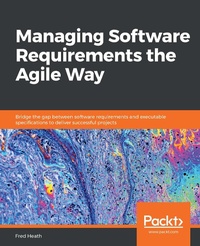
Managing Software Requirements the Agile Way
Bridge the gap between software requirements and executable specifications to deliver successful projects
Published on 23. September 2024
214 pages
978-1-80020-499-7 (ISBN)
Description

Learn how to deliver software that meets your clients' needs with the help of a structured, end-to-end methodology for managing software requirements and building suitable systems
Key Features
Learn how to communicate with a project's stakeholders to elicit software requirements
Deal every phase of the requirement life cycle with pragmatic methods and techniques
Manage the software development process and deliver verified requirements using Scrum and Kanban
Book DescriptionDifficulty in accurately capturing and managing requirements is the most common cause of software project failure. Learning how to analyze and model requirements and produce specifications that are connected to working code is the single most fundamental step that you can take toward project success. This book focuses on a delineated and structured methodology that will help you analyze requirements and write comprehensive, verifiable specifications. You'll start by learning about the different entities in the requirements domain and how to discover them based on customer input. You'll then explore tried-and-tested methods such as impact mapping and behavior-driven development (BDD), along with new techniques such as D3 and feature-first development. This book takes you through the process of modeling customer requirements as impact maps and writing them as executable specifications. You'll also understand how to organize and prioritize project tasks using Agile frameworks, such as Kanban and Scrum, and verify specifications against the delivered code. Finally, you'll see how to start implementing the requirements management methodology in a real-life scenario. By the end of this book, you'll be able to model and manage requirements to create executable specifications that will help you deliver successful software projects.What you will learn
Kick-start the requirements-gathering and analysis process in your first meeting with the client
Accurately define system behavior as features
Model and describe requirement entities using Impact Mapping and BDD
Create a feature-based product backlog and use it to drive software development
Write verification code to turn features into executable specifications
Deliver the right software and respond to change using either Scrum or Kanban
Choose appropriate software tools to provide transparency and traceability to your clients
Who this book is forThis book is for software engineers, business analysts, product managers, project managers, and software project stakeholders looking to learn a variety of techniques and methodologies for collating accurate software requirements. A fundamental understanding of the software development life cycle (SDLC) is needed to get started with this book. Although not necessary, basic knowledge of the Agile philosophy and practices, such as Scrum, along with some programming experience will help you to get the most out of this book.
Key Features
Learn how to communicate with a project's stakeholders to elicit software requirements
Deal every phase of the requirement life cycle with pragmatic methods and techniques
Manage the software development process and deliver verified requirements using Scrum and Kanban
Book DescriptionDifficulty in accurately capturing and managing requirements is the most common cause of software project failure. Learning how to analyze and model requirements and produce specifications that are connected to working code is the single most fundamental step that you can take toward project success. This book focuses on a delineated and structured methodology that will help you analyze requirements and write comprehensive, verifiable specifications. You'll start by learning about the different entities in the requirements domain and how to discover them based on customer input. You'll then explore tried-and-tested methods such as impact mapping and behavior-driven development (BDD), along with new techniques such as D3 and feature-first development. This book takes you through the process of modeling customer requirements as impact maps and writing them as executable specifications. You'll also understand how to organize and prioritize project tasks using Agile frameworks, such as Kanban and Scrum, and verify specifications against the delivered code. Finally, you'll see how to start implementing the requirements management methodology in a real-life scenario. By the end of this book, you'll be able to model and manage requirements to create executable specifications that will help you deliver successful software projects.What you will learn
Kick-start the requirements-gathering and analysis process in your first meeting with the client
Accurately define system behavior as features
Model and describe requirement entities using Impact Mapping and BDD
Create a feature-based product backlog and use it to drive software development
Write verification code to turn features into executable specifications
Deliver the right software and respond to change using either Scrum or Kanban
Choose appropriate software tools to provide transparency and traceability to your clients
Who this book is forThis book is for software engineers, business analysts, product managers, project managers, and software project stakeholders looking to learn a variety of techniques and methodologies for collating accurate software requirements. A fundamental understanding of the software development life cycle (SDLC) is needed to get started with this book. Although not necessary, basic knowledge of the Agile philosophy and practices, such as Scrum, along with some programming experience will help you to get the most out of this book.
More details
Edition
Digital original
Language
English
Place of publication
Birmingham
United Kingdom
Target group
Professional and scholarly
US School Grade: College Graduate Student
Edition type
Digital original
File size
7,21 MB
ISBN-13
978-1-80020-499-7 (9781800204997)
Copyright in bibliographic data and cover images is held by Nielsen Book Services Limited or by the publishers or by their respective licensors: all rights reserved.
Schweitzer Classification
Other editions
Additional editions
Fred Heath
Managing Software Requirements the Agile Way
Bridge the gap between software requirements and executable specifications to deliver successful projects
Book
08/2020
Packt Publishing
€45.30
Shipment within 3-4 weeks
Person
Heath Fred :
Fred Heath is a freelance developer and consultant based in Wales, UK. Over the last 20 years, he's worked at every stage of the software development life cycle using a variety of languages and platforms and ended up falling in love with Ruby and its ecosystem. Fred enjoys solving tricky problems, FOSS, meta programming, Behavior-Driven Development, and Agile processes. He also frequently writes online and speaks at conferences about Ruby, software development, and best practices. Fred is always happy to hear from you and chat about Ruby and Rails on Twitter.
Fred Heath is a freelance developer and consultant based in Wales, UK. Over the last 20 years, he's worked at every stage of the software development life cycle using a variety of languages and platforms and ended up falling in love with Ruby and its ecosystem. Fred enjoys solving tricky problems, FOSS, meta programming, Behavior-Driven Development, and Agile processes. He also frequently writes online and speaks at conferences about Ruby, software development, and best practices. Fred is always happy to hear from you and chat about Ruby and Rails on Twitter.
Content
Table of Contents
The Requirements Domain
Impact Mapping and Behavior-Driven Development
Writing Fantastic Features with the Gherkin Language
Crafting Features using Principles and Patterns
Discovering and Analyzing Requirements
Organizing Requirements
Feature-First development
Creating Automated Verification Code
The Requirements Life Cycle
Use-Case: The Camford University Paper Publishing System
The Requirements Domain
Impact Mapping and Behavior-Driven Development
Writing Fantastic Features with the Gherkin Language
Crafting Features using Principles and Patterns
Discovering and Analyzing Requirements
Organizing Requirements
Feature-First development
Creating Automated Verification Code
The Requirements Life Cycle
Use-Case: The Camford University Paper Publishing System
