

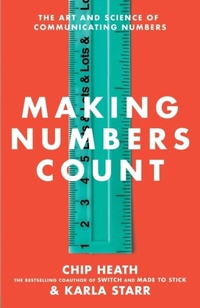
Making Numbers Count
The Art and Science of Communicating Numbers
1st Edition
Published on 11. January 2022
208 pages
978-1-9821-6545-1 (ISBN)
Description

A clear, practical, first-of-its-kind guide to communicating and understanding numbers and data?from bestselling business author Chip Heath.
How much bigger is a billion than a million?
Well, a million seconds is twelve days. A billion seconds is…thirty-two years.
Understanding numbers is essential?but humans aren't built to understand them. Until very recently, most languages had no words for numbers greater than five?anything from six to infinity was known as "lots." While the numbers in our world have gotten increasingly complex, our brains are stuck in the past. How can we translate millions and billions and milliseconds and nanometers into things we can comprehend and use?
Author Chip Heath has excelled at teaching others about making ideas stick and here, in Making Numbers Count, he outlines specific principles that reveal how to translate a number into our brain's language. This book is filled with examples of extreme number makeovers, vivid before-and-after examples that take a dry number and present it in a way that people click in and say "Wow, now I get it!"
You will learn principles such as:
-SIMPLE PERSPECTIVE CUES: researchers at Microsoft found that adding one simple comparison sentence doubled how accurately users estimated statistics like population and area of countries.
-VIVIDNESS: get perspective on the size of a nucleus by imagining a bee in a cathedral, or a pea in a racetrack, which are easier to envision than "1/100,000th of the size of an atom."
-CONVERT TO A PROCESS: capitalize on our intuitive sense of time (5 gigabytes of music storage turns into "2 months of commutes, without repeating a song").
-EMOTIONAL MEASURING STICKS: frame the number in a way that people already care about ("that medical protocol would save twice as many women as curing breast cancer").
Whether you're interested in global problems like climate change, running a tech firm or a farm, or just explaining how many Cokes you'd have to drink if you burned calories like a hummingbird, this book will help math-lovers and math-haters alike translate the numbers that animate our world?allowing us to bring more data, more naturally, into decisions in our schools, our workplaces, and our society.
How much bigger is a billion than a million?
Well, a million seconds is twelve days. A billion seconds is…thirty-two years.
Understanding numbers is essential?but humans aren't built to understand them. Until very recently, most languages had no words for numbers greater than five?anything from six to infinity was known as "lots." While the numbers in our world have gotten increasingly complex, our brains are stuck in the past. How can we translate millions and billions and milliseconds and nanometers into things we can comprehend and use?
Author Chip Heath has excelled at teaching others about making ideas stick and here, in Making Numbers Count, he outlines specific principles that reveal how to translate a number into our brain's language. This book is filled with examples of extreme number makeovers, vivid before-and-after examples that take a dry number and present it in a way that people click in and say "Wow, now I get it!"
You will learn principles such as:
-SIMPLE PERSPECTIVE CUES: researchers at Microsoft found that adding one simple comparison sentence doubled how accurately users estimated statistics like population and area of countries.
-VIVIDNESS: get perspective on the size of a nucleus by imagining a bee in a cathedral, or a pea in a racetrack, which are easier to envision than "1/100,000th of the size of an atom."
-CONVERT TO A PROCESS: capitalize on our intuitive sense of time (5 gigabytes of music storage turns into "2 months of commutes, without repeating a song").
-EMOTIONAL MEASURING STICKS: frame the number in a way that people already care about ("that medical protocol would save twice as many women as curing breast cancer").
Whether you're interested in global problems like climate change, running a tech firm or a farm, or just explaining how many Cokes you'd have to drink if you burned calories like a hummingbird, this book will help math-lovers and math-haters alike translate the numbers that animate our world?allowing us to bring more data, more naturally, into decisions in our schools, our workplaces, and our society.
More details
Other editions
Additional editions
Book
01/2022
Avid Reader Press / Simon & Schuster
€25.50
Shipment within 10-20 days
Persons
Chip Heath is a professor at Stanford Graduate School of Business. Chip and his brother Dan have written four New York Times bestselling books: Made to Stick, Switch, Decisive, and The Power of Moments. Their books have sold over three million copies worldwide and have been translated into thirty-three languages including Thai, Arabic, and Lithuanian. He has helped over 530 startups refine and articulate their strategy and mission. Chip lives in Los Gatos, California.
Karla Starr has written for O, The Oprah Magazine; The Atlantic; Slate; Popular Science; and appeared on CBS Sunday Morning. A member of the National Association of Science Writers and the recipient of a Best Science/Health award from the Society of Professional Journalists, her first book, Can You Learn to Be Lucky? Why Some People Seem to Win More Often Than Others, was named a Fast Company Best Book of the Year. She writes at KStarr.com and lives in Portland, Oregon.
Karla Starr has written for O, The Oprah Magazine; The Atlantic; Slate; Popular Science; and appeared on CBS Sunday Morning. A member of the National Association of Science Writers and the recipient of a Best Science/Health award from the Society of Professional Journalists, her first book, Can You Learn to Be Lucky? Why Some People Seem to Win More Often Than Others, was named a Fast Company Best Book of the Year. She writes at KStarr.com and lives in Portland, Oregon.
Content
- Intro
- Title Page
- Introduction
- Translate Everything, Favor User-Friendly Numbers
- Translate Everything
- Avoid Numbers: Perfect Translations Don't Need Numbers
- Try Focusing on 1 at a Time
- Favor User-Friendly Numbers
- To Help People Grasp Your Numbers, Ground Them in the Familiar, Concrete, and Human Scale
- Find Your Fathom: Help People Understand Through Simple, Familiar Comparisons
- Convert Abstract Numbers into Concrete Objects
- Recast Your Number Into Different Dimensions: Try Time, Space, Distance, Money, and Pringles
- Human Scale: Use the Goldilocks Principle to Make Your Numbers Just Right
- Use Emotional Numbers-Surprising and Meaningful-To Move People to Think and Act Differently
- Florence Nightingale Avoids Dry Statistics by Using Transferred Emotion
- Comparatives, Superlatives, and Category Jumpers
- Emotional Amplitude: Selecting Combos That Hit the Right Notes Together
- Make It Personal: "This Is About You"
- Bring Your Number into the Room with a Demonstration
- Avoid Numbing by Converting Your Number to a Process That Unfolds Over Time
- Offer an Encore
- Make People Pay Attention by Crystallizing a Pattern, Then Breaking It
- Build a Scale Model
- Map the Landscape by Finding the Landmarks
- Build a Scale Model You Can Work With
- Epilogue: The Value of Numbers
- Appendix: Making Your Numbers User-Friendly
- About the Authors
- Endnotes
- Index
- Copyright
