

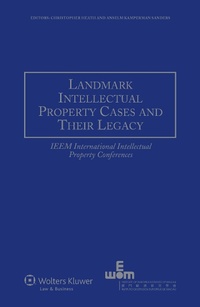
Landmark Intellectual Property Cases and Their Legacy
IEEM International Intellectual Property Conferences
Published on 21. December 2010
272 pages
978-90-411-5546-7 (ISBN)
Description

This is a book dedicated to the significance and legacy of landmark cases in
the field of intellectual property. Eleven well-known scholars offer in-depth
commentary and analysis of cases that have made an impact on legal theory or
critical thinking about the scope and purpose of the protection of
intellectual and industrial creativity. All the cases covered have proven
useful in developing doctrine, even though subsequent developments have made
some appear 'misleading' rather than 'leading', and for some recent cases it
is too early to say whether their approach will become mainstream. Among the
fundamental questions - all profoundly interesting, and to which no definite
answers have yet been found - arising in the course of the analysis are the
following:
Who should be master over the reputation, esteem and legacy of authors and
their works - authors and their heirs, or subsequent copyright owners?
What, if any, protection should be granted to achievements in the absence of
confusion?
Should prevention of unfair competition allow one to 'reap what one has not
sown'?
Should we protect commercial investment beyond the scope of defined
intellectual property rights?
Should it be considered a tort to use a well-known mark in a way that may
dilute its repute and distinctive character?
What kinds of monopolies should be protected, if any?
Does the patent system in its current form allow us to question the
assumption that technological progress is good per se, and that novel and
inventive solutions should thus be protected?
Should extraneous considerations such as public good and social usefulness
be considered at the stages of grant and enforcement of patent rights?
Should we grant patents over living organisms whose workings and
reproduction are a long way from being completely understood?
Should the rules developed for the enforcement of property rights limit a
patentee's remedies to appropriate damages, thereby effectively granting a
compulsory licence?
The book concludes with an analysis of two case clusters remarkable for the
worldwide dimension of the dispute. The authors show how litigation over Lego
in about 30 jurisdictions and Budweiser in over 40 jurisdictions has enriched
doctrine on such issues as contract, trade marks, trade names, geographical
indications, property rights in general, human rights, and various
international and bilateral treaties, all as they impinge on the protection of
intellectual property rights. For scholars in the field, as well as for
lawyers seeking a rich vein of doctrine to buttress a case, this unusual book
will be of incomparable value. As a masterful clarification of salient
doctrine, it represents a major contribution to the legal theory underpinning
intellectual property law.
the field of intellectual property. Eleven well-known scholars offer in-depth
commentary and analysis of cases that have made an impact on legal theory or
critical thinking about the scope and purpose of the protection of
intellectual and industrial creativity. All the cases covered have proven
useful in developing doctrine, even though subsequent developments have made
some appear 'misleading' rather than 'leading', and for some recent cases it
is too early to say whether their approach will become mainstream. Among the
fundamental questions - all profoundly interesting, and to which no definite
answers have yet been found - arising in the course of the analysis are the
following:
Who should be master over the reputation, esteem and legacy of authors and
their works - authors and their heirs, or subsequent copyright owners?
What, if any, protection should be granted to achievements in the absence of
confusion?
Should prevention of unfair competition allow one to 'reap what one has not
sown'?
Should we protect commercial investment beyond the scope of defined
intellectual property rights?
Should it be considered a tort to use a well-known mark in a way that may
dilute its repute and distinctive character?
What kinds of monopolies should be protected, if any?
Does the patent system in its current form allow us to question the
assumption that technological progress is good per se, and that novel and
inventive solutions should thus be protected?
Should extraneous considerations such as public good and social usefulness
be considered at the stages of grant and enforcement of patent rights?
Should we grant patents over living organisms whose workings and
reproduction are a long way from being completely understood?
Should the rules developed for the enforcement of property rights limit a
patentee's remedies to appropriate damages, thereby effectively granting a
compulsory licence?
The book concludes with an analysis of two case clusters remarkable for the
worldwide dimension of the dispute. The authors show how litigation over Lego
in about 30 jurisdictions and Budweiser in over 40 jurisdictions has enriched
doctrine on such issues as contract, trade marks, trade names, geographical
indications, property rights in general, human rights, and various
international and bilateral treaties, all as they impinge on the protection of
intellectual property rights. For scholars in the field, as well as for
lawyers seeking a rich vein of doctrine to buttress a case, this unusual book
will be of incomparable value. As a masterful clarification of salient
doctrine, it represents a major contribution to the legal theory underpinning
intellectual property law.
More details
Other editions
Additional editions
Christopher Heath | Anselm Kamperman Sanders
Landmark Intellectual Property Cases and Their Legacy
IEEM International Intellectual Property Conferences
Book
12/2010
1st Edition
Kluwer Law International
€229.16
Shipment within 10-20 days
Content
- Cover
- Half Title Page
- Title Page
- Copyright Page
- IEEM and International Intellectual Property Law
- Summary of Contents
- Table of Contents
- Preface
- Authors and Editors
- Chapter 1 Shostakovich and John Huston: The French Supreme Court on Copyright, Contracts and Moral Rights
- 1. THE SHOSTAKOVICH CASES
- 2. THE JOHN HUSTON CASE
- Chapter 2 Moral Rights 2.0
- 1. INTRODUCTION
- 2. OBSOLESCENCE
- 3. CREATIVE REUSE AND SEMIOTIC DEMOCRACY
- 4. LIBERATIVE REUSE AND DEMOCRACY
- 5. RIGHT TO DELETE
- 6. CONCLUSION
- Chapter 3 The Legacy of International News Service v. Associated Press (USA)
- 1. THE INS-CASE: THE CLASSIC AMERICAN TORT OF MISAPPROPRIATION
- 1.1. THE FACTS IN INS AND THE CENTRAL ELEMENTS OF THE MISAPPROPRIATION ACTION
- 1.2. QUASI-PROPERTY OR UNFAIR COMPETITION?
- 2. THE CHEQUERED HISTORY OF INS V. AP
- 2.1. THE IMPACT OF INS V. AP ON STATES' MISAPPROPRIATION LAWS, ON UK AND AUSTRALIAN LAW, AND ON FEDERAL US RESTATEMENTS IN THE FIELD
- 3. RELATIONSHIP TO IP RIGHTS: THE ISSUE OF PRE-EMPTION
- 3.1. PRE-EMPTION BY FEDERAL INTELLECTUAL PROPERTY LEGISLATION
- 3.2. LESSONS FOR EUROPEAN LAW
- 4. INS AND DATABASE PROTECTION
- 4.1. INS AND EUROPEAN DATABASE PROTECTION?
- 4.2. INS AS A PATHFINDER FOR US DATABASE PROTECTION?
- 5. DISCOVERING AND DEVELOPING IP RIGHTS: AN ASSIGNMENT FOR THE JUDGE OR FOR THE LEGISLATOR?
- Chapter 4 Odol: The Introduction of a Watery Concept with Steeled Resilience
- 1. INTRODUCTION
- 2. THE DISPUTE
- 3. THE ROOTS OF THE DILUTION RATIONALE
- 4. THE LEGACY OF ODOL: TRANSATLANTIC RECEPTION
- 5. THE LEGACY OF ODOL: CROSS-ATLANTIC PARALLEL IMPORT
- 6. CONCLUSION
- Chapter 5 Darcy v. Allen
- 1. OF MONOPOLIES . . .
- 1.1. . . .AND LEGACIES
- 2. A LITTLE BACKGROUND
- 3. THE CASE
- 3.1. THE PREROGATIVE QUESTIONED
- 3.2. THE DECISION
- 3.3. COKE'S REPORT OF THE DECISION
- 3.3.1. The First Question
- 3.3.2. The Second Question
- 3.4. COKE'S REPORT: ALTERED REALITY?
- 4. THE IMMEDIATE IMPACT OF THE DECISION
- 5. CONCLUSION
- Chapter 6 The Taiwanese 'Philips' CD-R Cases: Abuses of a Monopolistic Position, Cartel and Compulsory Patent Licensing
- 1. INTRODUCTION
- 2. ABUSE OF A JOINT MONOPOLISTIC POSITION
- 2.1. IMPROPERLY MAINTAINING PRICES
- 2.2. OTHER EXPLOITATIVE ABUSES
- 3. DID THE DEFENDANTS FORM A CARTEL?
- 3.1. CONFIRMED BY THE TFTC
- 3.2. DENIED BY THE TAIPEI ADMINISTRATIVE HIGH COURT AND THE SUPREME ADMINISTRATIVE COURT
- 4. THE COMPULSORY PATENT LICENSING
- 4.1. TIPO'S DECISION TO GRANT A COMPULSORY PATENT LICENSE AGAINST PHILIPS
- 4.2. TIPO'S DECISION TO ANNUL THE COMPULSORY PATENT LICENSE
- 4.3. THE TAIPEI ADMINISTRATIVE HIGH COURT RESCINDED TIPO'S DECISION TO GRANT A COMPULSORY PATENT LICENSE
- 5. THE RAMIFICATIONS ABROAD
- 5.1. IN THE US: RAISING THE PATENT MISUSE ISSUE UNDER THE PATENT ACT
- 5.1.1. Philips Has Market Power in the Relevant Market
- 5.1.2. Package License of 'Essential' and 'Non-essential' Patents
- 5.1.3. No Patent Misuse under Per Se Analysis
- 5.1.4. No Patent Misuse under Rule of Reason Analysis
- 5.1.5. Even if Philips and Sony Agreed to Suppress Sony's Technology, Such an Agreement would not Constitute Patent Misuse
- 5.2. IN THE EU
- 6. THE AFTERMATH
- 6.1. AILING CD-R MARKET IN TAIWAN
- 6.2. PHILIPS'S DEMAND OF SENSITIVE INFORMATION VIOLATED SECTION 24 OF THE FAIR TRADE ACT?
- 6.3. THE TFTC SUBSTANTIALLY REVISED ITS GUIDELINES ON TECHNOLOGY LICENSING ARRANGEMENTS IN 2009
- 6.3.1. Analytical Steps
- 6.3.2. White Clauses
- 6.3.3. Black Clauses
- 6.3.4. Evaluation of the Guidelines
- 6.4. THE IP COURT AWARDED PHILIPS FULL ROYALTY DESPITE OF VIOLATION OF ARTICLE 10 OF THE FAIR TRADE ACT
- 6.5. THE DRAFT COMPULSORY PATENT-LICENSING PROVISIONS
- 7. FUTURE PROSPECTS
- Chapter 7 The Anton Piller Case and Its Legacy: In Search of a Balance in Civil Search
- 1. ANTON PILLER KG V. MANUFACTURING PROCESSES LTD
- 1.1. WHEN LORD DENNING MEETS HUGH LADDIE QC
- 1.2. ANTON PILLER: IS IT A SEARCH WARRANT FOR CIVIL CASES?
- 1.3. WHAT ARE THE EXCEPTIONAL CIRCUMSTANCES PARTICULAR TO THE ANTON PILLER CASE?
- 1.4. ANTON PILLER ORDERS: DISQUIET ABOUT THEIR SUCCESS
- 2. THE ANTON PILLER ORDERS TODAY: THE SEARCH ORDERS IN THE UK
- 2.1. PROCEDURE FOR APPLICATION
- 2.2. BUILT-IN SAFEGUARDS TO AVOID MISUSE AND PROTECT THE DEFENDANT
- 2.3. IS THE DEFENDANT FORCED TO COMPLY WITH THE ORDER?
- 3. TOWARDS A GLOBAL RECOGNITION OF CIVIL SEARCH OR ANTON PILLER ORDER IN EUROPE AND BEYOND?
- 3.1. ARTICLE 50 OF THE TRIPS AGREEMENT DEFINES THE MINIMUM AT INTERNATIONAL LEVEL
- 3.2. THE LEGISLATIVE PROCESS LEADING TO ARTICLE 7 OF THE 2004 ENFORCEMENT DIRECTIVE: SOME EVIDENCE OF THE LEGACY OF ANTON PILLER
- 3.3. OBJECTIVES AND BUILDING BLOCKS OF ARTICLE 7 OF THE 2004 ENFORCEMENT DIRECTIVE
- 3.4. SOME UNRESOLVED ISSUES AND OPEN QUESTIONS IN RELATION TO THE IMPLEMENTATION OF ARTICLE 7 OF THE 2004 ENFORCEMENT DIRECTIVE
- 3.4.1. Protection of Confidential Information
- 3.4.2. Persons Participating to the Search
- 3.4.3. Persons Granting the Civil Order
- 3.4.4. The Evidence Needed to Obtain a Civil Search
- 3.4.5. The Possibility to Modulate the Evidence Threshold for the Description and for the Physical Seizure
- 4. CONCLUSION: FROM ANTON PILLER TO THE MODERN CIVIL SEARCH IN EUROPE, IN SEARCH OF THE BALANCE OF CIVIL SEARCH
- Chapter 8 The Case eBay Inc. v. MercExchange LLC, Its Impact on NPE's and Patent Enforcement
- Chapter 9 Hitting the Bricks Protecting the LEGO Brick around the World
- 1. OVERVIEW
- 1.1. THE CONTEXT OF THE ISSUE
- 1.2. OUTLINE OF PRESENTATION AND PAPER
- 2. LEGO BRICKS: AN AUSPICIOUS HISTORY
- 2.1. SEVENTY YEARS OF COMMERCIAL SUCCESS
- 2.2. HOW DID THE LEGO BRICK COME TO MARKET?
- 3. A SELECTION OF CASES
- 3.1. SUMMARY OF OUTCOMES
- 3.2. AUSTRALIA (FIRST INSTANCE), 1991
- 3.2.1. Background
- 3.2.2. Copyright
- 3.2.3. Trade Practices Act and Passing Off
- 3.2.4. Findings
- 3.3. AUSTRALIA (APPEAL), 1992
- 3.4. HONG KONG (FIRST INSTANCE), 1986
- 3.4.1. Background
- 3.4.2. Claims
- 3.4.3. Findings
- 3.5. HONG KONG (APPEAL AND PRIVY COUNCIL DECISION) 1987 AND 1988
- 3.5.1. Background and Appeal
- 3.5.2. Privy Council
- 3.5.3. Significance of Decision
- 3.6. SWEDEN, 1984-1987
- 3.6.1. Background
- 3.6.2. Findings
- 3.6.3. Summary of Appeals
- 3.7. FRANCE, 1989-1994
- 3.7.1. Background and First Instance
- 3.7.2. Appeal
- 3.8. HUNGARY, 1996
- 3.8.1. Background and First Instance
- 3.8.2. Appeal
- 3.9. FRANCE, 1994-2000
- 3.9.1. Background and First Instance
- 3.9.2. Appeals
- 3.9.3. Court of Appeal (Paris) decision
- 3.10. CHINA, 2002
- 3.10.1. Background and First Instance
- 3.10.2. Appeal
- 3.11. ITALY, 1991-1998
- 3.11.1. Background
- 3.11.2. Summary of Appeals
- 3.12. SWEDEN, 2004
- 3.12.1. Background
- 3.12.2. Market Research
- 3.12.3. Findings
- 3.13. CANADA, 2005
- 3.13.1. Background
- 3.13.2. Summary of Appeals
- 3.14. GERMANY, 1999-2004
- 3.14.1. Background
- 3.14.2. Summary of Appeals
- 3.14.3. Findings
- 3.15. CZECH REPUBLIC, 2006
- 3.15.1. Background
- 3.15.2. Finding
- 3.16. ITALY, 2008
- 3.16.1. Background and Initial Findings
- 3.16.2. Appeal to Supreme Court of Italy
- 3.17. REGISTRATION OF SHAPE MARKS
- 3.18. SWITZERLAND, 2003
- 3.18.1. Background
- 3.18.2. Summary of Appeals
- 3.19. HUNGARY, 2008
- 3.19.1. Background
- 3.19.2. Summary of Appeals
- 3.20. THREE-DIMENSIONAL MARKS IN THE EU, 2008
- 3.20.1. Background
- 3.20.2. Summary of Appeals
- 4. CONCLUSION
- Appendix. Hitting the Bricks
- Chapter 10 The Budweiser Cases: A Brewing Conflict
- 1. INTRODUCTION
- 2. THE PARTIES
- 2.1. ANHEUSER-BUSCH (A.B.)
- 2.2. BUDWEISER BUDVAR (B.B.)
- 3. 'BUDWEISER' LAWSUITS AROUND THE WORLD
- 3.1. THE TRADEMARK CASES
- 3.2. CASES INVOLVING THE LISBON AGREEMENT
- 3.3. CASES INVOLVING BILATERAL TREATIES ON GEOGRAPHICAL INDICATIONS
- 4. ANALYSIS, SUGGESTIONS AND CONCLUSIONS
- 4.1. CONTRACT LAW
- 4.1.1. The B.B.B.B. Agreement
- 4.1.2. The Cesky Agreement
- 4.1.3. The 1939 Agreement
- 4.1.4. Synoptical Overview and Analysis
- 4.2. THE ANGLE OF TRADEMARKS AND TRADE NAMES
- 4.2.1. General Matters
- 4.2.2. Similarity
- 4.2.3. Recognition
- 4.2.4. Registrability
- 4.2.4.1. General Considerations
- 4.1.2.2. Community Law
- 4.1.2.3. Cases related to Budweiser
- 5. DEFENCES
- 5.1. USE OF A COMPANY OR TRADE NAME (E.G., ARTICLE 6(1)(A) EUROPEAN TRADE MARK DIRECTIVE)
- 5.2. USE OF AN INDICATION CONCERNING THE GEOGRAPHICAL ORIGIN (E.G., ARTICLE 6(1)(B) EUROPEAN TRADE MARK DIRECTIVE)
- 5.3. GEOGRAPHICAL INDICATIONS
- 5.3.1. The Paris Convention and Madrid Arrangement
- 5.3.1.1. The Paris Convention
- 5.3.1.2. The Madrid Arrangement 1891
- 5.3.1.3. The Versailles Peace Treaty 1919 as a multilateral agreement
- 5.3.2. Bilateral Treaties
- 5.3.3. The Lisbon Agreement for the Protection of Appellations of Origin
- 5.3.3.1. History
- 5.3.3.2. Registration of Appellations
- 5.3.3.3. Scope and contents of such right are regulated in Articles 3, 5(6) and 6
- 5.3.3.4. Specific Issues related to the Budweiser cases
- 5.3.3.4.1. The Lisbon Register
- 5.3.3.4.2. National Courts
- 5.3.3.3. Relationship to Community Law
- 5.4. COMMENTS AND CONCLUSIONS
- 5.4.1. Comments
- 5.4.2. Conclusions
- 5.4.3. Outlook
- Appendix. The Budweiser Saga
- Index
- Back Cover
