

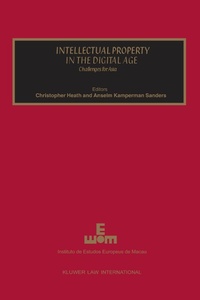
Intellectual Property in the Digital Age
Challenges for Asia
Published on 1. August 2001
234 pages
978-90-411-8062-9 (ISBN)
Description

What exactly do policymakers and journalists mean when they refer to the 'information age'? What bearing do the 'problems' they describe and the 'solutions' they offer have on current global realities? Specifically, what does the Euro-American concept of intellectual property mean in a global context?
These questions which clearly identify issues of crucial importance for the coming decades of human history are given full weight, stripped of ideology, in this provocative book, based on the papers presented at a seminar sponsored by the Macau Institute of European Studies (IEEM) in June 2000.
Although there are no clear answers, the accounts and analyses presented here provide a wealth of detail that comes as close as we can expect at this date to the facts of the case. The focus is on East Asia, Greater China in particular, an area which (most social theorists will agree) offers the most revealing social context for the examination of emerging global trends in this field.
Among the vital issues covered are:
- the collision of indigenous knowledge with the Euro-American patent concept; the idea of 'digital commons';
- software piracy and trade 'blacklists';
- the quality of information on offer, or (as the philosopher Baudrillard puts it) 'more and more information, less and less meaning';
- the hidden value judgments of information technologies;
- the postponement of more fundamental reforms caused by the belief in the possibilities of the 'new age'; and
- commercialization of the Internet as protection against its use by pornographers and racists.
These questions which clearly identify issues of crucial importance for the coming decades of human history are given full weight, stripped of ideology, in this provocative book, based on the papers presented at a seminar sponsored by the Macau Institute of European Studies (IEEM) in June 2000.
Although there are no clear answers, the accounts and analyses presented here provide a wealth of detail that comes as close as we can expect at this date to the facts of the case. The focus is on East Asia, Greater China in particular, an area which (most social theorists will agree) offers the most revealing social context for the examination of emerging global trends in this field.
Among the vital issues covered are:
- the collision of indigenous knowledge with the Euro-American patent concept; the idea of 'digital commons';
- software piracy and trade 'blacklists';
- the quality of information on offer, or (as the philosopher Baudrillard puts it) 'more and more information, less and less meaning';
- the hidden value judgments of information technologies;
- the postponement of more fundamental reforms caused by the belief in the possibilities of the 'new age'; and
- commercialization of the Internet as protection against its use by pornographers and racists.
More details
Other editions
Additional editions
Book
08/2001
1st Edition
Kluwer Law International
€90.95
Shipment within 10-20 days
Content
- Cover
- Half Title Page
- Title Page
- Copyright Page
- Table of Contents
- Preface
- About the Authors
- PART 1 General Introduction
- CHAPTER 1 The Information Society: Chances and Challenges
- 1. Introduction
- 2. Scepticism and Disagreement
- 3. The Language of Information
- 4. Political Translation
- PART 2 Copyright and Data Protection
- CHAPTER 2 The Legal Protection of Data and Databases
- 1. Introduction
- 2. Data Protection
- 3. Database Protection
- 4. Conclusion
- CHAPTER 3 Copyright Issues of Techno-Digital Property
- 1. Introduction
- 2. Circumvention of Technological Protection Measures and Integrity of Copyright Management Information
- 3. Liability of Online Service Providers
- Conclusion
- Annex of Legislation
- CHAPTER 4 Digital Property and the Digital Commons
- 1. Introduction
- 2. Why Does it Matter How the Scope of the Work is Determined?
- 3. Why is the Scope of the Work Difficult to Determine?
- 4. How are the Parameters of the Work Determined?
- 5. Conclusion
- PART 3 Patents and Indigenous Knowledge
- CHAPTER 5 Intellectual Property Protection in the North/South Divide
- 1. Introduction
- 2. Patents as Instruments of Conquest
- 3. Denial of Prior Art of Other Countries and Cultures
- 4. Biopiracy: Colonialism in an Age of Biology
- 5. The US: Promoter of Biopiracy and Patents on Life
- 6. A Review of TRIPs
- 7. TRIPs, Patents on Life and Monopolies on Community Knowledge
- 8. Digitalised Life
- 9. The Neem Patent Victory
- 10. Jaiv Panchayat: The Living Democracy Movement for Reclaiming Life's Diversity and Freedom
- PART 4 Trade Marks and Unfair Competition
- CHAPTER 6 Trade Marks, E-Commerce and the Internet
- 1. General Introduction
- 2. Doctrinary Foundations of Trade Mark Law
- 3. Domestic Jurisdiction in a Borderless World
- 4. Legal Conflicts in Using One's Own Indication on the Net
- 5. Legal Conflicts Arising from the Use of Another's Mark on the Net
- 6. Responsibility for Infringement
- 7. Conclusion
- Appendix 1
- Appendix 2
- PART 5 IP and E-Commerce in Greater China
- CHAPTER 7 Macau's Intellectual Property System in the Digital Age
- 1. Introduction
- 2. The Protection of Software
- 3. The Protection of Databases
- 4. The Protection of Personal Data
- 5. The Right of On-line Distribution
- 6. Copyright Circumvention Devices and Management Information
- 7. Domain Names
- 8. Optical Media Issues
- 9. Final Remarks
- CHAPTER 8 Electronic Commerce in Hong Kong
- 1. Introduction
- 2. Getting Started/Basic Requirements
- 3. Conducting Business over the Internet in Hong Kong
- 4. Control of Content
- 5. Conclusion
- CHAPTER 9 Electronic Commerce in China
- 1. Introduction
- 2. Protection of On-line Works
- 3. Reproduction Rights
- 4. Network Transmission Rights
- 5. Technical Measures and RMI
- 6. Conclusion
- Index
- Back Cover
