

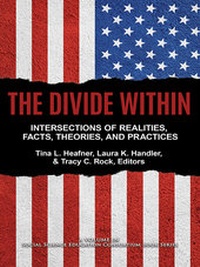
The Divide Within
Intersections of Realities, Facts, Theories, and Practices
1st Edition
Published on 1. January 2021
271 pages
978-1-64802-302-6 (ISBN)
Description

Globalization, modernization, and technologization have brought rapid social and economic change while also increasing diversity of democratic societies. Plurality of democracy, once viewed as a progressive ideology, has been met by the movement of identity politics to the margins of society. Although social movements demanding recognition on the part of groups that were once invisible to mainstream society have brought attention to systemic inequities, prejudice, and discriminatory policies, other groups feeling a loss of status and a sense of displacement have pushed back with counterclaims and protests. These conflicting narratives have fractured society and segmented the populace along narrowly defined identities, creating a new era of democracy and isolationism.
Today in the United States we see the troubling effects of increasingly polarized political discourse: amplified gridlock within government, the politicization and fragmentation of economic and social life, and the suppression of the spread of information across ideological lines. The socio-political climate in America is characterized by skepticism, hostility, distrust, claims of fake news, and unwavering opposition. The divide within our nation has shifted the narrative of democracy from promoting the common good to protecting the interests of likeminded factions and the preservation of power and privilege.
In recent decades, researchers focused attention on studying the social, geographic, political, and technological polarization in the United States. Trends manifest in myriad ways, both in politics and in everyday life, and expose the divergence between urban and rural communities. These inquiries also suggest that causes and effects of identity politics and polarization are too complex to be studied within the confines of a single discipline. Its exploration, therefore, requires participation and collaboration from scholars in many different fields, particularly those working in the social sciences. In this edited volume, we seek to leverage this research capacity to engage the reader in studies and instruction concerning the divide within and the intersections of realities, facts, theories, and practices in social science education.
Download a sample article:
Teaching to a Statue
Wade H. Morris, Georgia State University
Chara Haessler Bohan, Georgia State University
Today in the United States we see the troubling effects of increasingly polarized political discourse: amplified gridlock within government, the politicization and fragmentation of economic and social life, and the suppression of the spread of information across ideological lines. The socio-political climate in America is characterized by skepticism, hostility, distrust, claims of fake news, and unwavering opposition. The divide within our nation has shifted the narrative of democracy from promoting the common good to protecting the interests of likeminded factions and the preservation of power and privilege.
In recent decades, researchers focused attention on studying the social, geographic, political, and technological polarization in the United States. Trends manifest in myriad ways, both in politics and in everyday life, and expose the divergence between urban and rural communities. These inquiries also suggest that causes and effects of identity politics and polarization are too complex to be studied within the confines of a single discipline. Its exploration, therefore, requires participation and collaboration from scholars in many different fields, particularly those working in the social sciences. In this edited volume, we seek to leverage this research capacity to engage the reader in studies and instruction concerning the divide within and the intersections of realities, facts, theories, and practices in social science education.
Download a sample article:
Teaching to a Statue
Wade H. Morris, Georgia State University
Chara Haessler Bohan, Georgia State University
More details
Other editions
Additional editions
Tina L. Heafner | Laura K. Handler | Tracy C. Rock
The Divide Within
Intersections of Realities, Facts, Theories, and Practices
Book
11/2020
Information Age Publishing
€70.50
Shipment within 3-4 weeks
Tina L. Heafner | Laura K. Handler | Tracy C. Rock
The Divide Within
Intersections of Realities, Facts, Theories, and Practices
Book
11/2020
Information Age Publishing
€122.50
Shipment within 3-4 weeks
Content
- Front Cover
- The Divide Within
- Intersections of Realities, Facts, Theories, and Practices
- A Volume in Social Science Education Consortium Book Series
- Series Editors:
- Gregory L. Samuels and Amy Samuels,
- University of Montevallo
- CONTENTS
- Introduction
- 1. Exacerbating Existing Divides: Fake News, Desire, and Partisanship
- 2. The NC ACCESS Program: Remediating or Deepening Divisions in Public Education?
- 3. Socioeconomic Disparities: A Case Study Addressing the Urban/Rural Divide Using a World Café
- 4. A Quantitative Comparison of Rural and Urban School Teacher Characteristics
- 5. Discipline Disparities: An Analysis of School Discipline Practices in a North Carolina High School
- 6. Primary Contradictions: Qualitative Transformations of White Social Studies Teacher Identity
- 7. Teaching to a Statue: John B. Gordon, History Textbooks, and the Creation of a Lost Cause Hero
- 8. Bridging the Gap: One School's Attempt to Build Community Through Service-Learning
- 9. Evaluating the Effects of Discipline Literacy Versus General Literacy in Adolescent Readers
- 10. Responding to an Era of Globalization With Multicultural Education
- 11. Promoting Student Achievement
- 12. Understanding United States Economic Inequality and the Strain on Our Democracy
- 13. Bridging the Divide Between Data and Solutions: A Closer Look at a Restorative Justice Framework for School Discipline
- About the Authors 265
- Social Science Education Consortium Book Series
- The Divide Within
- Intersections of Realities, Facts, Theories, and Practices
- Edited by
- Tina L. Heafner, Laura K. Handler, and Tracy C. Rock University of North Carolina at Charlotte
- Information Age Publishing, Inc. Charlotte, North Carolina www.infoagepub.com
- Introduction
- Tina L. Heafner, Laura K. Handler, and Tracy C. Rock
- University of North Carolina at Charlotte
- Organization of Chapters
- References
- CHAPTER 1
- Exacerbating Existing Divides
- Fake News, Desire, and Partisanship
- Wayne Journell
- University of North Carolina at Greensboro
- Abstract
- Defining Fake News
- Actual Fake News
- Figure 1.1.
- Figure 1.2.
- Figure 1.3.
- Trump's Version of Fake News
- MOTIVATED REASONING AND CONFIRMATION BIAS
- Figure 1.4.
- Figure 1.5.
- Figure 1.6.
- PARTISANSHIP, POLARIZATION, AND SOCIAL MEDIA
- Conclusion
- NOTES
- 1. Although specific instructional strategies are beyond the scope of this chapter, readers interested in practical ideas for the classroom can consult Breakstone et al. (2018)
- Hauver (2019)
- Hodgin and Kahne (2019)
- Journell and Clark (2019)
- and M...
- 2. To see the full listing of all of the Russian advertisements released by Congress following their investigation into Russian influence in the 2016 election, visit https://intelligence.house.gov/social-media- content/social-media-advertisements.htm
- 3. Although it is unclear how many users, if any, were tricked into submitting their votes online based on these types of posts, Twitter has recently taken steps to help ensure that misleading tweets related to voting are quickly removed from the pla...
- 4. Despite being blocked, savvy users can still find ways to promote InfoWars content on these platforms, and it becomes a continual game of cat and mouse to take them down.
- 5. It is worth noting that in early 2020 CNN reached an out-of-court settlement with Sandmann, who had sued CNN and other media organizations for how they depicted him following the first video (Darcy, 2020).
- 6. Soon after calling for Trump's impeachment, Amash unaffiliated himself with the Republican Party and became an independent.
- 7. Those interested in a better technical understanding of how algorithms work can refer to Cohen (2019).
- References
- CHAPTER 2
- The NC ACCESS Program
- Remediating or Deepening Divisions in Public Education?
- Laura K. Handler and Tracy C. Rock
- University of North Carolina Charlotte
- Abstract
- Introduction
- Literature Review
- Charter Schools in the United States
- Charter Schools in North Carolina
- Overview of the NC ACCESS Program
- Core Elements of the NC ACCESS Subgrant Program
- Table 2.1. Types of Subgrants With Eligibility Criteria for NC ACCESS Program
- Review Process of NC ACCESS Applications
- Methods
- Findings
- Approach to Break Down Barriers
- Capacity to Break Down Barriers
- Desire to Break Down Barriers
- Table 2.3. Projected Schedule of Subgrant Awards With Submitted and Actual Awards Granted in Year 1
- Discussion
- NOTE
- References
- Appendix A: Scoring Rubric for NC ACCESS Subgrant Applications
- Table 2.2. Coding Matrix of Subgrant Application Narratives' Addressing of Known Barriers to Charter School Participation
- CHAPTER 3
- Socioeconomic Disparities
- A Case Study Addressing the Urban/Rural Divide Using a World Café
- Daniel A. Yonto
- Georgia Southern University
- ABSTRACT
- INTRODUCTION
- LITERATURE REVIEW
- Social Mobility
- Rural Social Mobility Challenges
- What Is a World Café?
- Table 3.1. World Café Principles for Hosting Conversations That Matter
- METHODS
- Context
- Figure 3.1. Watauga County, focus area for socioeconomic disparities research.
- Event Promotion
- Event Attendees
- Figure 3.2. Distribution of attendees by self-reported discipline concentration.
- Discussion Tables
- Data Capture
- Tablecloth
- Synthesis Wall
- Figure 3.3. Sample of sticky notes placed into themes on the synthesis wall.
- FINDINGS
- Theme 1: Improving Transportation Services
- Theme 2: Community Health
- DISCUSSION
- CONCLUSION
- REFERENCES
- CHAPTER 4
- A Quantitative Comparison of Rural and Urban School and Teacher Characteristics
- Jessica Norwood, Tina L. Heafner, and Paul Fitchett
- University of North Carolina at Charlotte
- ABSTRACT
- INTRODUCTION
- LITERATURE REVIEW
- Rural Communities and Education
- Urban Communities and Education
- The Value of Rural and Urban Education
- METHOD
- RESULTS
- Table 4.1. Descriptive Statistics for School-Level Variables
- Table 4.2. Chi-square Results for School-Level Variables
- Table 4.3. Chi-Square Results For Teacher-Level Characteristics
- INTERPRETATIONS
- CONCLUSION
- REFERENCES
- CHAPTER 5
- Discipline Disparities
- An Analysis of School Discipline Practices in a North Carolina High School
- Yvonna Hines-McCoy, Tina L. Heafner, and Jeanneine Jones
- University of North Carolina at Charlotte
- Abstract
- Introduction
- Literature Review
- Method
- Measuring Disproportionality
- Results
- Racial Composite of School Demographics
- Table 5.1. X High School Student Enrollment by Race/Ethnicity and Gender
- Figure 5.1. Total number/percentage of referrals by race/ethnicity.
- Figure 5.2. Disproportionality in student referrals by race/ethnicity.
- Figure 5.3. Total number/percentage of referrals by race/ethnicity and gender.
- Figure 5.4. Disproportionality in student referrals by race/ethnicity and gender.
- Referrals Resulting in In School Suspension (ISS)
- Figure 5.5. Total number/percentage of student referrals resulting in ISS by race/ ethnicity.
- Figure 5.6. Disproportionality in student referrals resulting in ISS by race/ethnicity.
- Figure 5.7. Total number/percentage of referrals resulting in ISS by race/ethnicity and gender.
- Referrals Resulting in OSS
- Figure 5.9. Total number/percentage of referrals resulting in OSS by race/ethnicity.
- Figure 5.10. Disproportionality in student referrals resulting in OSS by race/ethnicity.
- Figure 5.11. Total number/percentage of student referrals resulting in OSS by race/ethnicity and gender.
- IMPLICATIONS
- Recommendations
- Conclusion
- References
- CHAPTER 6
- Primary Contradictions
- Qualitative Transformations of White Social Studies Teacher Identity
- Dean P. Vesperman
- University of Wisconsin River Falls
- Jill Leet-Otley
- Luther College
- ABSTRACT
- BACKGROUND AND PURPOSE: THE CONTRADICTIONS OF WHITENESS
- THEORETICAL FRAMEWORK
- Critical Whiteness Studies
- Cultural-Historical Activity Theory (CHAT)
- Multicultural Education Course as Activity
- Figure 6.1. Second generation mediational triangle for multicultural education class
- RESEARCH METHOD
- Data Sources
- Table 6.1. Intercultural Development Inventory Score Range
- Participants
- Zach
- Isaiah
- FINDINGS
- Quantitative Analysis
- IDI
- Table 6.2. Participants' IDI Orientation
- Pre- and Postsurvey
- Table 6.3. Statistically Significant Shifts on the Common Beliefs Survey
- Table 6.4. Common Beliefs Survey Questions 3 and 12
- Qualitative Analysis
- Whiteness
- Figure 6.2. Zach: Initial conception of teaching history.
- Figure 6.3. Zach: Postconception of teaching history.
- Figure 6.4. Isaiah: Initial conception of teaching history.
- Pragmatism
- Figure 6.5. Isaiah: Postconception of teaching history.
- CONCLUSION: IMPLICATIONS
- REFERENCES
- CHAPTER 7
- Teaching to a Statue
- John B. Gordon, History Textbooks, and the Creation of a Lost Cause Hero
- Wade H. Morris Jr. and Chara Haeussler Bohan
- Georgia State University
- ABSTRACT
- INTRODUCTION
- LITERATURE REVIEW
- RESEARCH DESIGN AND METHODS
- THE MAN OF THE 12TH OF MAY
- FINDINGS AND DISCUSSION
- Figure 7.1. Words dedicated to Wartime Gordon versus words dedicated to wartime slavery.
- Figure 7.2. Words dedicated to the 12th of May versus words dedicated to the Emancipation Proclamation.
- CONCLUSION
- REFERENCES
- CHAPTER 8
- Bridging the Gap
- One School's Attempt to Build Community Through Service-Learning
- Amy Allen
- University of Oklahoma
- Abstract
- RESEARCH PURPOSE AND QUESTIONS
- Literature Review
- The Savior Complex
- Service-Learning
- Theoretical Framework
- The Nazareth Manifesto
- Research Design
- Table 8.1. Participant Information
- Findings
- Background Information: Student Initiated and Situated in Mutual Need
- Explicit Goals and Intentions
- Providing Science Programming and Building Community
- Helping the Marginalized and Transforming CHS Students
- Discussion
- Working For: CHS Movie Night
- Working With: Development of a Science Curriculum
- Being With: Developing Relationships
- Implications
- Conclusion
- NOTES
- References
- CHAPTER 9
- Evaluating the Effects of Discipline Literacy Versus General Literacy in Adolescent Readers
- Antoinette M. L. Rochester, Tina L. Heafner, and Kristen Beach
- University of North Carolina at Charlotte
- Abstract
- Introduction
- Literature Review
- Reading Comprehension
- Content Area and General Literacy
- Disciplinary Literacy
- Purpose of the Present Study
- Method
- Participants and Setting
- Design
- Procedures
- Measures
- Results
- Table 9.1. December and May Benchmark Percentages by Intervention Type and Class Period
- Table 9.2. 2. Gates Pre- and Posttest Assessment Raw Total and Grade Equivalent Averages
- Discussion
- Table 9.2. Gates Pre- and Posttest Assessment Raw Total and Grade Equivalent Averages
- Limitations
- Conclusion
- References
- CHAPTER 10
- Responding to an Era of Globalization With Multicultural Education
- Amanda R. Casto
- Southern Oregon University
- Greg Wiggan
- University of North Carolina at Charlotte
- Abstract
- Literature Review
- Defining Multicultural Education
- Multicultural Education in a Global Context
- Discussion
- South Korea in Context
- History
- Economics
- Education in South Korea
- Table 10.1. Program for International Student Assessment 2015 Data
- Multicultural Education in South Korea
- South Korean Multicultural Education Policies
- South Korean Multicultural Education Practices
- Multicultural Education in the United States
- Figure 10.1. Change in population percentage by race and ethnicity, 2014 and 2060.
- Table 10.2. National Assessment of Educational Progress Scale Scores per Race/Ethnicity Subgroup During the 21st Century
- U.S. Multicultural Education Policies
- U.S. Multicultural Education Practices
- PRESCRIPTIONS FOR MULTICULTURAL EDUCATION IN THE UNITED STATES
- 1. Recruit multicultural education spokesperson(s)
- 2. Invest in multicultural education professional development and specialized staff
- 3. Invest in multicultural curriculum and instructional mandates
- The Multicultural Education Spokesperson
- Multicultural Education Professional Development and Specialized Staff
- Multicultural Curriculum and Instructional Mandates
- The Role of National Standards for the Preparation of Social Studies Teachers
- Conclusion
- References
- CHAPTER 11
- Promoting Student Achievement
- Arts Integration in Urban Schools in the United States and Canada
- Portia Marie York and Greg Wiggan
- University of North Carolina Charlotte
- ABSTRACT
- INTRODUCTION
- LITERATURE REVIEW
- Creativity and Academic Achievement
- Social and Motivational Benefits of Arts Education
- CONCEPTUAL FRAMEWORK
- Figure 11.1. The CACA model.
- Table 11.1. Relationship Between Creativity and Constructivist Learning
- DIFFERENCES AMONG NEIGHBORS
- Table 11.2. PISA 2015 Results
- Assessing Creativity
- Investing in Creativity and the Arts
- DISCUSSION
- REFERENCES
- CHAPTER 12
- Understanding United States Economic Inequality and the Strain on Our Democracy
- James E. Davis
- Former Executive Director of the Social Science Education Consortium
- Abstract
- Introduction
- The Balance Sheet Measure
- Hypothetical Balance Sheets
- Figure 12.1.
- INTRODUCTION TO ECONOMICS
- Macroeconomics: The Basics
- Table 12.1. Nominal Gross Domestic Product by Major Demand Category
- 1. Employee compensation. This is the largest income category and includes wages and salaries paid to labor by both businesses and government.
- 2. Rents. Rent is the payment made to households and businesses. Included are rent paid to landlords and lease payments by business for office space use.
- 3. Interest. Interest is paid to households on their savings deposits, on their certificates of deposits, and on their corporate bonds.
- 4. Profits to business owners. Both individual business owners and partnerships seek profits-money left after all business costs have been paid.
- 5. Corporate profits. Corporations seek profits and they pay income taxes on their profits to both the federal and state governments. Corporations pay dividends from their profits to stockholders. Undistributed corporate profits are kept by corporati...
- Fiscal Policy
- Money and Banking
- The Federal Reserve System
- The Fed and the Money Supply
- 1. The Fed issues currency. These are Federal Reserve Notes (paper currency).
- 2. The Fed sets reserve requirements. Based on a bank's money deposits, The Fed requires a percentage of deposits be set aside as reserves.
- 3. The Fed lends money to banks and certain thrift institutions. The rate The Fed charges is called the discount rate.
- 4. The Fed provides for collecting checks. If a check is written in Charlotte, NC, to an organization in Boston, MA, in 2 or 3 days, the check "clears" and the bank deposit in Charlotte is reduced and the bank deposit in Boston is credited.
- 5. The Fed acts as a fiscal agent. The federal government collects taxes and spends a lot of money. The Fed acts as the bank for the federal government.
- 6. The Fed supervises bank operations. Commercial banks must adhere to many regulations, and The Fed is responsible for seeing to it that banks not only fulfill the regulations, but also detect fraud.
- 7. The Fed controls the money supply. This is probably the most important function of The Fed. The Fed is responsible for setting interest rates and controlling the nation's money supply with a goal to support full employment and control inflation.
- Summary: Tools of Fiscal and Monetary Policy
- Figure 12.2. A problem to think about.
- INCOME AND WEALTH INEQUALITY IN THE UNITED STATES
- Income Inequality
- Wealth Inequality
- Table 12.2. Median Net Worth by Race and Educational Attainment of Head of Family - 2016
- Figure 12.3. Case study: Entitlements of the rich.
- Income and Wealth Inequality: Impact on Our Democracy
- Poverty in the United States
- Democracy Must Change
- Summary: Threats to Democracy
- Proposals to Meet the Challenges for Democracy
- Proposal 1
- Proposal 2
- Proposal 3
- Proposal 4
- Proposal 5
- Proposal 6
- Proposal 7
- End Note
- Acknowledgment
- References
- CHAPTER 13
- Bridging the Divide Between Data and Solutions
- A Closer Look at a Restorative Justice Framework for School Discipline
- Bettie Ray Butler
- The University of North Carolina Charlotte
- Abstract
- Introduction
- "Restorative Justice"
- Historical Origin and Definition
- Juvenile Justice Systems and Schools
- Foundational Restorative Justice Principles: A Note of Caution to Schools
- It's a Mindset, NOT a Program
- It's a Compass, NOT a Map
- It's Proactive, NOT (Only) Reactive
- It's for Everyone, NOT Just Students
- Conclusion
- References
- About the Authors
- About the Authors
- Back Cover
