

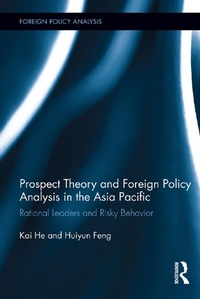
Prospect Theory and Foreign Policy Analysis in the Asia Pacific
Rational Leaders and Risky Behavior
Published on 17. January 2013
172 pages
978-1-135-13120-3 (ISBN)
Description

Why does North Korea behave erratically in pursuing its nuclear weapons program? Why did the United States prefer bilateral alliances to multilateral ones in Asia after World War II? Why did China become "nice"-no more military coercion-in dealing with the pro-independence Taiwan President Chen Shuibian after 2000? Why did China compromise in the negotiation of the Chunxiao gas exploration in 2008 while Japan became provocative later in the Sino-Japanese disputes in the East China Sea? North Korea's nuclear behavior, U.S. alliance strategy, China's Taiwan policy, and Sino-Japanese territorial disputes are all important examples of seemingly irrational foreign policy decisions that have determined regional stability and Asian security.
By examining major events in Asian security, this book investigates why and how leaders make risky and seemingly irrational decisions in international politics. The authors take the innovative step of integrating the neoclassical realist framework in political science and prospect theory in psychology. Their analysis suggests that political leaders are more likely to take risky actions when their vital interests and political legitimacy are seriously threatened. For each case, the authors first discuss the weaknesses of some of the prevailing arguments, mainly from rationalist and constructivist theorizing, and then offer an alternative explanation based on their political legitimacy-prospect theory model.
This pioneering book tests and expands prospect theory to the study of Asian security and challenges traditional, expected-utility-based, rationalist theories of foreign policy behavior.
By examining major events in Asian security, this book investigates why and how leaders make risky and seemingly irrational decisions in international politics. The authors take the innovative step of integrating the neoclassical realist framework in political science and prospect theory in psychology. Their analysis suggests that political leaders are more likely to take risky actions when their vital interests and political legitimacy are seriously threatened. For each case, the authors first discuss the weaknesses of some of the prevailing arguments, mainly from rationalist and constructivist theorizing, and then offer an alternative explanation based on their political legitimacy-prospect theory model.
This pioneering book tests and expands prospect theory to the study of Asian security and challenges traditional, expected-utility-based, rationalist theories of foreign policy behavior.
Reviews / Votes
"The authors of this excellent book investigate puzzles in the domain of Asian security studies and contrast agent-centered solutions provided by neoclassical realist theory with system-oriented solutions provided by structural neorealist theory. Prospect theory is employed to enrich a rational choice account of internal and external constraints on security decisions in the Asia-Pacific region. The results are fruitful, coherent, and cumulative, advancing our understanding of the interplay of causal mechanisms within two traditions of international relations theory as well as two models of foreign policy decision-making theory."-Stephen G. Walker, Arizona State University
"This book takes up a wide range of enduring and yet timely topics, such as the genesis of the U.S. hub-and-spokes alliance system in Asia and the evolving interactions regarding North Korea's nuclear program. He and Feng bring together these cases under a unifying theme of risk-taking (or risk-avoidance) behavior by leaders depending on whether these officials' political legitimacy is under strain or relatively secured. The book makes a contribution to the study of Asia Pacific relations by extending an important non-rationalist theory to the study of significant substantive and policy questions, and by adding to the growing body of literature on how prospect theory can inform our understanding about foreign policy decisions."
-Steve Chan, University of Colorado, Boulder "The authors of this excellent book investigate puzzles in the domain of Asian security studies and contrast agent-centered solutions provided by neoclassical realist theory with system-oriented solutions provided by structural neorealist theory. Prospect theory is employed to enrich a rational choice account of internal and external constraints on security decisions in the Asia-Pacific region. The results are fruitful, coherent, and cumulative, advancing our understanding of the interplay of causal mechanisms within two traditions of international relations theory as well as two models of foreign policy decision-making theory."
-Stephen G. Walker, Arizona State University
"This book takes up a wide range of enduring and yet timely topics, such as the genesis of the U.S. hub-and-spokes alliance system in Asia and the evolving interactions regarding North Korea's nuclear program. He and Feng bring together these cases under a unifying theme of risk-taking (or risk-avoidance) behavior by leaders depending on whether these officials' political legitimacy is under strain or relatively secured. The book makes a contribution to the study of Asia Pacific relations by extending an important non-rationalist theory to the study of significant substantive and policy questions, and by adding to the growing body of literature on how prospect theory can inform our understanding about foreign policy decisions."
-Steve Chan, University of Colorado, Boulder
'Its value is in its analysis of the circumstances and contexts that guide decisions that are otherwise considered irrational. In that sense, prospect theory's utility is deconstructing the risky behaviour in international relations a little more and this book demonstrates how it fits into the context of East Asian scenarios.'
-Avinash Godbole, Insight Turkey
More details
Series
Language
English
Place of publication
London
United Kingdom
Publishing group
Taylor & Francis Ltd
Target group
College/higher education
Illustrations
1 Tables, black and white
File size
1,74 MB
ISBN-13
978-1-135-13120-3 (9781135131203)
Copyright in bibliographic data and cover images is held by Nielsen Book Services Limited or by the publishers or by their respective licensors: all rights reserved.
Schweitzer Classification
Other editions
Additional editions
Kai He | Huiyun Feng
Prospect Theory and Foreign Policy Analysis in the Asia Pacific
Rational Leaders and Risky Behavior
Book
05/2017
1st Edition
Routledge
€71.30
Shipment within 10-20 days
Kai He | Huiyun Feng
Prospect Theory and Foreign Policy Analysis in the Asia Pacific
Rational Leaders and Risky Behavior
Book
12/2012
1st Edition
Routledge
€231.20
Shipment within 15-20 days
Persons
Kai He is an Assistant Professor of Political Science at Utah State University and the author of Institutional Balancing in the Asia Pacific: Economic Interdependence and China's Rise (Routledge, 2009). He was a postdoctoral fellow in the Princeton-Harvard China and the World Program and has published in European Journal of International Relations, Security Studies, Review of International Studies, and The Pacific Review.
Huiyun Feng is an Assistant Professor of Political Science at Utah State University and the author of Chinese Strategic Culture and Foreign Policy Decision-Making: Confucianism, Leadership and War (Routledge, 2007). She was a Jennings Randolph Peace Scholar at the United States Institute of Peace and has published in Security Studies, The Pacific Review, Chinese Journal of International Politics, and Asian Perspective.
Huiyun Feng is an Assistant Professor of Political Science at Utah State University and the author of Chinese Strategic Culture and Foreign Policy Decision-Making: Confucianism, Leadership and War (Routledge, 2007). She was a Jennings Randolph Peace Scholar at the United States Institute of Peace and has published in Security Studies, The Pacific Review, Chinese Journal of International Politics, and Asian Perspective.
Content
1. Prospect Theory, Neoclassical Realism, and Foreign Policy Puzzles in Asian Security. 2. "Why Is There No NATO in Asia" Revisited: U.S. Alliance Strategy under Risk. 3. North Korea Goes Nuclear: Rational Decisions and Risky Behavior. 4. China's Policy toward Taiwan under Risk: Between Military Coercion and Political Pressure. 5. China-Japan Territorial Disputes in the East China Sea: Risky Behavior during Power Transition. 6. Rational Leaders and Risky Decisions: Risk-Taking Behavior in World Politics
