

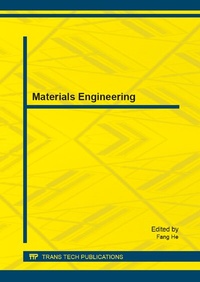
Materials Engineering
Published on 30. June 2014
196 pages
978-3-03826-537-5 (ISBN)
Description

Collection of selected, peer reviewed papers from the 2nd International Conference on Materials Engineering (ICMEN2014), May 17-18, 2014, Nanjing, China.
The 28 papers are grouped as follows:
Chapter 1: Function and Electronic Materials,
Chapter 2: High Performance Structural Material,
Chapter 3: Materials Processing Technology
The 28 papers are grouped as follows:
Chapter 1: Function and Electronic Materials,
Chapter 2: High Performance Structural Material,
Chapter 3: Materials Processing Technology
More details
Series
Language
English
Place of publication
Zurich-Durnten
Switzerland
Target group
Professional and scholarly
Illustrations
Illustrations
File size
37,39 MB
ISBN-13
978-3-03826-537-5 (9783038265375)
DOI
10.4028/b-2F0bDD
Copyright in bibliographic data and cover images is held by Nielsen Book Services Limited or by the publishers or by their respective licensors: all rights reserved.
Schweitzer Classification
Other editions
Additional editions
Fang He
Materials Engineering
Selected, peer reviewed papers from the 2nd International Conference on Materials Engineering (ICMEN 2014), May 17-18, 2014, Nanjing, China
Book
08/2014
Trans Tech Publications Ltd
€159.70
Shipment within 10-15 days

Fang He
Materials Engineering
Software
06/2014
Trans Tech Publications Ltd
€173.48
Shipment within 10-15 days
Content
Preface and Committees
Chapter 1: Function and Electronic Materials
Growth Dynamics of Single Void during Czochralski Silicon Crystal Growth Using Phase-Field Modeling
Electronic and Optical Properties of Sn-Doped Zno with and without O Vacancy
Enhanced Flux Pinning in La1.84Sr0.16CuO4 Thin Film with the Ferroelectric Polarization Effect of BiFeO3
Controllable Synthesis of Monodisperse Metal Oxide Nanostructures via a Solvothermal Route and Their Catalytic Properties
Preparation and Optical Properties of One-Dimensional Ag/SiOx Photonic Crystal
Study on Fabrication and Properties of In Situ Si and Al2O3 Particulate Reinforced Composites
The Synthesis and Application of the NaCl-KCl-K2HfCl6 Electrolyte
The Study on Photocatalytic Degradation of Methyl Orange Using SrFe0.5Co0.5O3-?
Preparation of Antimicrobial PHEMA-g-PCBMAE Hydrogels with Improved Mechanical Properties
Chapter 2: High Performance Structural Material
Research on the Hydration Mechanism of Portland Cement with Magnesium Slag
Effects of Mono-And Dianhydrides on Thermal and Mechanical Properties Enhancement of Polybenzoxazine: A Property Comparison
Reliability Optimization Design of Composite Transmission Shaft
Effect of Rubber Contents on Tribological and Thermomechanical Properties of Polybenzoxazine
Study on Seismic Resistant Properties of the Integral Structure after Adding Steel Storey on Top of the Multistoried Brick-Concrete Architecture
Thermally Induced Vibration Analysis of Composite Laminate Based on Equivalent Displacement Method
Chapter 3: Materials Processing Technology
Mesoscopic Simulation Analysis of the Influence of Die Wall Friction on Compression Process of Powder Particles
The Influence of Cr Gradient of Transition Layer on Creep Rupture Properties of Dissimilar Joint
Influence of Prior Austenite Grain Size on the Dispersion of Fatigue Crack Propagation Thresholds in Weld Metal
Modeling of Disk-Shaped Anode-Support SOFC with Proton Conductor Electrolyte and Sm0.5Sr0.5CoO3-?-Sm0.2Ce0.8O2-? Cathode
Electroless Copper Coating on Boron Carbide Particles by Using Copper Activation Method
Strength Loss Method to Evaluate the Sulfate Attack Resistance of the Cement-Porous Silica Fume Mortar
Thermal Vibration Compound Stress Relief on Thick DH36 Steel Welded Plates
Iron Removal from Hafnium Crystal Bar by Iodide Process
Research and Application of Numerical Control Milling Machine Tool Length Compensation Instructions
Effect of Coiling Temperature and Cold Rolling Reduction on Planar Anisotropy of Ti-Alloyed Low Carbon Steel
Device Design of Hot-Air Curing and Study on the Properties of Hot-Air Cured Phosphate Sand
The Effects of Cross Cold Rolling Reductions on Microstructure of Ti+P-IF Steel
The Breakdown Characteristic Research of Polymer Materials in Liquid Nitrogen
Chapter 1: Function and Electronic Materials
Growth Dynamics of Single Void during Czochralski Silicon Crystal Growth Using Phase-Field Modeling
Electronic and Optical Properties of Sn-Doped Zno with and without O Vacancy
Enhanced Flux Pinning in La1.84Sr0.16CuO4 Thin Film with the Ferroelectric Polarization Effect of BiFeO3
Controllable Synthesis of Monodisperse Metal Oxide Nanostructures via a Solvothermal Route and Their Catalytic Properties
Preparation and Optical Properties of One-Dimensional Ag/SiOx Photonic Crystal
Study on Fabrication and Properties of In Situ Si and Al2O3 Particulate Reinforced Composites
The Synthesis and Application of the NaCl-KCl-K2HfCl6 Electrolyte
The Study on Photocatalytic Degradation of Methyl Orange Using SrFe0.5Co0.5O3-?
Preparation of Antimicrobial PHEMA-g-PCBMAE Hydrogels with Improved Mechanical Properties
Chapter 2: High Performance Structural Material
Research on the Hydration Mechanism of Portland Cement with Magnesium Slag
Effects of Mono-And Dianhydrides on Thermal and Mechanical Properties Enhancement of Polybenzoxazine: A Property Comparison
Reliability Optimization Design of Composite Transmission Shaft
Effect of Rubber Contents on Tribological and Thermomechanical Properties of Polybenzoxazine
Study on Seismic Resistant Properties of the Integral Structure after Adding Steel Storey on Top of the Multistoried Brick-Concrete Architecture
Thermally Induced Vibration Analysis of Composite Laminate Based on Equivalent Displacement Method
Chapter 3: Materials Processing Technology
Mesoscopic Simulation Analysis of the Influence of Die Wall Friction on Compression Process of Powder Particles
The Influence of Cr Gradient of Transition Layer on Creep Rupture Properties of Dissimilar Joint
Influence of Prior Austenite Grain Size on the Dispersion of Fatigue Crack Propagation Thresholds in Weld Metal
Modeling of Disk-Shaped Anode-Support SOFC with Proton Conductor Electrolyte and Sm0.5Sr0.5CoO3-?-Sm0.2Ce0.8O2-? Cathode
Electroless Copper Coating on Boron Carbide Particles by Using Copper Activation Method
Strength Loss Method to Evaluate the Sulfate Attack Resistance of the Cement-Porous Silica Fume Mortar
Thermal Vibration Compound Stress Relief on Thick DH36 Steel Welded Plates
Iron Removal from Hafnium Crystal Bar by Iodide Process
Research and Application of Numerical Control Milling Machine Tool Length Compensation Instructions
Effect of Coiling Temperature and Cold Rolling Reduction on Planar Anisotropy of Ti-Alloyed Low Carbon Steel
Device Design of Hot-Air Curing and Study on the Properties of Hot-Air Cured Phosphate Sand
The Effects of Cross Cold Rolling Reductions on Microstructure of Ti+P-IF Steel
The Breakdown Characteristic Research of Polymer Materials in Liquid Nitrogen
