

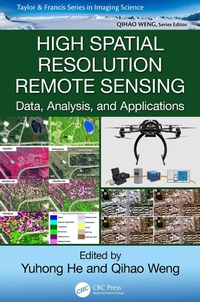
High Spatial Resolution Remote Sensing
Data, Analysis, and Applications
1st Edition
Published on 27. June 2018
405 pages
978-0-429-89300-1 (ISBN)
Description

High spatial resolution remote sensing is an area of considerable current interest and builds on developments in object-based image analysis, commercial high-resolution satellite sensors, and UAVs. It captures more details through high and very high resolution images (10 to 100 cm/pixel). This unprecedented level of detail offers the potential extraction of a range of multi-resource management information, such as precision farming, invasive and endangered vegetative species delineation, forest gap sizes and distribution, locations of highly valued habitats, or sub-canopy topographic information. Information extracted in high spatial remote sensing data right after a devastating earthquake can help assess the damage to roads and buildings and aid in emergency planning for contact and evacuation.
To effectively utilize information contained in high spatial resolution imagery, High Spatial Resolution Remote Sensing: Data, Analysis, and Applications addresses some key questions:
What are the challenges of using new sensors and new platforms?
What are the cutting-edge methods for fine-level information extraction from high spatial resolution images?
How can high spatial resolution data improve the quantification and characterization of physical-environmental or human patterns and processes?
The answers are built in three separate parts: (1) data acquisition and preprocessing, (2) algorithms and techniques, and (3) case studies and applications. They discuss the opportunities and challenges of using new sensors and platforms and high spatial resolution remote sensing data and recent developments with a focus on UAVs. This work addresses the issues related to high spatial image processing and introduces cutting-edge methods, summarizes state-of-the-art high spatial resolution applications, and demonstrates how high spatial resolution remote sensing can support the extraction of detailed information needed in different systems. Using various high spatial resolution data, the third part of this book covers a range of unique applications, from grasslands to wetlands, karst areas, and cherry orchard trees.
To effectively utilize information contained in high spatial resolution imagery, High Spatial Resolution Remote Sensing: Data, Analysis, and Applications addresses some key questions:
What are the challenges of using new sensors and new platforms?
What are the cutting-edge methods for fine-level information extraction from high spatial resolution images?
How can high spatial resolution data improve the quantification and characterization of physical-environmental or human patterns and processes?
The answers are built in three separate parts: (1) data acquisition and preprocessing, (2) algorithms and techniques, and (3) case studies and applications. They discuss the opportunities and challenges of using new sensors and platforms and high spatial resolution remote sensing data and recent developments with a focus on UAVs. This work addresses the issues related to high spatial image processing and introduces cutting-edge methods, summarizes state-of-the-art high spatial resolution applications, and demonstrates how high spatial resolution remote sensing can support the extraction of detailed information needed in different systems. Using various high spatial resolution data, the third part of this book covers a range of unique applications, from grasslands to wetlands, karst areas, and cherry orchard trees.
More details
Series
Edition
1. Auflage
Language
English
Place of publication
London
United Kingdom
Publishing group
Taylor & Francis Ltd
Target group
Professional and scholarly
Illustrations
55 Tables, black and white; 24 Illustrations, color; 102 Illustrations, black and white
File size
13,11 MB
ISBN-13
978-0-429-89300-1 (9780429893001)
Copyright in bibliographic data and cover images is held by Nielsen Book Services Limited or by the publishers or by their respective licensors: all rights reserved.
Schweitzer Classification
Other editions
Additional editions
Book
07/2018
CRC Press
€326.83
Shipment within 15-20 days

Book
06/2018
1st Edition
CRC Press
€119.04
The article will not be published
Persons
Dr. Yuhong He is an Associate Professor of geography at University of Toronto, Canada. She received her Ph.D. degree in geography from the University of Saskatchewan in 2008 and worked as a Postdoctoral fellow from 2008-2009 in Environmental Remote Sensing lab under supervision of Dr. Steven Franklin. She joined the University of Toronto as an assistant professor in 2009 and since then, she has taught courses on introductory remote sensing, advanced remote sensing, remote sensing-GIS.
Qihao Weng is the Director of the Center for Urban and Environmental Change and a Professor at Indiana State University, and worked as a Senior Fellow at the National Aeronautics and Space Administration from December 2008 to December 2009. He received his Ph.D. degree from the University of Georgia in 1999. Weng is currently the Lead of Group on Earth Observation (GEO) Global Urban Observation and Information Initiative, and serves as an Editor-in-Chief of ISPRS Journal of Photogrammetry and Remote Sensing and the Series Editor of Taylor & Francis Series in Remote Sensing Applications. He has been the Organizer and Program Committee Chair of the biennial IEEE/ISPRS/GEO sponsored International Workshop on Earth Observation and Remote Sensing Applications conference series since 2008, a National Director of American Society for Photogrammetry and Remote Sensing from 2007 to 2010, and a panelist of U.S. DOE's Cool Roofs Roadmap and Strategy in 2010. In 2008, Weng received a prestigious NASA senior fellowship. He is also the recipient of the Outstanding Contributions Award in Remote Sensing in 2011 and the Willard and Ruby S. Miller Award in 2015 for his outstanding contributions to geography, both from the American Association of Geographers. In 2005 at Indiana State University, he was selected as a Lilly Foundation Faculty Fellow and in the following year, he also received the Theodore Dreiser Distinguished Research Award. In addition, he was the recipient of 2010 Erdas Award for Best Scientific Paper in Remote Sensing (1st place) and 1999 Robert E. Altenhofen Memorial Scholarship Award, which were both awarded by American Society for Photogrammetry and Remote Sensing. He was also awarded the Best Student-Authored Paper Award by International Geographic Information Foundation in 1998. Weng has been invited to give 100 talks by organizations and conferences held in U.S.A., Canada, China, Brazil, Greece, UAE, and Hong Kong. Weng's research focuses on remote sensing applications to urban environmental and ecological systems, land-use and land-cover changes, urbanization impacts, environmental modeling, and human-environment interactions. Weng is the author of 210 articles and 10 books. According to Google Scholar, as of October 2017, his SCI citation reached 12,227 (H-index of 50), and 28 of his publications had more than 100 citations each. Weng's research has been supported by funding agencies that include NSF, NASA, USGS, USAID, NOAA, National Geographic Society, European Space Agency, and Indiana Department of Natural Resources.
Qihao Weng is the Director of the Center for Urban and Environmental Change and a Professor at Indiana State University, and worked as a Senior Fellow at the National Aeronautics and Space Administration from December 2008 to December 2009. He received his Ph.D. degree from the University of Georgia in 1999. Weng is currently the Lead of Group on Earth Observation (GEO) Global Urban Observation and Information Initiative, and serves as an Editor-in-Chief of ISPRS Journal of Photogrammetry and Remote Sensing and the Series Editor of Taylor & Francis Series in Remote Sensing Applications. He has been the Organizer and Program Committee Chair of the biennial IEEE/ISPRS/GEO sponsored International Workshop on Earth Observation and Remote Sensing Applications conference series since 2008, a National Director of American Society for Photogrammetry and Remote Sensing from 2007 to 2010, and a panelist of U.S. DOE's Cool Roofs Roadmap and Strategy in 2010. In 2008, Weng received a prestigious NASA senior fellowship. He is also the recipient of the Outstanding Contributions Award in Remote Sensing in 2011 and the Willard and Ruby S. Miller Award in 2015 for his outstanding contributions to geography, both from the American Association of Geographers. In 2005 at Indiana State University, he was selected as a Lilly Foundation Faculty Fellow and in the following year, he also received the Theodore Dreiser Distinguished Research Award. In addition, he was the recipient of 2010 Erdas Award for Best Scientific Paper in Remote Sensing (1st place) and 1999 Robert E. Altenhofen Memorial Scholarship Award, which were both awarded by American Society for Photogrammetry and Remote Sensing. He was also awarded the Best Student-Authored Paper Award by International Geographic Information Foundation in 1998. Weng has been invited to give 100 talks by organizations and conferences held in U.S.A., Canada, China, Brazil, Greece, UAE, and Hong Kong. Weng's research focuses on remote sensing applications to urban environmental and ecological systems, land-use and land-cover changes, urbanization impacts, environmental modeling, and human-environment interactions. Weng is the author of 210 articles and 10 books. According to Google Scholar, as of October 2017, his SCI citation reached 12,227 (H-index of 50), and 28 of his publications had more than 100 citations each. Weng's research has been supported by funding agencies that include NSF, NASA, USGS, USAID, NOAA, National Geographic Society, European Space Agency, and Indiana Department of Natural Resources.
Content
Section I: Data Acquisition and Preprocessing 1. High-Resolution UAS Imagery in Agricultural Research: Concepts, Issues, and Research Directions 2. Building a UAV-Hyperspectral System I: UAV and Sensor Considerations 3. Building a UAV-Hyperspectral System II: Hyperspectral Sensor Considerations and Data Preprocessing 4. LiDAR and Spectral Data Integration for Coastal Wetland Assessment 5. Multiview Image Matching for 3D Earth Surface Reconstruction 6. High-Resolution Radar Data Processing and Applications Section II: Algorithms and Techniques 7. Structure from Motion Techniques for Estimating the Volume of Wood Chips 8. A Workflow to Quantify the Carbon Storage in Urban Trees Using Multispectral ALS Data 9. Suitable Spectral Mixing Space Selection for Linear Spectral Unmixing of Fine-Scale Urban Imagery 10. Segmentation Scale Selection in Geographic Object-Based Image Analysis 11. Computer Vision Methodologies for Automated Processing of Camera Trap Data: A Technological Review Section III: Case Studies and Applications 12. UAV-Based Multispectral Images for Investigating Grassland Biophysical and Biochemical Properties 13. Inversion of a Radiative Transfer Model Using Hyperspectral Data for Deriving Grassland Leaf Chlorophyll 14. Wetland Detection Using High Spatial Resolution Optical Remote Sensing Imagery 15. Geomorphic and Biophysical Characterization of Wetland Ecosystems with Airborne LiDAR: Concepts, Methods, and a Case Study 16. Fraction Vegetation Cover Extraction Using High Spatial Resolution Imagery in Karst Areas 17. Using High Spatial Resolution Imagery to Estimate Cherry Orchard Acreage in Michigan
