

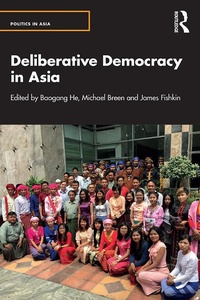
Deliberative Democracy in Asia
1st Edition
Published on 24. August 2021
240 pages
978-1-000-42730-1 (ISBN)
Description

Featuring cases from India, China, Nepal, Japan, South Korea, Singapore, Mongolia and Malaysia, the authors demonstrate and compare the differing uses of public deliberation in Asia.
Many countries in Asia have long traditions of public deliberation, in both democratic and undemocratic settings, some of which continue today. Yet in the face of pressures from complex governance, popular protests and democratization, certain deliberative practices - notably deliberative polling - have been 'parachuted' into the region without regard to historical or traditional practices of deliberation. And, the motivations differ. Some states have made use of public deliberation in order to contain dissent, while others have more emancipatory goals in mind. The contributors to this book take a comparative perspective on the emergence and evolution of deliberative practices in Asia, and their relationships with democracy. They analyse the main motivations for introducing public deliberation in different political regimes and the effectiveness of public deliberation in Asian countries for solving problems and improving governance. In doing so they evaluate whether deliberative democratic tools, can apply to all societies regardless of their political and cultural differences.
Essential reading for students and scholars of Asian Politics, this book will also be of great use to all political scientists with an interest in deliberative democracy.
Many countries in Asia have long traditions of public deliberation, in both democratic and undemocratic settings, some of which continue today. Yet in the face of pressures from complex governance, popular protests and democratization, certain deliberative practices - notably deliberative polling - have been 'parachuted' into the region without regard to historical or traditional practices of deliberation. And, the motivations differ. Some states have made use of public deliberation in order to contain dissent, while others have more emancipatory goals in mind. The contributors to this book take a comparative perspective on the emergence and evolution of deliberative practices in Asia, and their relationships with democracy. They analyse the main motivations for introducing public deliberation in different political regimes and the effectiveness of public deliberation in Asian countries for solving problems and improving governance. In doing so they evaluate whether deliberative democratic tools, can apply to all societies regardless of their political and cultural differences.
Essential reading for students and scholars of Asian Politics, this book will also be of great use to all political scientists with an interest in deliberative democracy.
Reviews / Votes
The book opens new directions for future research as it pushes the reader to think further. The acknowledgement by the authors of the diversity of deliberative practices will also have larger implications at a theoretical level of democracy. The purpose of deliberative democracy is to allow citizens to have an active role within the political process, and that can be achieved by developing a renewed approach to understanding the social, political, economic and cultural aspects of their countries. Therefore, deliberative democracy in Asia is an invaluable contribution to the discipline of political science and political theory overall. - Ekta Shaikh, University of Delhi, India in Asian Studies Reviewhttps://doi.org/10.1080/10357823.2022.2040081
More details
Series
Edition
1. Auflage
Language
English
Place of publication
London
United Kingdom
Publishing group
Taylor & Francis Ltd
Target group
College/higher education
Product notice
Reflowable
Illustrations
18 Tables, black and white; 9 Line drawings, black and white; 9 Illustrations, black and white
ISBN-13
978-1-000-42730-1 (9781000427301)
Copyright in bibliographic data and cover images is held by Nielsen Book Services Limited or by the publishers or by their respective licensors: all rights reserved.
Schweitzer Classification
Other editions
Additional editions
Baogang He | Michael Breen | James Fishkin
Deliberative Democracy in Asia
Book
08/2021
1st Edition
Routledge
€54.50
Shipment within 15-20 days
Baogang He | Michael Breen | James Fishkin
Deliberative Democracy in Asia
Book
08/2021
1st Edition
Routledge
€193.50
Shipment within 15-20 days
Persons
Baogang He is Alfred Deakin Professor, Fellow of the Academy of the Social Sciences in Australia, Chair in International Relations since 2005, at Deakin University, Australia, and was inaugural Head of Public Policy and Global Affairs at Nanyang Technological University, Singapore.
Michael G Breen is a McKenzie Research Fellow in the School of Social and Political Sciences at The University of Melbourne and is the author of The Road to Federalism in Nepal, Myanmar and Sri Lanka: Finding the Middle Ground (2018, Routledge).
James S. Fishkin holds the Janet M. Peck Chair in International Communication at Stanford University where he is Professor of Communication and Professor of Political Science, is Director of Stanford's Center for Deliberative Democracy and Chair of the Dept of Communication and in 2014, was elected to the American Academy of Arts and Sciences.
Michael G Breen is a McKenzie Research Fellow in the School of Social and Political Sciences at The University of Melbourne and is the author of The Road to Federalism in Nepal, Myanmar and Sri Lanka: Finding the Middle Ground (2018, Routledge).
James S. Fishkin holds the Janet M. Peck Chair in International Communication at Stanford University where he is Professor of Communication and Professor of Political Science, is Director of Stanford's Center for Deliberative Democracy and Chair of the Dept of Communication and in 2014, was elected to the American Academy of Arts and Sciences.
Content
1 Deliberative Democracy in Asia: Past, Present and Future PART 1: Village Deliberation 2 Village Deliberative Democracy and Village Governance in China 3 Indonesia: Deliberate and Deliver - Deepening Democracy through Social Accountability 4 Deliberative Democracy in Indian Villages PART 2: Deliberation in Divided Societies 5 Nepal: Participatory and Deliberative Constitution-making in a Divided Society 6 Deliberative Democracy versus Elite Deliberation in Malaysia 7 Consultation as Non-Democratic Participation: Singapore and its Implications 8 The Philippines: An Uneven Trajectory of Deliberative Democracy PART 3: Deliberative Polling 9 Democracy and Deliberative Poll on Policy Making in Japan 10 Deliberative Democracy in South Korea: Four Deliberative Polling Experiments 11 Deliberative Polling on the Amendment of the Press Law and the Audio-Visual Broadcasting Act in Macao 12 Mongolia: Piloting Elements of a Deliberative System 13 Conclusion: Comparative Questions About Deliberative Democracy in Asia
