

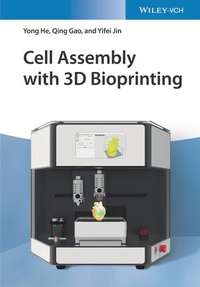
Cell Assembly with 3D Bioprinting
1st Edition
Published on 15. November 2021
368 pages
978-3-527-82858-6 (ISBN)
Description

This book covers comprehensive information of 3D bioprinting from methods to design of bioink, to biofabrication approaches and their applications.
More details
Other editions
Additional editions
Yong He | Qing Gao | Yifei Jin
Cell Assembly with 3D Bioprinting
Book
12/2021
1st Edition
Wiley-VCH
€155.00
Shipment within 5-7 days
Yong He | Qing Gao | Yifei Jin
Cell Assembly with 3D Bioprinting
Software
12/2021
Wiley-VCH
€206.52
No shipping information available
Persons
Yong He obtained his PhD degree in mechanical engineering at the ZheJiang University in 2008. He is currently a professor at College of Mechanical Engineering, ZheJiang University, China. He is also the deputy director of Key Lab of 3D Printing Process and Equipment of ZheJiang Province. His research is focused on the biofabrication with 3D printing especially on the building organs on chips. He has published more than 100 international journal papers and authorized over 30 patents. He has developed many special 3D printers for the fabrication of microfluidic devices, such as 3D sugar printer and 3D softmatter printer.
Qing Gao obtained his BSc in mechanical design, manufacturing and automation at Hefei University of Technology in 2012. In 2017 he obtained his PhD degree in mechanical manufacturing and automation at the ZheJiang University and continue working in the university as a postdoc. He engages in research on biomanufacturing, biological 3D printing, organ chips, etc. As a core member, he has developed a portable biological 3D printer and high-performance GelMA bio-ink and is committed to building a "material + equipment + service" integrated intelligent manufacturing product system.
Yifei Jin received his Ph.D. in mechanical engineering from the University of Florida in 2018, He joined the Department of Mechanical Engineering at the University of Nevada, Reno as assistant professor in July 2019. His primary research interests mainly involve 3D bioprinting of living tissue constructs, 3D printing of hydrophobic functional materials, yield-stress fluids for 3D printing applications, stimuli-responsive materials for 4D printing applications, and fabrication of multi-layered capsules. His research emphasizes the coupling of materials and fabrication approaches to develop novel 3D printing techniques and understand the underlying physics during printing.
Qing Gao obtained his BSc in mechanical design, manufacturing and automation at Hefei University of Technology in 2012. In 2017 he obtained his PhD degree in mechanical manufacturing and automation at the ZheJiang University and continue working in the university as a postdoc. He engages in research on biomanufacturing, biological 3D printing, organ chips, etc. As a core member, he has developed a portable biological 3D printer and high-performance GelMA bio-ink and is committed to building a "material + equipment + service" integrated intelligent manufacturing product system.
Yifei Jin received his Ph.D. in mechanical engineering from the University of Florida in 2018, He joined the Department of Mechanical Engineering at the University of Nevada, Reno as assistant professor in July 2019. His primary research interests mainly involve 3D bioprinting of living tissue constructs, 3D printing of hydrophobic functional materials, yield-stress fluids for 3D printing applications, stimuli-responsive materials for 4D printing applications, and fabrication of multi-layered capsules. His research emphasizes the coupling of materials and fabrication approaches to develop novel 3D printing techniques and understand the underlying physics during printing.
Content
1.3D bioprinting, a powerful tool for 3D cell assembly
2. Representative 3D Bioprinting Approaches
3. Bioink design
4. Coaxial 3D bioprinting
5. Digital Light Projection-based 3D bioprinting
6. Direct Ink Writing for 3D Bioprinting Applications
7. Liquid Support Bath-Assisted 3D Bioprinting
8. Bioprinting Approaches of Hydrogel Microgel
9. Biomedical Applications of Microgels
10. Microfiber-based organoids bioprinting for in vitro model
11. Large scale tissues bioprinting
12. 3D printing of vascular chips
13. 3D printing of in vitro models
14. Protocol of typical 3D bioprinting
2. Representative 3D Bioprinting Approaches
3. Bioink design
4. Coaxial 3D bioprinting
5. Digital Light Projection-based 3D bioprinting
6. Direct Ink Writing for 3D Bioprinting Applications
7. Liquid Support Bath-Assisted 3D Bioprinting
8. Bioprinting Approaches of Hydrogel Microgel
9. Biomedical Applications of Microgels
10. Microfiber-based organoids bioprinting for in vitro model
11. Large scale tissues bioprinting
12. 3D printing of vascular chips
13. 3D printing of in vitro models
14. Protocol of typical 3D bioprinting
