

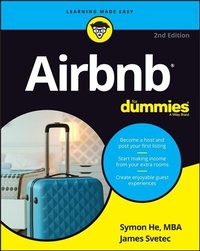
Airbnb For Dummies
Description

Airbnb For Dummies is here to help you prep your property and post your first listing on the wildly popular short-term rental site. Even if you don't have a house, you can become an Airbnb host. A spare room at your place, a camper, a boat, a treehouse, a castle--you can turn just about anything into an Airbnb and earn additional income hosting guests. You can even offer tours around your hometown. This comprehensive resource helps you make your goals a reality, with details on how to get set up and navigate the platform and where to turn for info on local short-term rental rules, plus all the post-pandemic changes to travel and to Airbnb's policies. Learn to attract adventurers from far and wide, with help from For Dummies experts.
* Decide whether becoming an Airbnb host is right for you
* Create an appealing listing on the Airbnb site and attract guests
* Host experiences and ensure the health and safety of guests
* Get positive reviews and improve your property's visibility
This book is especially for you, the first-time Airbnb host in need of a guide for creating a listing, keeping up a property, and attracting guests.
More details
Other editions
Additional editions
Persons
James Svetec is the creator and founder of BNB Mastery Program and BNB Inner Circle. He is co-owner of LearnBNB.com.
Content
Part 1: Getting Started with Airbnb 5
Chapter 1: The Lowdown on Airbnb, Just the Basics 7
Chapter 2: Hosting on Airbnb: What It Really Means 17
Chapter 3: Buying or Building a Property for Airbnb 29
Chapter 4: Determining Your Profit Potential 41
Part 2: Putting the Spotlight on Your Listing 59
Chapter 5: Preparing Your Property for Airbnb 61
Chapter 6: Building the Perfect Listing 85
Chapter 7: Making Your Listing Shine with Photography 109
Part 3: Uncovering Important Pricing Essentials 121
Chapter 8: Setting Your Listing Pricing 123
Chapter 9: Increasing Your Profit Potential 143
Chapter 10: Going on Cruise Control and Still Making Money 165
Chapter 11: It's a Bird, It's a Plane No It's a Superhost! 179
Part 4: Mastering Your Guests' Experience 191
Chapter 12: Comprehending What Being a Good Host Means 193
Chapter 13: Creating a Seamless Check-In Process 207
Chapter 14: Continuing a Stress-Free Guest Stay Through Check-Out 223
Chapter 15: Upkeeping Your Space to Keep the Reservations Coming 243
Part 5: Tackling Important Money Matters 255
Chapter 16: Hosting without a Property through Airbnb Experiences 257
Chapter 17: Understanding Airbnb Taxes 281
Chapter 18: Making Big Bucks as an Airbnb Co-Host 299
Part 6: The Parts of Tens 307
Chapter 19: Ten Tips to Become a Better Host 309
Chapter 20: Ten Best Purchases for Hosts 313
Chapter 21: Ten Ways to Increase Your Earnings 317
Index 321
Chapter 1
The Lowdown on Airbnb, Just the Basics
IN THIS CHAPTER
Understanding what Airbnb is at its core
Finding out why people love Airbnb
Considering common hosting questions and misconceptions
Airbnb is a home-sharing platform founded in 2008 that now offers more listings than all the top five hotel brands in the world combined. It started out as two guys hosting friends and guests on an air mattress in a San Francisco living room. They didn't know at the time that they were starting a wave that would spread across the world, where people could open their homes and properties to travelers seeking a more personal stay. If you're reading this book (and clearly you are), more than likely you're interested in listing your property on Airbnb to meet interesting new people and make money at the same time.
If so, you've come to the right place. Consider this chapter your jumping-off point into the world of Airbnb hosting. Here we dive into the lowdown on Airbnb and share just what you need in order to understand how Airbnb works so you can start hosting.
Looking at the Big Picture
Airbnb is a marketplace to connect people who are looking to stay at someone's property with someone who has said property and is looking to have people stay there. It's a community for both guests and host to connect with one another. Airbnb provides the front-end and back-end tools to easily and effectively connect the dots.
These sections clarify a few ideas behind Airbnb a bit more, including what a sharing economy is, what short-term rentals are, and what you need to start hosting.
The sharing economy - putting underutilized resources to use
A sharing economy is defined as an economic system in which assets or services are shared between private individuals. This system can be free or require a fee and typically occurs over the Internet. These transactions are effectively consumer-to-consumer rather than the more traditional business-to-consumer. It's a whole economy run by consumers rather than big corporations.
In other words, individuals connect with one another to share (either for free or for a fee) different assets or services. Individuals typically already have these assets and services at their disposal.
Examples of this sharing economy have become widespread today. Uber and its main competitor Lyft are prime examples. People take advantage of an asset they possess (their car) and a service they can offer (the driving of that car). One individual is providing that asset and service and another individual is benefitting. It exists entirely between two private individuals. Uber or Lyft provide the marketplace for those interactions and transactions.
Airbnb acts the same in bringing together homeowning individuals (or anyone with a spare space) with other individuals who are looking for that asset (an accommodation) and service (a night to stay and someone to host them).
Consider two strangers trying to find one another in the world and all the circumstances that would need to line up for them to successfully do that. Instead, Airbnb acts as the marketplace that enables these individuals to find and connect with one another. It makes facilitating that transaction quite easy.
Understanding what short-term rentals are
Airbnb is an online platform that enables hosts to make their space available to guests who are seeking short-term rental accommodations. Short-term rentals are accommodations that meet the following:
PAVING THE WAY: THE ORIGINAL SHARING ECONOMY
Although Uber and Airbnb were arguably the first companies to popularize the sharing economy, several other companies came before them in the sharing economy space.
In 2008, there was Taxi Magic. Taxi Magic was Uber before Uber was Uber. However where Uber gained widespread success and was adopted nearly worldwide, Taxi Magic was a failure.
Many other companies tried to make the sharing economy happen and operated in that space. Back before Uber and Airbnb became successful, the idea of getting into a stranger's car so he could drive you somewhere or staying in a stranger's house was crazy. It was a scary and ridiculous idea.
Today, you likely don't think twice about requesting an Uber and getting into a stranger's car. Most people are completely open to booking an Airbnb and staying with a stranger. Uber and Airbnb paved the way and normalized the idea of the sharing economy among the masses.
- Furnished: The space must be furnished with the basics that guests would need and expect when staying overnight somewhere. Guests will need a place to sleep, not just a barren room. Refer to Chapter 5 where we discuss what necessities to include.
- Transient occupancy: Under most regulations a short-term rental is defined as a stay that lasts for less than 28 or 30 days. This definition may change slightly depending on the location, but essentially it's any stay that lasts for less than one month.
In other words, a short-term rental is when guests are staying for a short, fixed time period and for a specific purpose. They're visiting your city and want to stay at a property for a couple days or weeks to see the city, attend a conference or event, conduct business, or visit family and friends.
Knowing what you need to host
In order to host on Airbnb, you need the following:
- A space: The first and most important aspect to hosting is having a space. This space can range from an air mattress in your living room to a tree house or an entire property. Essentially, it's anywhere someone can sleep that you can post on Airbnb. You need to be able to define your space so people don't come to your mattress expecting a castle. However, you can truly list any spare space on Airbnb. Chapter 5 covers everything you need to know about getting your space setup for Airbnb. Chapter 6 discusses how to word your Airbnb listing so that guests arrive with the right expectations.
- A listing: Before you can host, you need to create a listing for that space on Airbnb. This listing tells guest what to expect and highlights the space. Chapter 6 gives you tips for making your listing stand out. In addition, your listing sets the rates so people can book the space for the time period they want and for a specific price. Just as important, your listing includes photos of your space. Including photos that capture the essence of your space is important. Check out Chapter 7 for in-depth advice about what you need to do to ensure your photos stand out and get prospective guests' attention.
- The right tools: Having the right tools make hosting on Airbnb much easier. In Chapter 10 we discuss several different tools, both hardware and software, that make tasks such as messaging guests, pricing your listing, and checking guests into your space much less time consuming.
- The right methods and strategies: You need an actual system that contains different methods and strategies to best perform as a host. With this base knowledge you continue discovering what hosting entails. Consider learning how to drive. In order to drive, you first need to have a car, but you also need to know how to drive that car. Similarly with Airbnb, if you have a space and a listing, you also need to know how to combine the two and make them work together. In other words, you need to know how to continually operate your listing to the best of your abilities with no issues. Throughout the rest of this book, our goal is to show you those strategies so that you can host successfully without needing to learn through trial and error.
Understanding How the Pandemic Changed Airbnb Hosting
The global pandemic of 2020 changed Airbnb hosting in a few notable ways:
- It changed the way people travel. During the pandemic, the most notable shift was a near total elimination of interational travel. With national borders closed in many parts of the world and reluctancy to board crowded airplanes, we saw more people traveling locally than ever before. This lead to many markets just outside of major urban centers to experience substantial demand growth, and many markets that relied on international tourism to see the exact opposite. Post-pandemic, we're seeing a new era of remote work, where many travelers are looking to stay for months instead of weeks given their new-found freedom to work from anywhere.
- It changed the way people host. Hosts have become much more focused on cleanliness and sanitation, and many hosts who offered up a shared space within their home turned off their listings. This change meant that Airbnb was dominated by whole-home listings even more than before.
- It changed the way Airbnb structured it's platform. In light of the changes that Airbnb recognized were taking place in the travel industry, Airbnb restructured their entire platform in some big ways. The platform is more focused than ever on catering to longer-term stays and cool getaways. If you've got a cool or unique space to list, your odds of success are higher now than ever before.
AIRBNB - THEN VERSUS NOW
In the early days of Airbnb the company hosted guests with air mattresses in apartment living rooms. Today, Airbnb has more than six million listings...
