

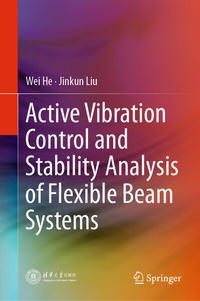
Active Vibration Control and Stability Analysis of Flexible Beam Systems
Description

This book presents theoretical explorations of several fundamental problems in the dynamics and control of flexible beam systems. By integrating fresh concepts and results to form a systematic approach to control, it establishes a basic theoretical framework. It includes typical control design examples verified using MATLAB simulation, which in turn illustrate the successful practical applications of active vibration control theory for flexible beam systems. The book is primarily intended for researchers and engineers in the control system and mechanical engineering community, offering them a unique resource.
Reviews / Votes
"The book is well written. The references to important works are given. Solutions using MATLAB are presented in detail. The book should be of interest to practicing and research engineers as well as Ph.D. students in the area of modeling and control of flexible beam systems." (Abbes Benaissa r, Mathematical Reviews, April, 2025)
More details
Other editions
Additional editions
Persons
Professor Wei received his PhD from Department of Electrical & Computer Engineering, the National University of Singapore (NUS), Singapore, in 2011, his M.Eng. and B.Eng. degrees both from School of Automation Science and Engineering, South China University of Technology (SCUT), Guangzhou, China, in 2008 and 2006 respectively. He was a Research Fellow at the Department of Electrical & Computer Engineering, the National University of Singapore (NUS), Singapore, from 2011 to 2012. He is currently working as the Full Professor at School of Automation and Electric Engineering, University of Science and Technology Beijing (USTB), China. He has (co)-authored 1 book published in Springer, 80 international journal papers, and 51 conference papers. 4 of them is the Essential Science Indicator (ESI) Hot Paper, and 10 of them is the Essential Science Indicator (ESI) Highly Cited Paper. He is a senior member of IEEE, the member of IEEE Control System Society (CSS), and the member of IEEEIndustrial Electronics Society (IES). He is a receipt of The National Natural Science Fund for Excellent Young Scholars of China in 2015. He is serving as the Associate Editor of IEEE Transactions on Systems, Man, and Cybernetics: Systems, a Leading Guest Editor for of IEEE Transactions on Neural Networks and Learning Systems special issue on "Intelligent Control through Neural Learning and Optimization for Human Machine Hybrid Systems", Editor of Journal of Intelligent & Robotic Systems, Springer, and the Editor of IEEE/CAA Journal of Automatica Sinica. He is the member of the IFAC TC on Distributed Parameter Systems, IFAC TC on Computational Intelligence in Control and IEEE TC on Distributed Parameter Systems. His current research interests include vibration control, adaptive control and robotics.
Professor Jinkun Liu received BS, MS and PhD degrees from Northeastern University, Shenyang, China, in 1989, 1994 and 1997, respectively. He was a postdoctoral fellow in Zhejiang University from 1997 to 1999. He is currently a full professor in Beihang University. He has published more than 100 research papers and eight books. His research interests include Intelligent Control and Sliding Mode Control; PDE modeling and boundary control.
