

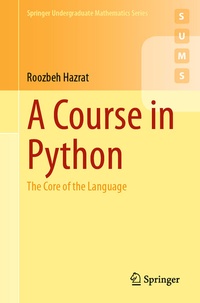
A Course in Python
The Core of the Language
Published on 4. January 2024
VIII, 250 pages
978-3-031-49780-3 (ISBN)
Description

This textbook introduces Python and its programming through a multitude of clearly presented examples and worked-out exercises.
Based on a course taught to undergraduate students of mathematics, science, engineering and finance, the book includes chapters on handling data, calculus, solving equations, and graphics, thus covering all of the basic topics in Python. Each section starts with a description of a new topic and some basic examples. The author then demonstrates the new concepts through worked out exercises. The intention is to enable the reader to learn from the codes, thus avoiding lengthy, exhausting explanations. With its strong focus on programming and problem solving, and an emphasis on numerical problems that do not require advanced mathematics, this textbook is also ideal for self-study, for instance for researchers who wish to use Python as a computational tool.
Based on a course taught to undergraduate students of mathematics, science, engineering and finance, the book includes chapters on handling data, calculus, solving equations, and graphics, thus covering all of the basic topics in Python. Each section starts with a description of a new topic and some basic examples. The author then demonstrates the new concepts through worked out exercises. The intention is to enable the reader to learn from the codes, thus avoiding lengthy, exhausting explanations. With its strong focus on programming and problem solving, and an emphasis on numerical problems that do not require advanced mathematics, this textbook is also ideal for self-study, for instance for researchers who wish to use Python as a computational tool.
More details
Series
Edition
1st ed. 2023
Language
English
Place of publication
Cham
Switzerland
Publishing group
Springer International Publishing
Illustrations
VIII, 250 p. 96 illus., 91 illus. in color.
File size
8,28 MB
ISBN-13
978-3-031-49780-3 (9783031497803)
DOI
10.1007/978-3-031-49780-3
Schweitzer Classification
Other editions
Additional editions
Book
01/2024
Springer
€58.84
Available immediately
Person
Roozbeh Hazrat is a Professor of Pure Mathematics at Western Sydney University. He has taught computer programming since early 1990s when he was an undergraduate and codes were written on blackboards. He has continued teaching programming at Queen's University United Kingdom, Western Sydney University, and has run crash courses for the Reserve Bank of Australia and other financial institutions. Besides his many journal publications in pure mathematics, he is the author of the textbook
Mathematica: A Problem-Centred Approach
.
Content
1 Basics of Python.- 2 Lists and Tuples.- 3 Decisions and Repetitions.- 4 Functions.- 5 List Comprehension and Generators.- 6 The sympy Library.- 7 The numpy Library .- 8 The matplotlib Library and Projects.
