

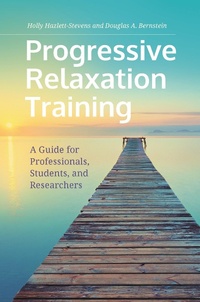
Progressive Relaxation Training
A Guide for Professionals, Students, and Researchers
1st Edition
Published on 1. June 2022
264 pages
979-8-216-13303-2 (ISBN)
Description

Offers comprehensive guidance for practitioners, students, and researchers in psychology, psychiatry, and counseling to teach relaxation to clients.
Two clinical psychologists widely known for their writings on relaxation present state-of-the-art methods for teaching clients to ease muscle and mind tension to deal with stress and anxiety disorders, as well as other conditions where stress and anxiety play a role.
Bernstein and Hazlett-Stevens explain who the targets for Progressive Relaxation Training (PRT) are; the rationale, basic procedures, and variations of PRT; the setting and possible problems and solutions of PRT; and how to assess a client's progress. They also address hypnosis, drugs, and PRT, as well as PRT used in a mindfulness-based clinical practice. Case studies and evaluative research in PRT are also included.
Students and practitioners in psychology, psychiatry, and counseling will find this work of interest. This book may also be useful supplemental reading for behavior modification courses and practicum courses in behavior therapy.
Two clinical psychologists widely known for their writings on relaxation present state-of-the-art methods for teaching clients to ease muscle and mind tension to deal with stress and anxiety disorders, as well as other conditions where stress and anxiety play a role.
Bernstein and Hazlett-Stevens explain who the targets for Progressive Relaxation Training (PRT) are; the rationale, basic procedures, and variations of PRT; the setting and possible problems and solutions of PRT; and how to assess a client's progress. They also address hypnosis, drugs, and PRT, as well as PRT used in a mindfulness-based clinical practice. Case studies and evaluative research in PRT are also included.
Students and practitioners in psychology, psychiatry, and counseling will find this work of interest. This book may also be useful supplemental reading for behavior modification courses and practicum courses in behavior therapy.
More details
Edition
1. Auflage
Language
English
Place of publication
New York
United States
Publishing group
Bloomsbury Publishing Plc
Target group
Interest Age: From 7 to 17 years
ISBN-13
979-8-216-13303-2 (9798216133032)
Copyright in bibliographic data and cover images is held by Nielsen Book Services Limited or by the publishers or by their respective licensors: all rights reserved.
Schweitzer Classification
Other editions
Additional editions
Holly Hazlett-Stevens | Douglas A. Bernstein
Progressive Relaxation Training
A Guide for Professionals, Students, and Researchers
Book
06/2022
Praeger Publishers Inc
€70.90
Shipment within 10-20 days
Persons
Holly Hazlett-Stevens, PhD, is associate professor in the department of psychology at the University of Nevada, Reno.
Douglas A. Bernstein, PhD, is professor emeritus at the University of Illinois and courtesy professor of psychology at the University of South Florida.
Douglas A. Bernstein, PhD, is professor emeritus at the University of Illinois and courtesy professor of psychology at the University of South Florida.
Content
Foreword by Tom Borkovec
Introduction
PART ONE: Overview of Progressive Relaxation Training
Chapter 1
The History of Progressive Relaxation Training
Chapter 2
Targets for Progressive Relaxation Training
Chapter 3
Physical Setting for Progressive Relaxation Training
Chapter 4
The Physiology of Relaxation
PART TWO: The Practice of Progressive Relaxation Training
Chapter 5
Presenting the Rationale for Progressive Relaxation Training
Chapter 6
Basic Procedures
Chapter 7
Variations on the Basic Procedures
Chapter 8
Differential Relaxation and Conditioned Relaxation
Chapter 9
Possible Problems and Suggested Solutions
Chapter 10
Assessing a Client's Progress
Chapter 11
Case Studies in Progressive Relaxation Training
Chapter 12
Evaluative Research on Progressive Relaxation Training
PART THREE: New Directions for Integration and Application of PRT
Chapter 13
Applied Relaxation and Related Techniques
Chapter 14
Meditation, Mindfulness, and Relaxation Training
Chapter 15
Hypnosis, Drugs, and Progressive Relaxation
Appendix A
Content Outline for Rationale Presentation
Appendix B
Relaxation Patter
Appendix C
Client Handouts for Progressive Relaxation Training Practice and Applied Relaxation
Appendix D
Relaxation by Slowed, Diaphragmatic Breathing
Bibliography
Index
Introduction
PART ONE: Overview of Progressive Relaxation Training
Chapter 1
The History of Progressive Relaxation Training
Chapter 2
Targets for Progressive Relaxation Training
Chapter 3
Physical Setting for Progressive Relaxation Training
Chapter 4
The Physiology of Relaxation
PART TWO: The Practice of Progressive Relaxation Training
Chapter 5
Presenting the Rationale for Progressive Relaxation Training
Chapter 6
Basic Procedures
Chapter 7
Variations on the Basic Procedures
Chapter 8
Differential Relaxation and Conditioned Relaxation
Chapter 9
Possible Problems and Suggested Solutions
Chapter 10
Assessing a Client's Progress
Chapter 11
Case Studies in Progressive Relaxation Training
Chapter 12
Evaluative Research on Progressive Relaxation Training
PART THREE: New Directions for Integration and Application of PRT
Chapter 13
Applied Relaxation and Related Techniques
Chapter 14
Meditation, Mindfulness, and Relaxation Training
Chapter 15
Hypnosis, Drugs, and Progressive Relaxation
Appendix A
Content Outline for Rationale Presentation
Appendix B
Relaxation Patter
Appendix C
Client Handouts for Progressive Relaxation Training Practice and Applied Relaxation
Appendix D
Relaxation by Slowed, Diaphragmatic Breathing
Bibliography
Index
