

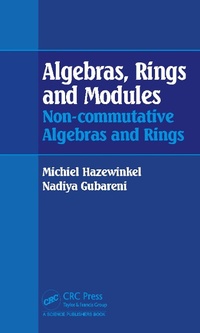
Algebras, Rings and Modules
Non-commutative Algebras and Rings
1st Edition
Published on 5. April 2016
388 pages
978-1-4822-4505-9 (ISBN)
Description

The theory of algebras, rings, and modules is one of the fundamental domains of modern mathematics. General algebra, more specifically non-commutative algebra, is poised for major advances in the twenty-first century (together with and in interaction with combinatorics), just as topology, analysis, and probability experienced in the twentieth centu
Reviews / Votes
Rings, which play a fundamental role in analysis, geometry, and topology, constitute perhaps the most ubiquitous algebraic structures across mathematics. Starting with fields (the most familiar rings), considering polynomials leads to commutative rings and considering matrices leads to non-commutative algebra. The present volume, though lacking a number, joins a series now spread over three publishers. Like volumes 1 and 2, it surveys aspects of non-commutative rings (volume 3 went in another direction) but stands self-contained, despite the occasional reference to previous volumes. Progress in ring theory depends on conditions designed to isolate special classes of rings admitting satisfying structure theorems. Each chapter surveys such conditions and their consequences: hereditary rings, valuation domains, nonsingular rings, Goldie rings, FDI-rings, exchange rings, Rickart rings, serial nonsingular rings, and many more. Commutative ring concepts tend to have diverse, but limited, generalizations in the non-commutative context, and the early chapters particularly explore such themes. The authors supply complete details, even for simple arguments that other authors might package into exercises (of which this book has none), making the book an excellent reference. Readers will find all developments digested into small satisfying steps, with major results seeming to drop out effortlessly.--D. V. Feldman, University of New Hampshire, Appeared in February 2017 issue of CHOICE Rings, which play a fundamental role in analysis, geometry, and topology, constitute perhaps the most ubiquitous algebraic structures across mathematics. Starting with fields (the most familiar rings), considering polynomials leads to commutative rings and considering matrices leads to non-commutative algebra. The present volume, though lacking a number, joins a series now spread over three publishers. Like volumes 1 and 2, it surveys aspects of non-commutative rings (volume 3 went in another direction) but stands self-contained, despite the occasional reference to previous volumes. Progress in ring theory depends on conditions designed to isolate special classes of rings admitting satisfying structure theorems. Each chapter surveys such conditions and their consequences: hereditary rings, valuation domains, nonsingular rings, Goldie rings, FDI-rings, exchange rings, Rickart rings, serial nonsingular rings, and many more. Commutative ring concepts tend to have diverse, but limited, generalizations in the non-commutative context, and the early chapters particularly explore such themes. The authors supply complete details, even for simple arguments that other authors might package into exercises (of which this book has none), making the book an excellent reference. Readers will find all developments digested into small satisfying steps, with major results seeming to drop out effortlessly.
--D. V. Feldman, University of New Hampshire, Appeared in February 2017 issue of CHOICE
More details
Language
English
Place of publication
London
United Kingdom
Publishing group
Taylor & Francis Ltd
Target group
College/higher education
Illustrations
10 s/w Abbildungen
10 b/w images
File size
5,20 MB
ISBN-13
978-1-4822-4505-9 (9781482245059)
Copyright in bibliographic data and cover images is held by Nielsen Book Services Limited or by the publishers or by their respective licensors: all rights reserved.
Schweitzer Classification
Other editions
Additional editions
Michiel Hazewinkel | Nadiya M. Gubareni
Algebras, Rings and Modules
Non-commutative Algebras and Rings
Book
03/2021
1st Edition
CRC Press
€74.40
Shipment within 15-20 days
Michiel Hazewinkel | Nadiya M. Gubareni
Algebras, Rings and Modules
Non-commutative Algebras and Rings
Book
01/2016
1st Edition
CRC Press
€184.50
Article not available for order
Persons
Content
Preface. Preliminaries. Basic general constructions of rings and modules. Homological dimensions of rings and modules. Goldie and Krull dimensions of rings and modules. Rings with Finiteness conditions. Krull-Remak-Schmidt-Azumaya theorem. Hereditary and semihereditary rings. Serial nonsingular rings. Jacobson's conjecture. Rings related to Finite posets. Distributive and semidistributive rings. The group of extensions. Modules over semiperfect rings. Representations of primitive posets. Representations of quivers, species and finite dimensional algebras. Artinian rings of finite representation type. Semiperfect rings of bounded representation type.
