

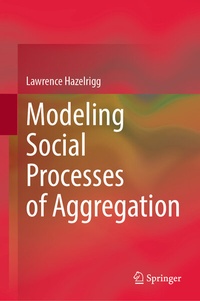
Modeling Social Processes of Aggregation
Description

This book demonstrates, via formal statements and empirical illustrations, that nonlinearities in social processes can be modeled systematically to create solutions with practical applications in the institutional forms of paid employment, schooling, and familial relations including marital and kinship ties and the rearing of children. It shows how social processes can be modeled accurately through analyzing time series data-specifically, a temporal sequence of process outcomes that is dense enough in observation time to support appropriate techniques of modeling the outcome sequence. The book illustrates techniques using minimal mathematical formalism which is explained also in careful narrative descriptions of the model logic.
More details
Other editions
Additional editions
Person
Lawrence Hazelrigg is Professor Emeritus of Sociology at Florida State University, Tallahassee, Florida. His primary areas of specialization and interest are social theory and philosophy of social science. He has had a long history of publishing books, chapters and articles from the 1960s. He published Prison within Society (1968) and, as co-author, Class, Conflict and Mobility (1972, 2005), Ending a Career in the Auto Industry (1996), and Pension Puzzles (2007). He has contributed to reference books such as the Encyclopedia of Sociology (on individualism) and Handbook of Data Analysis (on inference). He is best known for his trilogy, Social Science and the Challenge of Relativism , published by the University Press of Florida. He also is an Associate Editor of Current Perspectives in Social Theory , and has co-edited two volumes that form a set (with Harry F. Dahms), Theorizing the Dynamics of Social Processes (vol. 27) and Theorizing Modern Society as a Dynamic Process (vol. 30).
Content
Introduction: Intentions, Actions, Institutions.- On the Arts of Modeling.- Modeling Aggregation Processes.- Applications to Work as Paid Employment.- Supplements and Bridges in the Meter of Time.
