

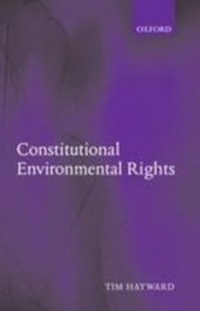
Constitutional Environmental Rights
1st Edition
Published on 16. December 2004
249 pages
978-0-19-153531-4 (ISBN)
Description

Should the fundamental right to an adequate environment be provided in the constitution of any modern democratic state? Drawing on precedents from around the world, this book provides the first politically-focused analysis of this pivotal issue. Hayward compellingly demonstrates how the right is both necessary and effective, conducive to democracy, and serves the cause of international environmental justice.
More details
Other editions
Additional editions
Tim Hayward
Constitutional Environmental Rights
Book
12/2004
Oxford University Press
€103.90
Shipment within 15-20 days
Tim Hayward
Constitutional Environmental Rights
Book
12/2004
Oxford University Press
€103.10
Shipment within 15-20 days
Content
- Intro
- Contents
- Acknowledgements
- Introduction
- 1. Background
- 2. Rationale
- 2.1. The rationale for a constitutional approach to environmental protection
- 2.2. The rationale for taking environmental protection to be a human rights issue
- 2.3. Section conclusion
- 3. Overview of the arguments of the book
- 1. The Case for a Human Right to an Adequate Environment
- 1.1. The case for pursuing environmental ends by means of human rights
- 1.1.1. The scope of an environmental human right
- 1.1.2. Addressing doubts from an environmental perspective
- 1.2. A genuine human right?
- 1.3. A universal moral right to an adequate environment
- 1.3.1. Why the right to an adequate environment meets the criteria of a genuine human right
- 1.3.2. Defending the case means critically assessing the relation of rights to duties
- 1.4. International recognition of a human right to an adequate environment: the precedents
- 1.5. Conclusion
- 2. Constitutionalizing the Right to an Adequate Environment: Challenges of Principle
- 2.1. Why the right to an adequate environment ought to be constitutionalized
- 2.1.1. Assessing the claim that 'all human rights ought to be constitutionalized'
- 2.2. Why environmental protection should not be constitutionalized only in the form of a policy statement
- 2.3. Why a substantive right to an adequate environment should not be provided with lesser constitutional status than a fundamental right
- 2.3.1. Why the distinction between fundamental rights and social rights is conceptually problematic
- 2.3.2. Why environmental rights should be substantive and not merely procedural
- 2.4. Conclusion
- 3. The Challenge of Effective Implementation
- 3.1. The necessary conditions for judicial enforcement of constitutional rights, and claims that these cannot be fulfilled for the right to an adequate environment
- 3.2. The peculiar difficulties of enforcing environmental norms
- 3.3. The institutional and constitutional competence of courts
- 3.3.1. Specialist environmental courts
- 3.3.2. The constitutional competence of courts
- 3.4. The jurisprudence of human rights
- 3.5. The effectiveness of a constitutional right to an adequate environment
- 4. Environmental Rights as Democratic Rights
- 4.1. Are constitutional rights inherently undemocratic?
- 4.1.1. Undemocratic transfer of powers from legislature to judiciary
- 4.1.2. Undemocratically binding the future?
- 4.1.3. Rights proposals have an undemocratic motivational structure?
- 4.1.4. Internal tensions in the majoritarian critique of constitutional rights
- 4.1.5. Section conclusion
- 4.2. Democratic rights
- 4.2.1. Democracy's 'self-binding' rights: procedural rights
- 4.2.2. Environmental procedural rights
- 4.3. Substantive environmental rights as democratic rights
- 4.4. Environmental rights as negative rights
- 4.5. The democratic legitimacy of negative environmental rights
- 4.6. Conclusion
- 5. Is a Constitutional Environmental Right Necessary? A European Perspective
- 5.1. Contextualizing the question
- 5.2. Environmental rights in European Community law
- 5.2.1. EC policy principles
- 5.2.2. Directives
- 5.3. Using human rights for environmental protection
- 5.3.1. The environmental potential of existing substantive rights in Europe
- 5.3.2. Procedural environmental rights and the Aarhus Convention
- 5.4. Conclusion
- 6. Environmental Rights and Environmental Justice: A Global Perspective
- 6.1. State constitutions and the permeability of normative orders
- 6.1.1. The continuing importance of the nation-state
- 6.1.2. The permeability of domestic and international normative orders
- 6.2. Constitutional environmental rights viewed from the normative perspective of global justice
- 6.3. The value of constitutional environmental rights for poorer societies
- 6.3.1. The need for environmental rights is not nullified by imperatives of development
- 6.3.2. Illustrations of permeability in practice
- 6.3.3. Poorer countries in the avant garde of environmental human rights jurisprudence
- 6.4. Conclusion
- Bibliography
- Index
- A
- B
- C
- D
- E
- F
- G
- H
- I
- J
- K
- L
- M
- N
- O
- P
- R
- S
- T
- U
- V
- W
